 EUR /
EUR /  USD — Euro / US Dollar
 JPY — US Dollar / Japanese Yen
 GBP /
GBP /  AUD /
AUD /  CAD — US Dollar / Canadian Dollar
 CHF — US Dollar / Swiss Franc
 NZD /
NZD / 
Commodity Talk – Oil, Natgas, Gold and Cocoa
- April 7, 2026
- Posted by: Today Markets
- Categories: Competitive research, Funding trends, Markets, Soft Commodities, Technical Analysis, WTI.Oil

Oil:
- Brent crude oil exceeds $110 on the June contract amid further escalation of the situation in the Middle East.
- Despite the emergence of prospects for a ceasefire, Iran has rejected all terms from the United States.
- Iran indicated it wants permanent peace and the withdrawal of American troops. A ceasefire could be preparation for a stronger strike.
- The next 48-hour deadline announced by Trump expires at 12:00 GMT from Tuesday to Wednesday, although Iran has repeatedly indicated it does not intend to comply.
- The Wall Street Journal indicates that the United States is preparing to strike energy and transport infrastructure in Iran.
- During the holiday weekend, the highest number of ships since the beginning of the conflict passed through the Strait of Hormuz, which is related to agreements between Iran and several Asian countries.
- Ships from countries such as India, Pakistan, the Philippines, Malaysia, and China have recently passed through the Strait of Hormuz. It is unknown whether the agreements on the passage of ships concerned the flag or specific units.
- Pakistan was said to have reached an agreement for the passage of 20 units; theoretically, all Indian units can cross the strait. Iran indicates that all ships from Iraq can also freely pass through the strait. However, there are no details of such agreements, and additionally, vessel insurance remains a key aspect.
- OPEC+ agreed during a weekend meeting that it will increase production by another 206,000 barrels per day in May at the moment the Strait of Hormuz opens.
- It is worth emphasizing that Russia also has major problems with increasing production and exports, which is related to Ukraine’s attacks on Russian oil infrastructure.
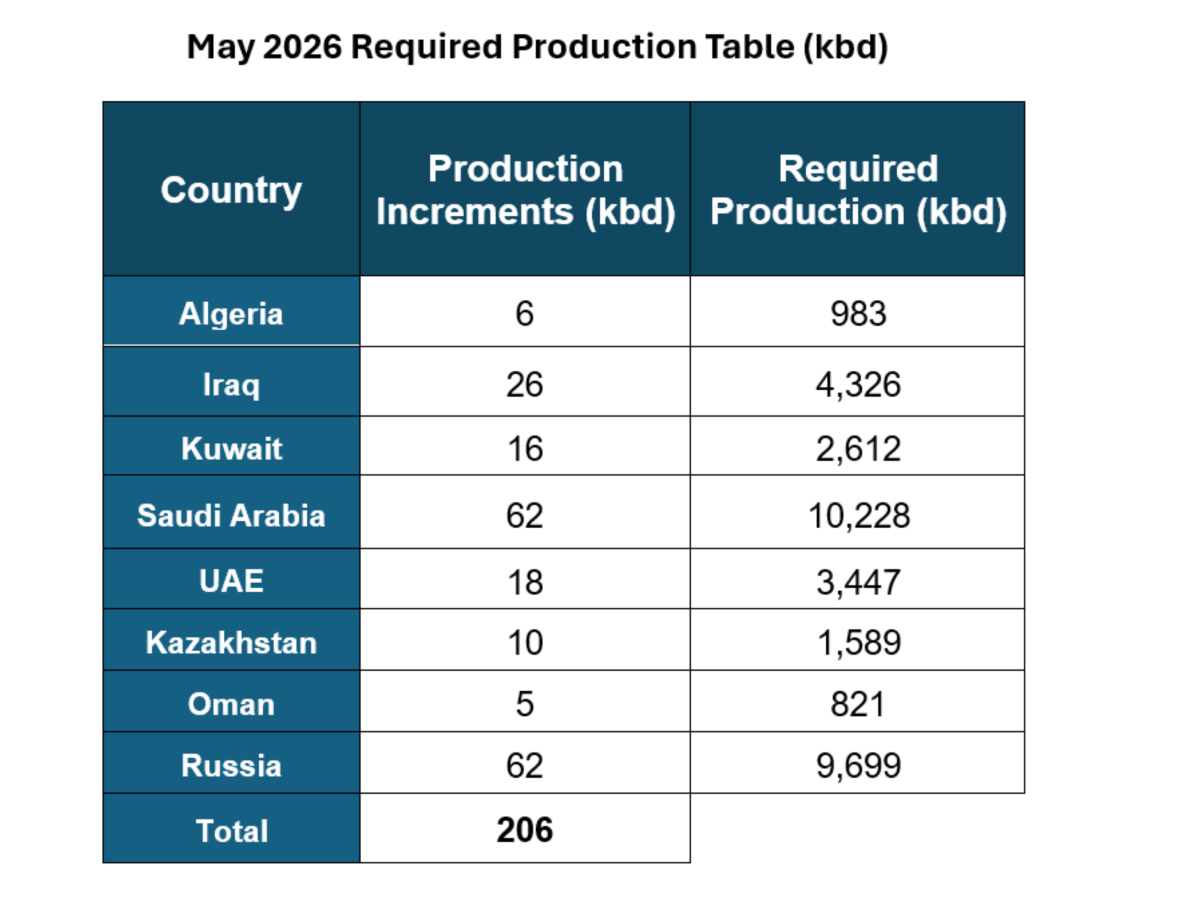 New production quotas for countries in the agreement on voluntary production cuts. It is worth noting that countries like Iraq, Kuwait, Saudi Arabia, the UAE, and also Russia have significantly reduced their production volumes recently. Source: OPEC
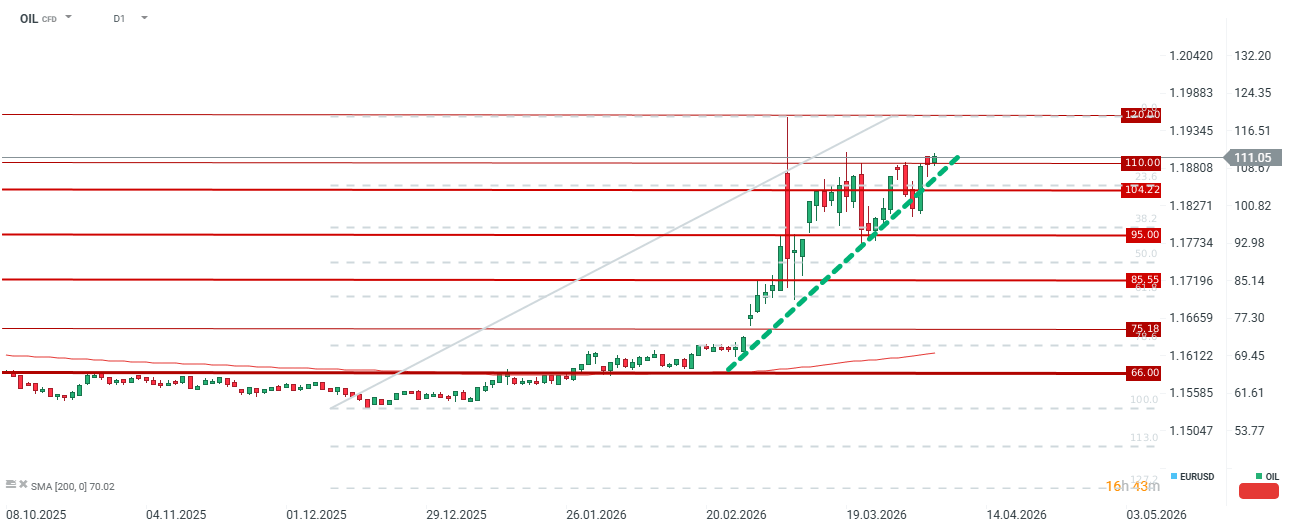 Oil is currently in a zone of strong supply and is no longer reacting as dynamically as it was a few days ago. The Strait of Hormuz remains closed, but some ships are passing through, so prices may be under slight pressure. Nevertheless, a few ships will not lead to a significant improvement in the global supply situation. Source: xStation5
Gas:
- Gas prices fell toward $2.8/MMBTU due to the end of the heating season in the USA, although on Monday we observed an attempted recovery due to forecasts indicating lower temperatures.
- Gas production on Monday was 110.4 bcfd, which was an almost 3% increase compared to last year. In turn, domestic demand was almost 73 bcfd, which was a level nearly 7% lower than a year ago.
- LNG exports amounted to 20.4 bcfd, which was a level almost 2% higher than in the previous week. It is worth emphasizing that despite global tension in the LNG gas market due to the blockade of the Strait of Hormuz, the United States cannot significantly increase export capacities beyond current levels due to the use of full export capacities.
- It is expected that by 2030, export capacities in North America will increase to approx. 30 bcfd.
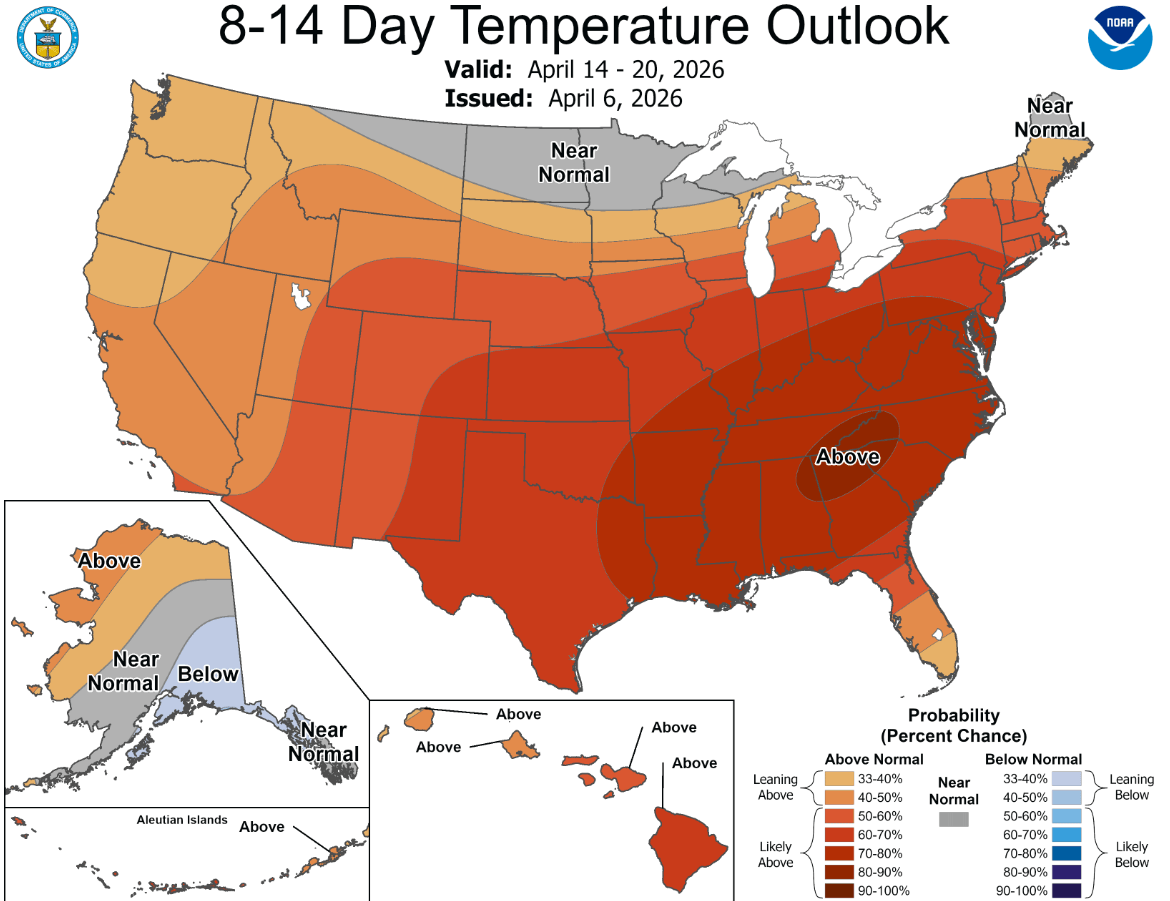 Forecasts for the next 2 weeks indicate that temperatures will be higher than standard. This means that gas consumption for heating purposes should be minimal. Nevertheless, seasonal forecasts suggest that in the summer period, temperatures should also be higher, which means higher consumption in the future. Source: NOAA
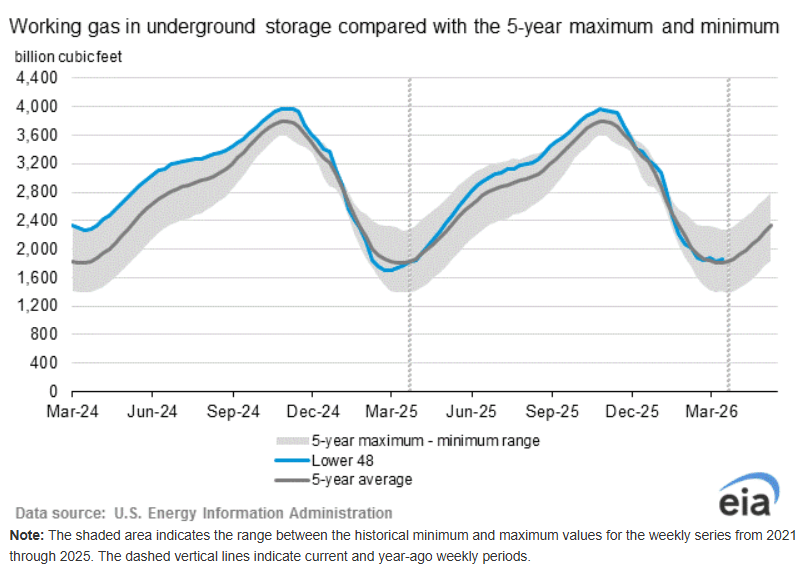 Gas inventories have fallen toward the 5-year average, but are now starting to rebound. In March, we had 2 reports that showed a rebound in inventories, despite the theoretical duration of the heating season. Source: EIA
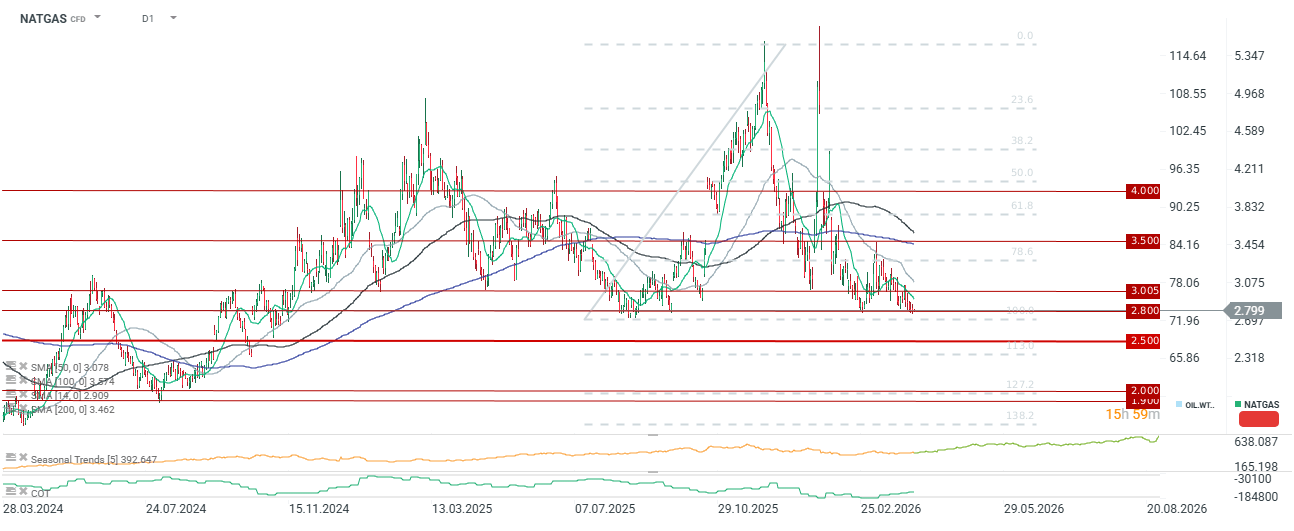 The price is at very important support around $2.8/MMBTU. Source: xStation5
Gold:
- Gold remains at lower levels after Friday’s pullback. Gold still remains trapped amid rising expectations for interest rate hikes and due to massive geopolitical risk and uncertainty regarding further strong global debt growth.
- According to a World Gold Council report, central banks still intend to buy gold in 2026.
- Goldman Sachs maintains price forecasts above $5500 per ounce at the end of this year.
- Signing an agreement to end the fighting or a simple ceasefire could theoretically mean a reduction in geopolitical risk, but also mean a temporary rebound in inflation.
- Currently, we see that gold or silver behaves more as a risk asset, dependent on interest rates, which is why we observe a high correlation with American indices.
- It is worth remembering, however, that in 2020, when all assets lost value very strongly, gold rebounded quite quickly after a larger correction.
- The current correction since the beginning of March is approx. 15%, although at one point the drop was nearly 25%.
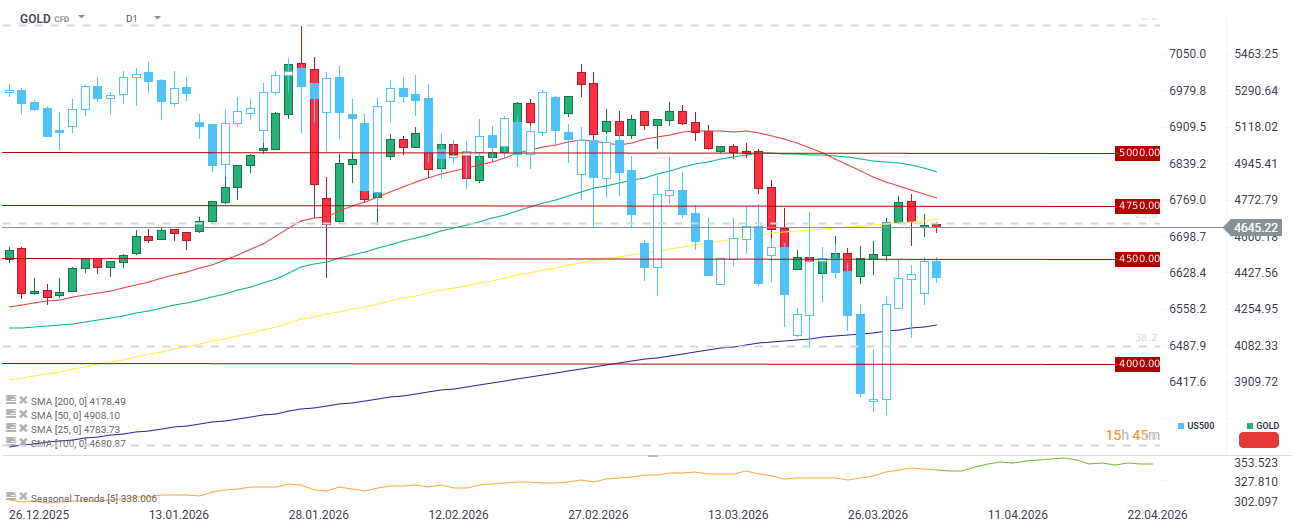 The correlation between the price of gold and the US500 has been quite high since almost the beginning of this year. Nevertheless, the scale of the US500 rebound recently does not coincide so strongly with the rebound in the gold price. Source: xStation5
Cocoa:
- The price of cocoa rebounded at the turn of March and April. However, the peaks from March 11 were not broken, which means a lack of a new sequence of higher highs and higher lows.
- A Bloomberg Intelligence report indicates that chocolate sales in the USA during the Easter period were 5% lower, which continues to mean destruction of consumer demand due to the persistence of high prices.
- Cheaper cocoa beans should enter the market in the second half of the year and have the greatest impact on product prices in 2027. Nevertheless, it cannot be ruled out that producers, in order to recover losses, will continue to maintain higher margins with lower bean prices.
- Cocoa inventories on ICE rose to a 1.5-year peak, reaching almost 2.4 million bags.
- Just before the start of the mid-season, about half of Ivory Coast and 2/3 of Ghana are currently experiencing dry conditions, which could potentially reduce harvests in the coming months.
- Nevertheless, taking into account the increase in inventories and oversupply for the second year in a row, a strong price rebound at this point due to potentially worse production is unlikely. The key aspect of the market at this moment is low demand, which shows that chocolate producers have dealt with the lower availability of the raw material that took place after 2022.
- It is worth remembering that the massive increase in fertilizer prices after 2022 also resulted in less fertilization of cocoa crops, which affected the reduction of production in 2023 and 2024 (aside from weather factors). Therefore, the current increase in fertilizer prices could potentially affect the 2026/2027 main season.
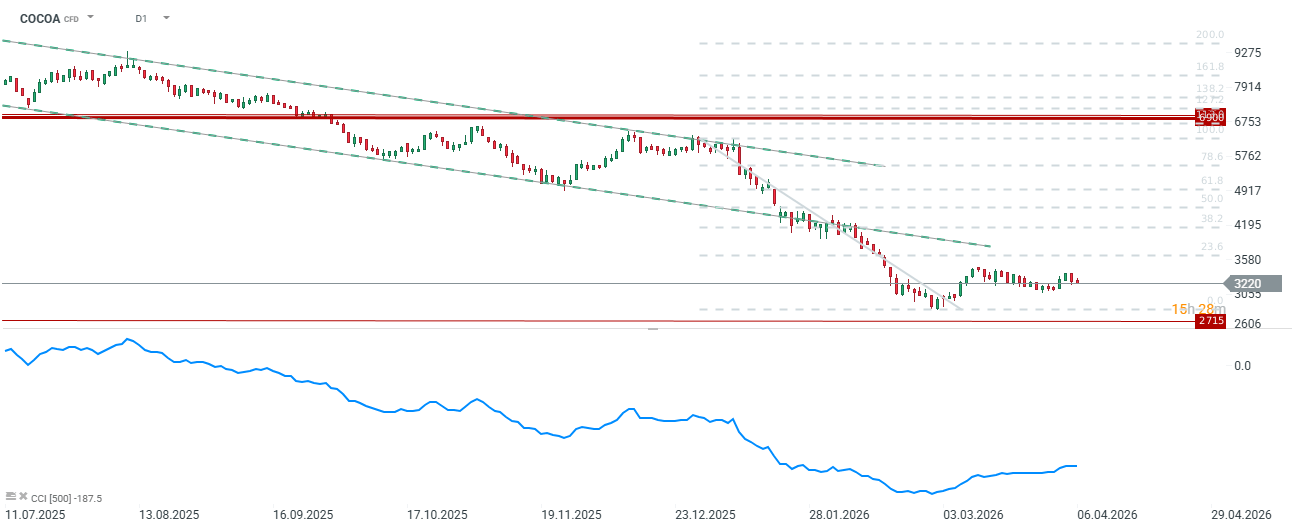 The cocoa price remains at low levels due to the lack of signs of a demand rebound. Theoretically, we should observe an improvement in the second half of this year after the exhaustion of inventories from previous years. Source: xStation5
The material on this page does not constitute financial advice and does not take into account your level of understanding, investment objectives, financial situation or any other specific needs. All information provided, including opinions, market research, mathematical results and technical analyzes published on the Website or transmitted To you by other means, it is provided for information purposes only and should in no way be construed as an offer or solicitation for a transaction in any financial instrument, nor should the information provided be construed as advice of a legal or financial nature on which any investment decisions you make should be based exclusively To your level of understanding, investment objectives, financial situation, or other specific needs, any decision to act on the information published on the Website or sent to you by other means is entirely at your own risk if you In doubt or unsure about your understanding of a particular product, instrument, service or transaction, you should seek professional or legal advice before trading. Investing in CFDs carries a high level of risk, as they are leveraged products and have small movements Often the market can result in much larger movements in the value of your investment, and this can work against you or in your favor. Please ensure you fully understand the risks involved, taking into account investments objectives and level of experience, before trading and, if necessary, seek independent advice.