
Oil Falls 10%
- April 8, 2026
- Posted by: Today Markets
- Categories: Markets, Technical Analysis, WTI.Oil

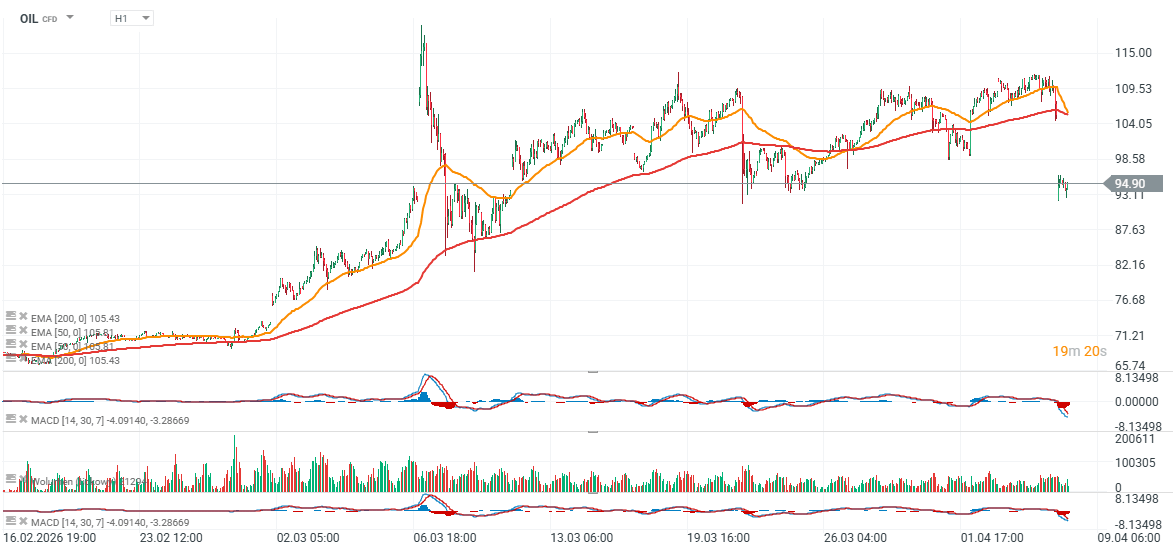
📌Oil falls sharply amid the Middle East ceasefire and ongoing US – Iran negotiationsOil is plunging sharply after the US called off a planned strike on Iran at the last moment and, through mediation involving Pakistan, agreed on a two-week ceasefire with Tehran. Brent crude (OIL) is down more than 10% to around $94 per barrel, although it opened the session even lower near $91.
- Some tanker traffic through the Strait of Hormuz is resuming, which should ease short-term supply constraints and allow Europe and Asia to partially rebuild inventories. Trump indicated that the US had already agreed to parts of Iran’s 10-point peace proposal during earlier negotiations, before the US and Israel strikes on Tehran. According to the US president, the military objectives of the operation have been achieved, and the proposed framework could serve as a starting point for a broader agreement.
- However, major repair work on oil infrastructure in the Persian Gulf is likely to remain on hold until a full peace deal is reached—not just a temporary ceasefire. According to Rystad Energy, a complete reconstruction of the region’s infrastructure could take years and cost over $25 billion.
- If a comprehensive agreement is ultimately secured, oil prices could come under pressure toward pre-conflict levels, around $71 per barrel. For now, however, this scenario remains uncertain. In the coming weeks, the market is likely to remain in a state of suspension—caught between the risk of renewed conflict, which could trigger another price spike, and the possibility of a deeper decline.
Even under peaceful conditions, repairing damage to refining infrastructure will likely take several months, with full recovery extending much longer. Markets will now focus on signals from US and Iranian delegations, particularly on key red lines such as uranium enrichment—Tehran insists on continuing it for civilian purposes—and control over transit through the Strait of Hormuz. Potential fees of around $2 million per tanker could generate up to $40 billion annually for Iran, which—combined with sanctions relief—would significantly strengthen its position in the region. This is a scenario Washington and its allies may be unwilling to accept. Around 20,000 vessels pass through the Strait each year.
OIL (H1)
Source: xStation5
The material on this page does not constitute financial advice and does not take into account your level of understanding, investment objectives, financial situation or any other specific needs. All information provided, including opinions, market research, mathematical results and technical analyzes published on the Website or transmitted To you by other means, it is provided for information purposes only and should in no way be construed as an offer or solicitation for a transaction in any financial instrument, nor should the information provided be construed as advice of a legal or financial nature on which any investment decisions you make should be based exclusively To your level of understanding, investment objectives, financial situation, or other specific needs, any decision to act on the information published on the Website or sent to you by other means is entirely at your own risk if you In doubt or unsure about your understanding of a particular product, instrument, service or transaction, you should seek professional or legal advice before trading. Investing in CFDs carries a high level of risk, as they are leveraged products and have small movements Often the market can result in much larger movements in the value of your investment, and this can work against you or in your favor. Please ensure you fully understand the risks involved, taking into account investments objectives and level of experience, before trading and, if necessary, seek independent advice.