
 EUR /
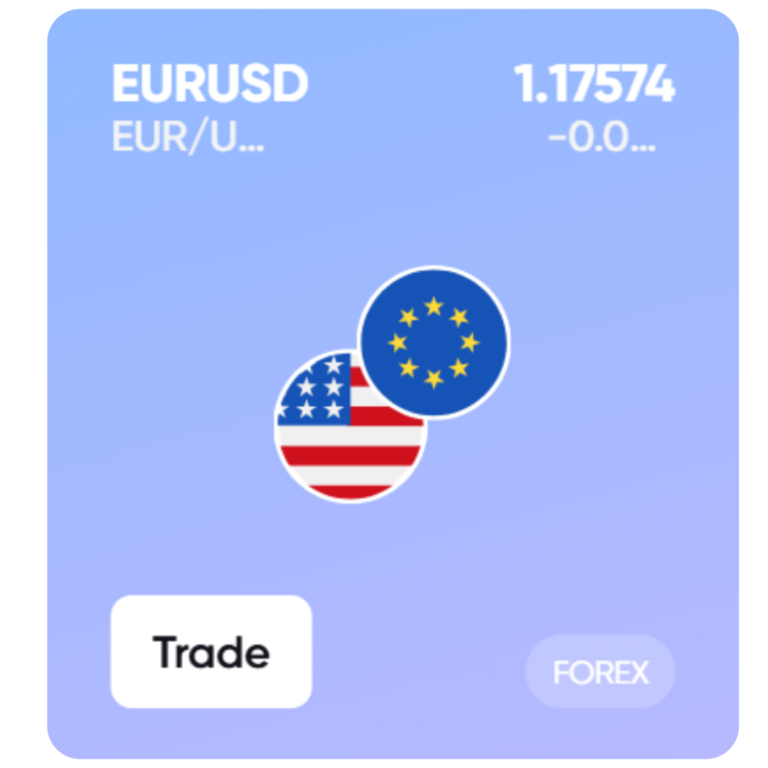
EUR /  USD — Euro / US Dollar
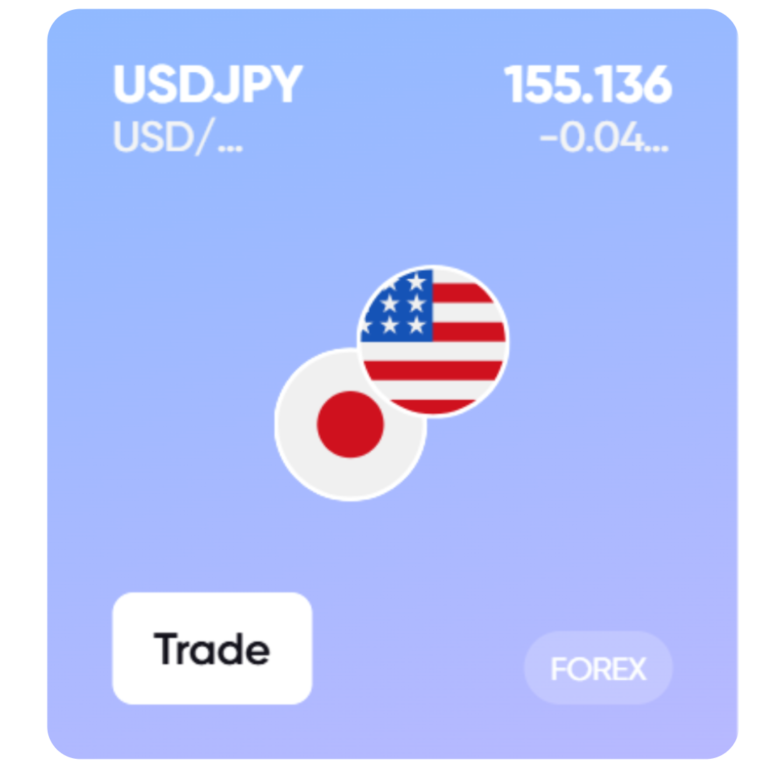
 JPY — US Dollar / Japanese Yen
 GBP /
GBP /  AUD /
AUD /  CAD — US Dollar / Canadian Dollar
 CHF — US Dollar / Swiss Franc
 NZD /
NZD / 
Forex
Explore trading opportunities in the world’s most traded financial market and get access to major, minor, and exotic CFD currency pairs.
Discover Forex CFDs
What are Currency Pairs?
Currency pairs are financial instruments where one currency is quoted against another currency. The quote indicates the amount you would pay in one currency for the other.
Here's a simplified example
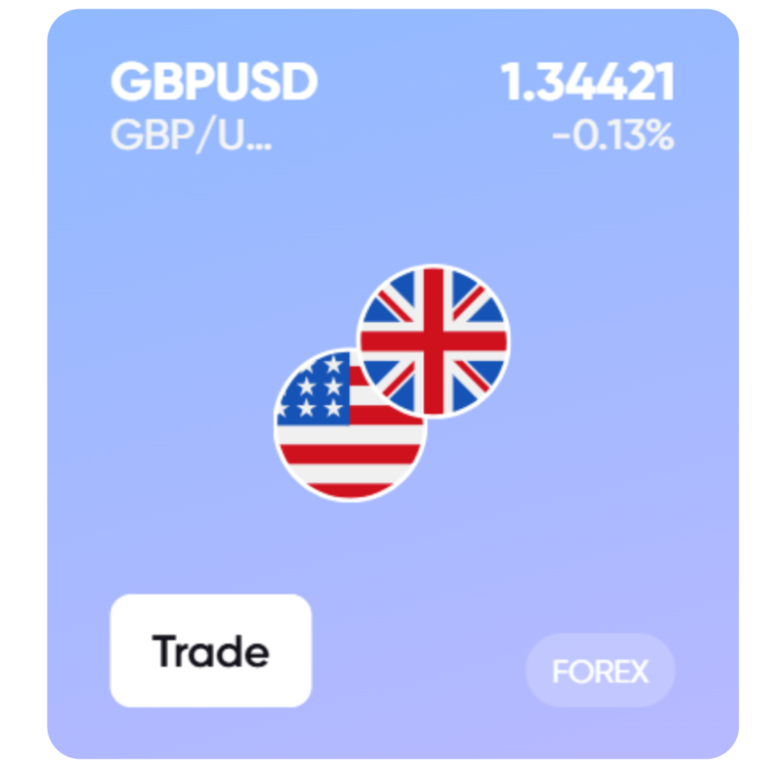
The currency pair GBP/USD is at 1.15. You can exchange 1 GBP for 1.15 USD.
- If GBP/USD started the day at 1.15, and by the end of the day rose to 1.16, it’s because the Sterling has strengthened against the Dollar.
- If GBP/USD started the day at 1.15, then drops 1.13, it’s because the Sterling has weakened against the Dollar.
Why Trade Forex CFDs with todaymarkets.com
- Competitive spreads from 0.6 pips on EUR/USD
- Powerful charting tools integral to the markets.com intuitive platform
- You can trade Forex 24/5
- Currency pairing CFDs enables trade at a fraction of the trade’s total value
- Trade on margin and go long or short

Our most traded Forex pairs with the lowest spreads

Forex CFDs: the essentials
Before getting started, there are some key things all traders should know about the forex market and CFDs as a way to trade financial markets. Here are the five essentials to know:
What’s the difference between forex and CFDs?
Forex is one of the many markets you can trade with us. When trading forex, you’re speculating on the value of one currency against another – for example, EUR vs USD. CFDs – short for contracts for difference – is the method you can use to get exposure to forex with us. When trading with a CFD account, you don’t take ownership of physical currencies. Instead, you’ll use the derivative to speculate on price movements.
Forex is traded in pairs and mimics the underlying
Forex is always traded in pairs – for example, the euro and the US dollar (EUR/USD). You’re always buying one currency and selling the other in the pair, based on which currency you think is going to appreciate in value against the other. The currency being bought is known as the base currency (appears on the left), while the other is called the quote currency (appears on the right).
The price of the pair shows how many of the quote currency it’ll cost to buy one of the base. So, if EUR/USD is trading at 1.35000, it means it costs $1.35 to buy €1. Note that CFD forex trading is designed to mimic trading the underlying market relatively closely. Our forex CFD prices are only driven by the movements of the underlying market (with the exception of our weekend FX prices, when most markets are closed, so prices driven by upcoming market events and client sentiment).
Lastly, currencies are traded in lots – batches of currency used to standardise forex trades. These lots tend to be large, to account for the fact that forex price movements are usually small. For example, a standard lot is 100,000 units of the base currency while a micro lot is 1,000 units.
Forex CFDs trade in the quote currency
With us, you’d usually trade FX CFDs on the spot (on the current cash price of that currency pair, as opposed to the future price) and you’d always trade in the quote currency. For example, when trading EUR/USD, you’ll trade in US dollars.
In forex, you can trade major pairs like the EUR/USD or GBP/USD or minor pairs like the GBP/CAD and even exotic pairs like the EUR/MXN.
Spot vs options for forex CFDs
Most of our CFD forex trades are on spot markets, meaning you trade them based on their current cash price, in real time. However, you can also trade FX options.
Options give you the right, but not the obligation, to buy or sell currency pairs before a predetermined expiry date. Unlike spot market forex, which work on current prices, you get daily, weekly, monthly and quarterly options.
Although FX options are based on the spot price of currency pairs, there are differences between the two. Spot forex markets have no expiry date, but do incur overnight funding charges if you leave a position open longer than a day. Forex options do have an expiry date but no overnight funding charges. There are 80 currency pairs to trade with spot forex (including major, minor and exotic ones), while forex options have nine.
Both forex spot trading and forex options are traded using CFDs. There are many pros and cons to trading with CFDs – not least of all that CFDs are leveraged. As mentioned, this means that you only need to put up a deposit (called margin) to open a larger position – which can stretch your capital further. However, your total profit and loss can far outweigh your initial deposit as both are calculated on the total position and not your margin amount.
Spot forex CFDs are traded in contracts
With spot forex CFDs, you’ll be trading in contracts. To calculate the profit or loss earned from a CFD forex trade, you’ll multiply the deal size of your position (the total number of contracts) by the value of each contract. Then, you’ll multiply that figure by the difference in points between the price when you opened the trade and the price when you closed it