
 EUR /
EUR /  USD — Euro / US Dollar
 JPY — US Dollar / Japanese Yen
 GBP /
GBP /  AUD /
AUD /  CAD — US Dollar / Canadian Dollar
 CHF — US Dollar / Swiss Franc
 NZD /
NZD / 
Bonds CFDs
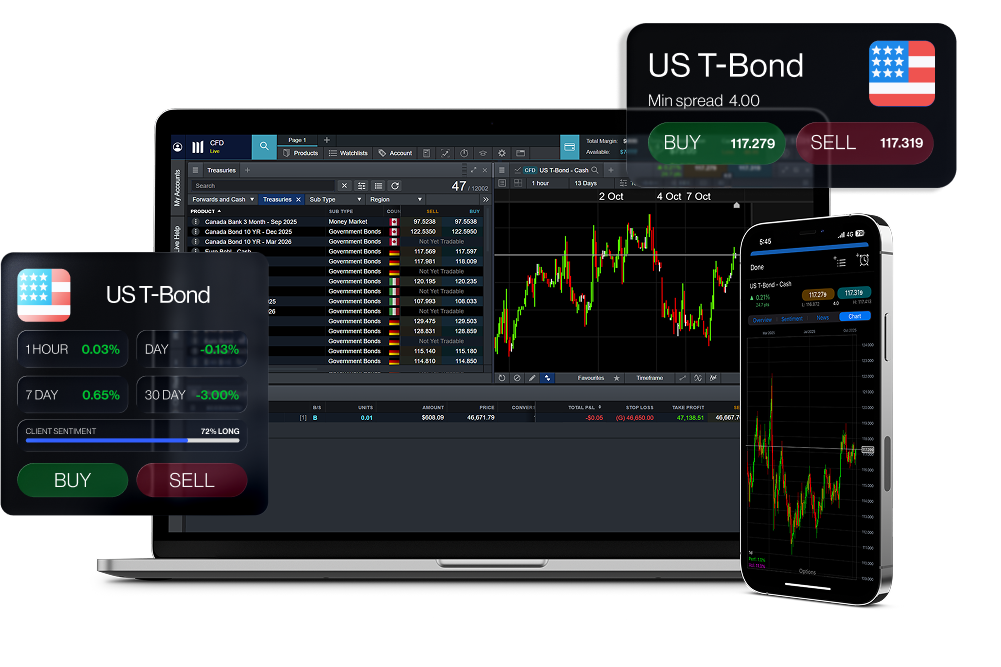
ake a position on where you think interest rates are heading with our tradeable government bond markets.
Bonds CFDs
Why trade CFD bonds at todaymarkets.com
- First derivative: Gain more direct exposure to central bank decisions than in Forex
- Trade inverse and leveraged bond ETFs depending on your strategy and goals
- Take a position on where you think interest rates are going and what central banks are doing

Ways to Trade Bonds CFDs
Trade CFDs - A CFD account will allow you to trade on bonds directly and via access to a range of ETFs.
Bond ETFs
Trade on a variety of bond ETFs that track the daily performance of government bonds, such as the ProShares UltraShort 20+ Year Treasury (TBT).
Benefits of Trading Bond CFDs
Trading bond CFDs offer several compelling advantages that traditional bond investing simply can’t match. For starters, the leverage factor allows you to control substantial positions with relatively small capital outlays, potentially amplifying your returns significantly.
The ability to profit in both rising and falling markets stands out as perhaps the most attractive feature. Unlike conventional bond ownership where you only benefit when prices increase, CFD trading lets you capitalize on downward price movements by going short – particularly valuable in rising interest rate environments when bond prices typically decline.
Transaction costs tend to be lower with CFDs compared to traditional bond purchases, with no stamp duty and often tighter spreads than purchasing bonds directly. The process is also remarkably streamlined, with instantaneous execution through online platforms that eliminate the need for cumbersome paperwork or physical certificates.
Diversification becomes much more accessible too. Instead of committing large sums to purchase individual government or corporate bonds, you can spread your capital across various bond markets worldwide – from US Treasuries to German Bunds or Japanese Government Bonds – all from a single trading account.
CFD bonds also offer exceptional flexibility with position sizing. You can fine-tune your exposure precisely rather than being constrained by standard bond denominations, making it easier to implement sophisticated risk management strategies or optimize your trading approach.
Finally, the transparency of pricing and the ability to set automated stop-loss and take-profit levels provide greater control over your trading outcomes, helping you manage risk more effectively in volatile market conditions.