 EUR /
EUR /  USD — Euro / US Dollar
 JPY — US Dollar / Japanese Yen
 GBP /
GBP /  AUD /
AUD /  CAD — US Dollar / Canadian Dollar
 CHF — US Dollar / Swiss Franc
 NZD /
NZD / 
AI boom fuels inflation fears, complicating Fed’s next rate move
- July 9, 2026
- Posted by: Today Markets
- Categories: Competitive research, Markets
Federal Reserve officials were split last month on whether to increase interest rates or keep them steady, with many seeing accelerating demand for artificial intelligence as a driver of inflation, according to meeting minutes released on Wednesday.
The minutes covered the first monetary policy meeting under Fed Chair Kevin Warsh. Many Federal Open Market Committee members said that “ongoing strong demand for AI infrastructure would likely sustain upward pressure on prices for technology products and electricity,” according to the minutes.
AI-related inflationary pressure, colloquially known as “chipflation,” stems from the rising cost of semiconductors used by data centers. This surge in demand, along with data center competition for energy, has pushed up consumer prices for a wide range of electronic goods, devices and power, and may continue as AI demand increases.
Higher inflation is generally bad news for risk assets such as crypto, as it results in lower liquidity and spending power and higher interest rates, making borrowing more expensive and cash investments more attractive.
Inflation will remain elevated in the near term
Participants anticipated that inflation would “remain elevated in the near term” but may decline as the Middle East conflict eases. However, they judged that the “risks to the inflation outlook were still tilted to the upside.”
AI growth remained a strong theme, both boosting economic growth and contributing to inflation at the same time.
Most participants remarked that growth in economic activity that exceeded that of potential output, owing in part to strong AI business investment, could contribute to more persistent inflationary pressures.
The Fed’s “dot plot” signals hikes, not cuts, with nine of 18 voting members projecting at least one rate hike before the end of 2026 and six expecting two 25-basis-point increases. The central bank’s PCE inflation projection for year-end also jumped from 2.7% to 3.6%.
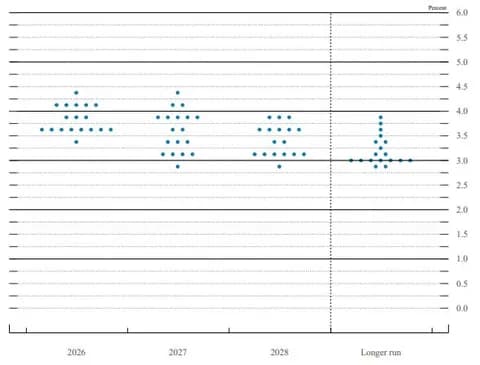
The Fed kept rates steady at 3.5% to 3.75% at its June meeting, while CME futures markets currently show a 70% probability that they will remain unchanged at the next meeting on July 29.
AI infra buildout driving higher inflation
Nick Ruck, director of LVRG Research, told Cointelegraph that the Fed’s recent meeting highlights how the massive AI infrastructure buildout is “driving higher inflation through surging demand for semiconductors, energy and data centers, even as it promises future productivity gains.”
“While this short-term pressure complicates monetary policy, it also underscores the need for innovative solutions in decentralized technologies to optimize resource allocation and ease bottlenecks in the digital economy,” he said.
Analysts said this week that crypto markets could benefit from any Fed intervention to backstop the booming US equity market in a downturn.