
 EUR /
EUR /  USD — Euro / US Dollar
 JPY — US Dollar / Japanese Yen
 GBP /
GBP /  AUD /
AUD /  CAD — US Dollar / Canadian Dollar
 CHF — US Dollar / Swiss Franc
 NZD /
NZD / 
The Week Ahead
- July 20, 2026
- Posted by: Today Markets
- Categories: Markets, Technical Analysis
Key takeaways
- Strait of Hormuz traffic slows to a trickle
- Rising oil prices have macro consequences
- Animal spirits contained
- Bulls no longer have control
- What next for SpaceX?
- Where are the bargain hunters?
- Physical assets back in fashion
- Earnings season ramps up
- Burnham, yet another PM for the UK
The Week Ahead:
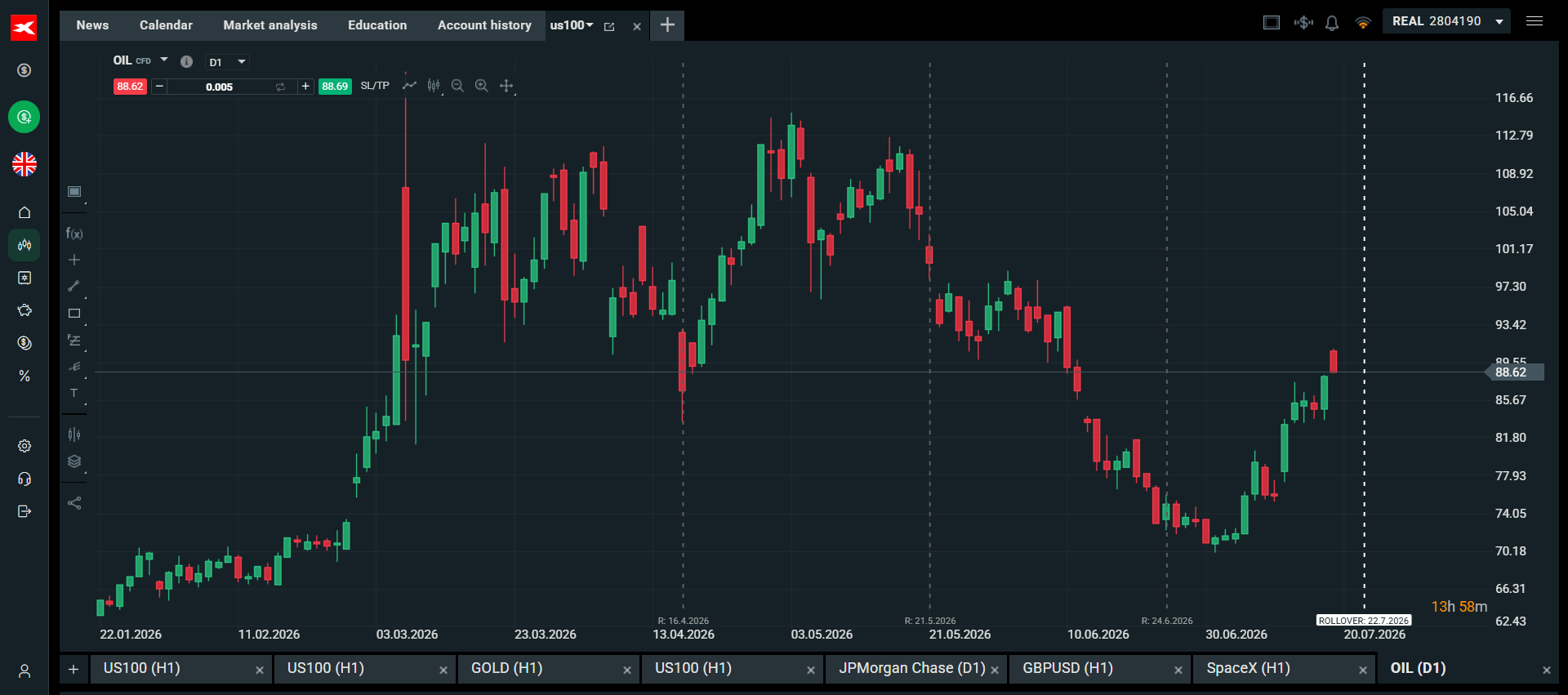
Oil prices jump, as stocks face earnings test While Donald Trump was handing out World Cup trophies in New Jersey, US forces were embarking on their nibAt the start of this week the oil price is in focus once again, Brent crude is higher by more than 3% and is testing $91 per barrel, the highest level since mid-June. The latest geopolitical flare up between Iran and the US escalated over the weekend, US forces hit Iran for the ninth consecutive day on Monday and there are concerns that the Strait of Hormuz will close fully to traffic, after Iran said that two tankers had ex[plodded and been immobilized.
Strait of Hormuz traffic slows to a trickle
The interim ceasefire agreement is unravelling daily, and the Strait of Hormuz is likely to see traffic slow to a standstill on the back of this latest flare up. There are reports that some shipowners are still crossing the Strait, but this comes at an elevated risk, and high insurance costs, which will no doubt put others off. In another sign of increasing tensions, Iran has targeted the key infrastructure sites of the US’s allies in the region, including Kuwait, which suggests that the attacks from the US will continue in the near term.
Rising oil prices have macro consequences
Brent crude rose by 8% last week. As political risk premiums push the oil price above $90 per barrel, this poses broader macro economic risks as we move through the second half of the year. It has also eroded the assumption that the crisis in the Middle East is over and energy prices would normalize. If headline price pressures bleed into core inflation in the coming weeks and months, then geopolitical concerns will once more cause a headache for global central bankers.
Animal spirits contained A
fter a losing week for Wall Street, stock futures are little changed, Nasdaq futures are pointing to a small gain later today, while the S&P 500 is set to make a small decline. European stocks are also mostly lower this morning, after another rough day in Asia, both the Nikkei and the Kospi fell 4% on Monday. As we start a new week, there has been a major shift in stock market sentiment. Investors are shedding their animal spirits towards some sections of the AI trade, and Q3 is proving to be much harder than Q2. Investors are moving on from the exuberance of the second quarter to a fundamental-based assessment. They want to see what the AI giants can deliver this earnings season before they commit to another leg higher in the AI stock market rally.
Bulls no longer have control
This is a powerful moment for global stock markets, and for the first time in several months, the bulls are not in control. Last week there was a major rotation away from tech stocks. The Nasdaq 100 fell nearly 3.5%. compared to a 1.2% drop for the S&P 500 and a 1% decline for the Russell 2000. While a 3% drop is sharp, the sell off in tech was particularly acute for chip stocks. The Philadelphia semiconductor index fell nearly 9% last week and is lower by 14% in the past month. There were two drivers of last week’s chip stock sell off. Firstly, there was news that Google would delay its latest AI model. This has led to fears about a slowdown in AI capex spending in the coming quarters. Taiwanese chip maker TSMC also reported an increase in its cost base, which is causing concerns about more inflation in the AI pipeline, which could ultimately trigger demand destruction. The high price of memory chips is already worrying investors, especially as we continue to wait for the monetization of AI investment. If earnings reports in the coming weeks suggest that we remain in the spend phase of the AI buildout, investors are likely to get more impatient, and the sell off could drag on over the summer months.
What next for SpaceX?
As we start a new week, two factors are worth watching. Firstly, what will happen to SpaceX? Its share price fell below its IPO price last week, and the stock closed below $124 per share, after dropping 5.4% on Friday. It lost 17% last week, and is down 40% from its peak. Secondly, after a severe sell off, some AI stocks look oversold, but will investors come in and buy them now that their valuations are more reasonable?
Where are the bargain hunters?
AI stocks that are heavily oversold include Oracle, which fell 15% last week, but managed to eke out a 1.7% gain on Friday. It was also higher overnight, rising by 0.25%, which suggests that any recovery could be tepid on Monday. Super Micro also fell 15% last week, and IBM experienced its worst ever sell-off, declining by more than 28%. Oracle’s decline began when the company announced that it would have negative free cash flow for this year, at the same time it tried to raise more money to spend on its AI build out. Investors do not like this kind of financial indiscipline, and we will need to see if the sharp decline in the share price is enough to entice more investors back to the stock.
Oracle now has a P/E ratio of 21 times, this is lower than the P/E ratio for the S&P 500, which is more than 25 times earnings. It also looks attractive from a technical perspective, it has an RSI reading that is well into negative territory at 17. Asian indices took a knock last week, the Chinese Shenzhen index slumped 11%, while South Korea’s Kospi sunk another 8%. The Kospi is now in bear market territory and is down nearly 30% in the past month. However, it is still up 54% YTD, so there could be further downside to come, especially since its sell offs have been exacerbated by the large number of leveraged ETFs linked to the South Korean market and its components.
Physical assets back in fashion
European indices were the top performers, and the FTSE 100 rose by more than 1%. It benefitted from a double whammy of being light on tech stocks, and getting a boost from a rising oil price. In the US, weakness in tech helped to boost demand for energy, real estate and consumer staples. Physical assets are back in fashion as we move into Q3. There are two factors that will drive volatility in markets in the coming days. Below, we assess what they are and how they could impact your trading decisions.
1, Earnings season ramps up
Google and Tesla are the key releases for this week, as 77 companies listed on the S&P 500 are due to report last quarter’s earnings in the coming days. IBM will also provide its full earnings update, after its preliminary report suggested that demand for its hardware was adversely affected by some customers redirecting capex spend to more expensive AI chips. This caused the stock to have its largest ever daily fall; it dropped 28% last week. Executives will now be rushing to find a way to turn the narrative around when it delivers its full report later this week. Tesla will report results after the market closes on Wednesday. It reported an earnings beat last quarter, and it recently reported an encouraging delivery report for Q2.
It delivered a record-breaking 480,126 vehicles in the three months to June, a 25% uplift compared to a year ago and beat consensus estimates by 18%. The company has already announced that it achieved a record 13.5 giga watts in energy storage deployment, as Tesla’s lucrative battery business continues to do well. These reports have added upward momentum and set lofty expectations for this earnings report. The market will want to hear about cash flow, Q2 saw under-production as Tesla sold off some of its inventory of vehicles, which positions the company well for the future. However, there could be a sting in the tail, and some analysts are expecting Musk to announce a delay to cybertaxi production. Tesla shares joined in the tech stock sell off last week, and slumped 7%, bringing its YTD loss to 16%.
Tesla’s shares do not have a good record of performance when it comes to earnings reports, and its share price has declined after the last 3 earnings releases. The question now is, can it break the cycle and will a better-than-expected earnings report boost the stock price? Google is also worth watching as it is the first hyperscaler to deliver earnings, which are also released on Wednesday evening. Wall Street is expecting another superb reading, although the stock price has been grinding lower for the past month. Revenue is expected to be $116.5- $116.9bn, representing more than 20% YoY growth. Earnings per share is also expected to expand by 24% compared to 12 months ago, and operating margin is expected to rise by 3% to 35.3%.
Key areas to watch include momentum at Google Cloud. It is the company’s major growth engine, and investors want to know if it can continue to post 60% + growth rates like it did last quarter. This should not be a problem, as the company has a backlog of demand worth hundreds of billions of dollars. The capex data is arguably the most important number that investors will be looking out for on Wednesday night. The company has fundamentally shifted its balance sheet strategy in recent months, after announcing plans to secure over $80bn in equity capital to finance its aggressive AI infrastructure buildout. Analysts will be searching for signs that return on investment will be worth it. Its capex guidance for this fiscal year is $175-$190bn, which was increased last quarter. In the current market environment, it is hard to see investors tolerating any increase to capex spend above this level. To highlight how critical these results are, we believe that how well, or not, Google’s earnings are received could determine the direction of the AI trade in the near term.
2, A new PM for the UK
The UK will get its 7th prime minister in 10 years today, when Andy Burnham takes over at 10 Downing Street. He may not stay long, as the King of the North also wants a Downing Street of the North, which sounds expensive and extremely EU-like to many people. Whether he will turn the Labour Party’s fortunes around remains to be seen. Initial polls suggest that there has been a mild bounce, but nothing of the scale needed for him to trigger an early general election. Look out for our in-depth UK piece later today, but unsurprisingly, the new PM will have little money to play with, this should be confirmed after the June public sector finance data that is released later this week. Unemployment could also rise in his first week as PM, and retail sales could be subdued. Burnham has his work cut out for him, especially since his main pledge is to dampen down cost of living pressures. Spoiler, he cannot do this, since he cannot control the cost of internationally priced commodities. The best way to give people more money in their pockets is to cut taxes, yet he is looking to raise them ‘a little more’, even though the IMF and the OECD have said that is folly when they tax burden is already at multi-decade highs. A rising oil price means that Burnham takes charge with the 10-year UK Gilt yield hovering dangerously close to 5%. However, in the past week, the pound was the third best performing major currency, and it is also higher to start the week, at $1.3475 vs. the USD, one of the highest levels for 2-months.
Chart 1: Brent crude oil price
Source: XTB Chart 2: GBP/USD
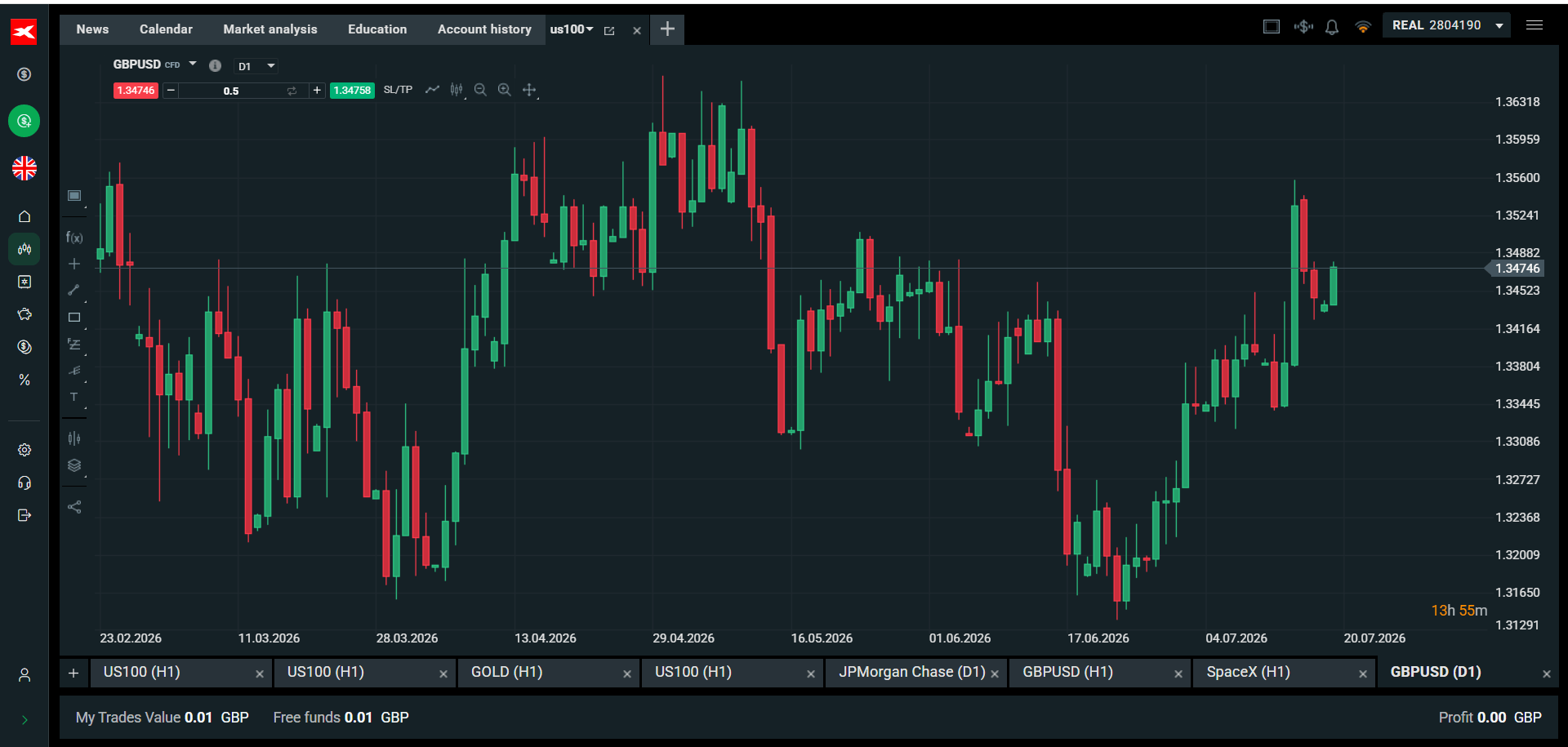
Source: XTB