





How Today Markets
Makes Money
We believe transparency is essential to building long-term relationships with our clients. Here's how our business model works and the costs that may apply when you trade with us.
A Transparent Trading Model
Today Markets generates revenue primarily through spreads, guaranteed stop-loss order premiums, currency conversion fees and overnight funding charges.
We do not charge commission on positions where the applicable trading costs are incorporated into the spread. The specific costs applicable to your trading activity depend on the asset class, market conditions and product you trade.
Spreads
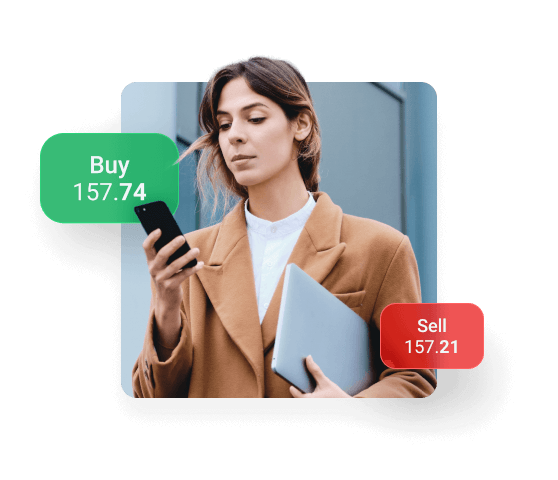
The difference between the buy and sell price of a tradable instrument. Spreads can vary according to the asset and prevailing market conditions.
Guaranteed Stops
A premium may apply when a Guaranteed Stop-Loss Order is triggered to provide protection against slippage and market gaps.
Currency Conversion
Currency conversion fees may apply when trading activity or account transactions require the conversion of one currency into another.
Overnight Funding
A daily funding charge or credit may apply when leveraged positions are held beyond the standard trading day.
Built Around Long-Term Relationships
In line with our mission to assist clients in making better-informed decisions, we invest heavily in tools, technology and market access designed to support the trading experience.
Today Markets implements negative balance protection for retail clients. This means that, subject to applicable terms and conditions, trading losses cannot exceed the funds available in the trading account.
Where a client wishes to maintain a position after a margin call, additional funds may be deposited to meet the applicable margin requirement and prevent the position from being closed, subject to the relevant trading conditions.
We aim to build long-lasting relationships with our clients based on trust, transparency and responsible engagement.
Spreads
Spreads are the difference between the buy and sell price of a tradable security and represent one of the primary ways brokers generate revenue.
Spreads can vary in size according to the asset and market conditions. Typically, highly liquid markets such as EUR/USD or gold may have tighter spreads than less-traded markets such as corn or orange juice.
This means that the overall cost of trading highly liquid markets can, relatively, be lower than trading less liquid markets. However, less liquid markets may experience higher volatility, which can attract traders who understand and accept the associated risks.
Market liquidity and volatility can influence the size of the spread and therefore the cost of opening and closing a position. It is important to understand the applicable trading costs before opening a position.
Spread Example
Suppose you are trading one US 500 CFD contract representing $1 per point of index movement. If the spread is 0.8 points, the spread cost is:
$1 × 0.8 points = $0.80
If you increase your position to 10 contracts, the spread cost would be:
$0.80 × 10 contracts = $8.00
For example, if you trade GBP/USD at a notional value of £10,000 with a spread of 0.00013, equivalent to 1.3 points, the spread calculation would be:
0.00013 × £10,000 = £1.30 equivalent spread cost
Guaranteed Stop-Loss Orders
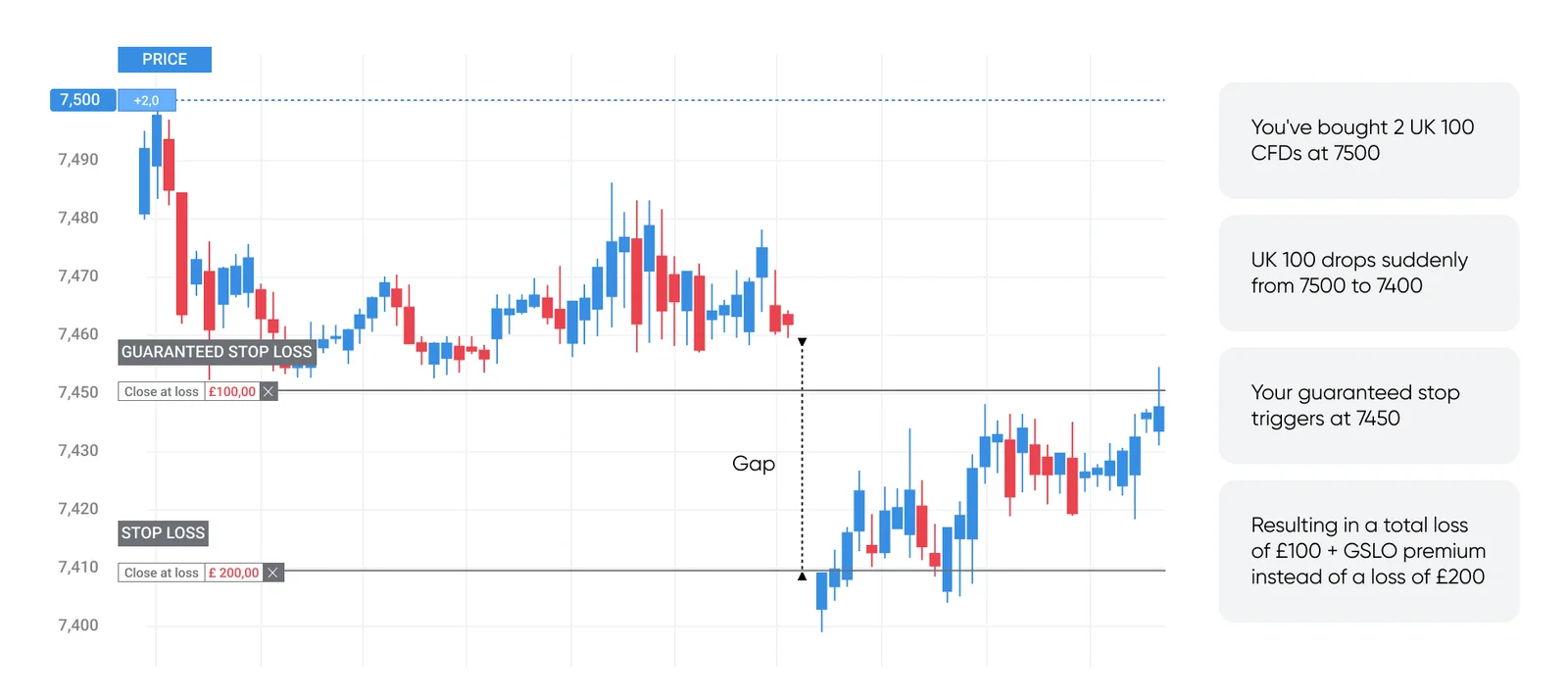
A Guaranteed Stop-Loss Order, or GSLO, is designed to guarantee the closing of a trade at a specified price, regardless of slippage or market gaps.
A standard stop-loss order is an instruction to close a position at a particular price level. However, in volatile markets or periods of low liquidity, the execution price may differ from the requested level due to slippage.
During a market gap, a standard stop may execute at the next available price rather than the specified level. A Guaranteed Stop-Loss Order provides additional certainty by guaranteeing execution at the selected price, subject to the applicable product terms.
A premium may apply if a Guaranteed Stop-Loss Order is triggered. The applicable charge should be reviewed before placing the order.
Overnight Funding
Overnight funding is an industry-standard daily charge or credit that may apply when a leveraged position is held overnight.
Overnight funding helps recoup the costs associated with financing leveraged positions outside a market's standard trading hours. Depending on the instrument, position and applicable rates, funding may also be credited in certain circumstances.
Overnight funding is calculated differently depending on the asset class being traded. Factors may include interest-rate benchmarks such as SONIA or SOFR, an overnight basis adjustment, an applicable swap rate and the daily fee applicable to the instrument.
A complete breakdown of the applicable components and examples of how overnight funding is calculated can be found on the relevant fees and charges information.
Know the Costs. Trade with Confidence.
Understanding how trading costs work is an important part of making informed decisions. Review the applicable charges for your chosen markets before opening a position.