






The week has begun with relatively low volatility in the currency market. An exception is the Canadian dollar, which is weakening against the US dollar today by over 0.4%. Figure 1: G10 Currency Dashboard (24.06.2026)
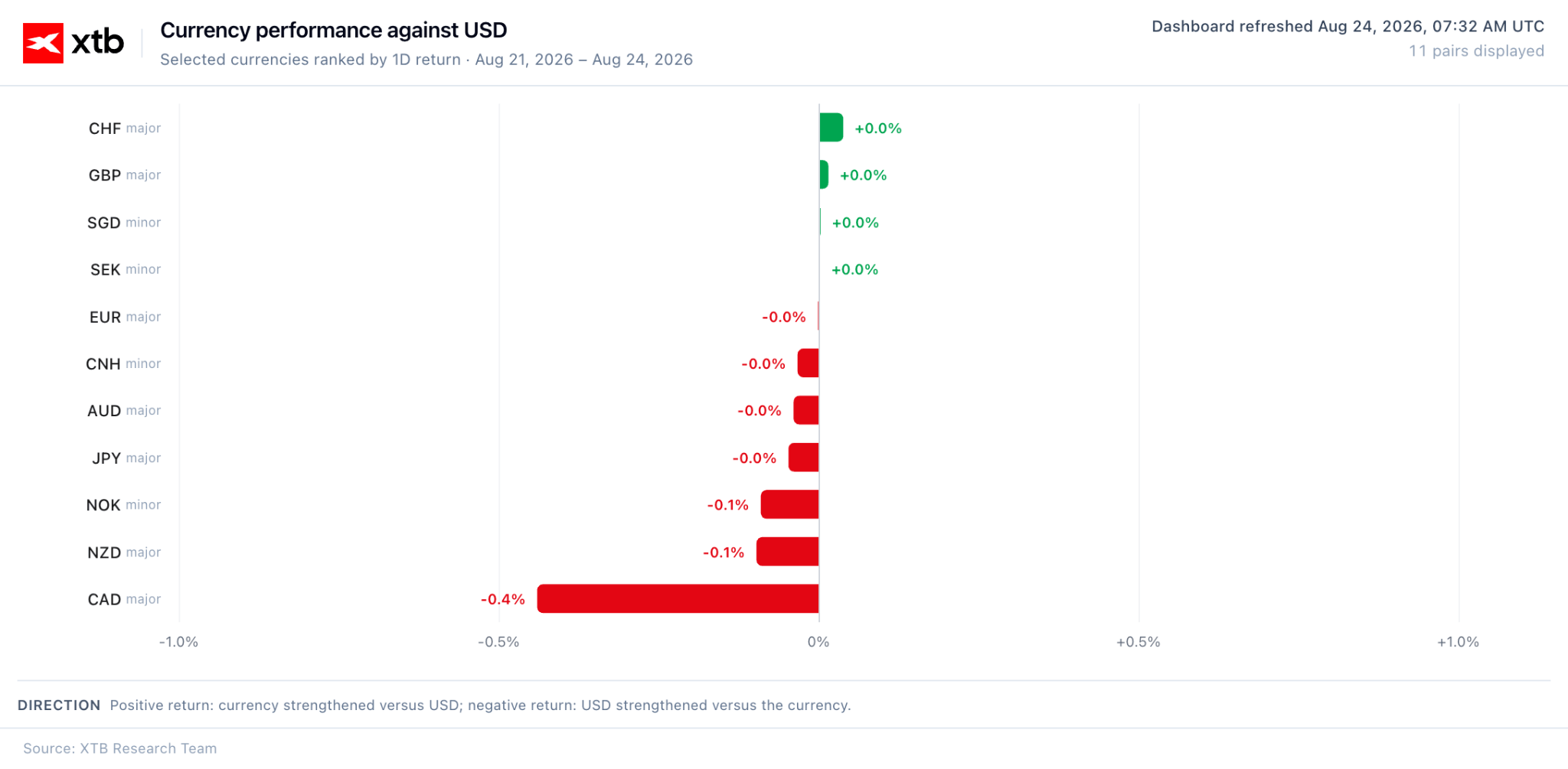
Source: XTB Research, 24.08.2026 Where can the reasons for such a move be found?
Return of the Trade War
Talks regarding a new trade agreement between Washington and Ottawa have unexpectedly failed. Negotiations were broken off on Friday, which resulted in the implementation of 50% tariffs on Canadian products exported to the USA. These will cover goods with a total value of approximately 20-28 billion dollars (5-7% of all Canadian exports to the USA). The tariff list includes timber, cement, furniture, selected dairy products, wine, electrical equipment, and hockey gear, among others. President Donald Trump is firmly defending the decision. On social media, he accused Canada of “wanting to reap the benefits of being a state without being one.” Canadian Prime Minister Mark Carney accuses the US of introducing unfair and economically harmful demands at the last minute, including attempts to limit Canada’s ability to enter into trade agreements with other nations. The American side (represented by Jamieson Greer) rejects these accusations, claiming that it was the Canadian negotiators who broke the previously reached compromise with new demands.
Planned Retaliation
According to Carney’s announcements, Canadian tariffs aimed at US exports of similar value are to come into force on 8 September (“dollar for dollar,” as the Prime Minister himself says). They will hit sectors such as steel, agricultural machinery, household appliances, electronics, and dairy products. Incidentally, the selection is not accidental; they are intended to be felt quickly in politically key US states (which may be of particular importance in view of the fast-approaching midterm elections).
Debt, PCE, and Jackson Hole
On the dollar side, three elements will attract attention. The first will be the situation in the debt market. The decline in the yield of 30-year US bonds resulting from Treasury Department intervention proved unsustainable. It currently stands at 5.24%, which means it is approx. 6 bps above Thursday’s lows. If further statements appear signalling an increased supply of dollars in the market, we should expect further currency depreciation. The second is Wednesday’s publication of PCE inflation data. This is a reading significantly lagged relative to the CPI measure, but historically preferred by FOMC policymakers. The publication naturally takes on particular significance in light of the recent valuation change. After Scott Bessent’s last failed intervention, the market-implied probability of a rate hike in the autumn has risen. The September hike is priced at approx. 40%. The October one at just over 60%. The third, and perhaps most important, may prove to be the Jackson Hole symposium, which will run from Thursday to Saturday. On Friday, around 11:00 AM, Chair Warsh will take the podium. It seems that a lack of forward guidance is not an option. Markets are expecting clarity; its absence may add to the already significant pressure on the US dollar. The Fed Chair has announced he will treat Jackson Hole as a kind of clean slate. The question is how he intends to write on it.
Technical Analysis
Figure 2: USDCAD [D1] (31.03.2026 – 24.08.2026)
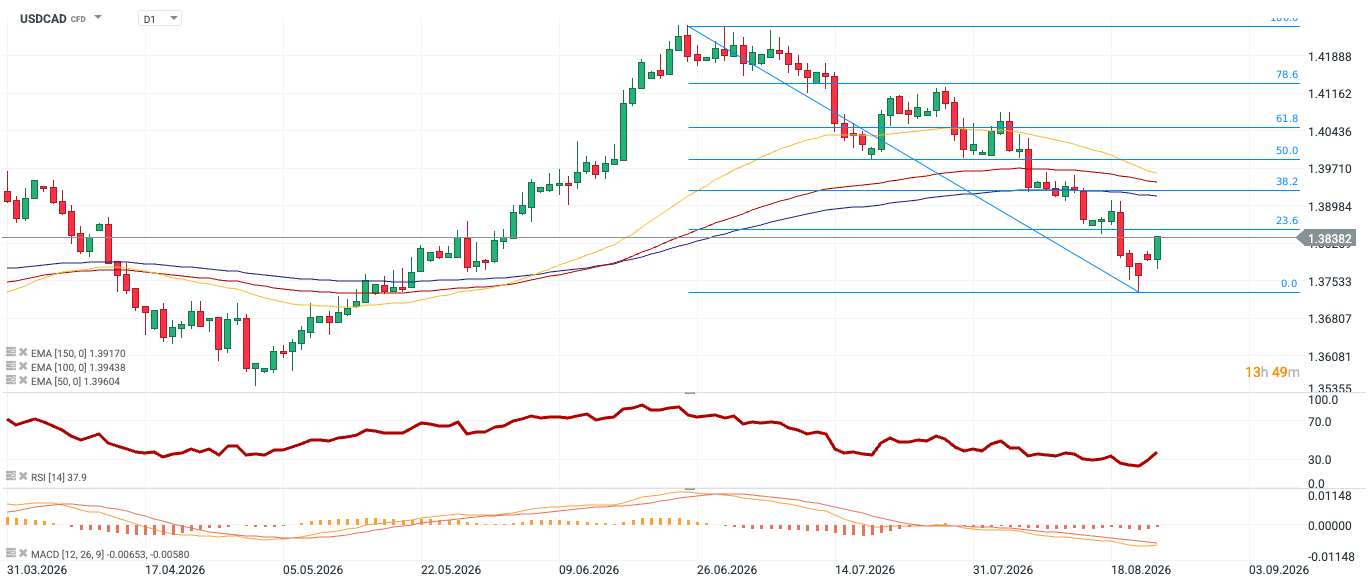
Source: xStation, 24.08.2026 In the medium term, the advantage still lies with the supply side, which is confirmed by the price position below all key moving averages. The 50, 100, and 150 EMA averages, together with the 38.2% Fibonacci retracement level, create a strong resistance zone. The RSI indicator at 37.9 is, however, slowly rising from the oversold zone, which allows room for further upward movement as part of a correction.