




Key takeaways
- The dollar has come bottom of the G10 currency rankings for the past week.
- The market does not believe that Kevin Warsh, the new Fed chairman, is a hawk.
- Oil prices are falling, which is also putting pressure on the US dollar.
- Higher GDP growth and inflation are fuelling expectations of interest rate rises in the eurozone.
- The yen is strengthening following the first coordinated intervention by the US and Japan in 15 years.
In recent months, the market has repeatedly cast doubt on Donald Trump’s promises and announcements. This phenomenon has become so widespread that it has even been given its own name (TACO, i.e. Trump Always Chickens Out). In keeping with this motto, the US President backed down from a planned attack on Iran over the weekend, which, as he himself put it, was to be “the biggest since the Second World War”.
However, what proved more significant for the currency was investors’ scepticism regarding statements made by another US official. Kevin Warsh, the new Fed chairman, continued to emphasise his uncompromising stance on inflation, seeking to convince the markets of his supposed hawkishness. Whilst this was sufficient in June, by July investors were expecting much more.
Chart 1: Exchange rates of selected currencies [vs. USD] (27 July – 3 August)
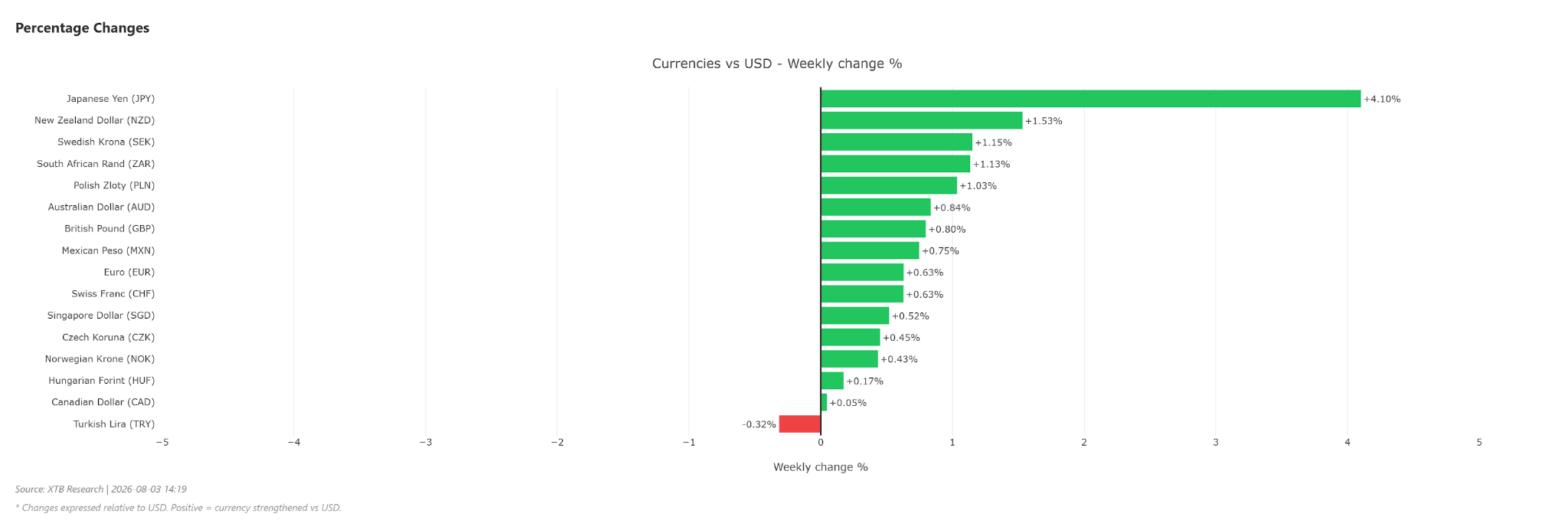
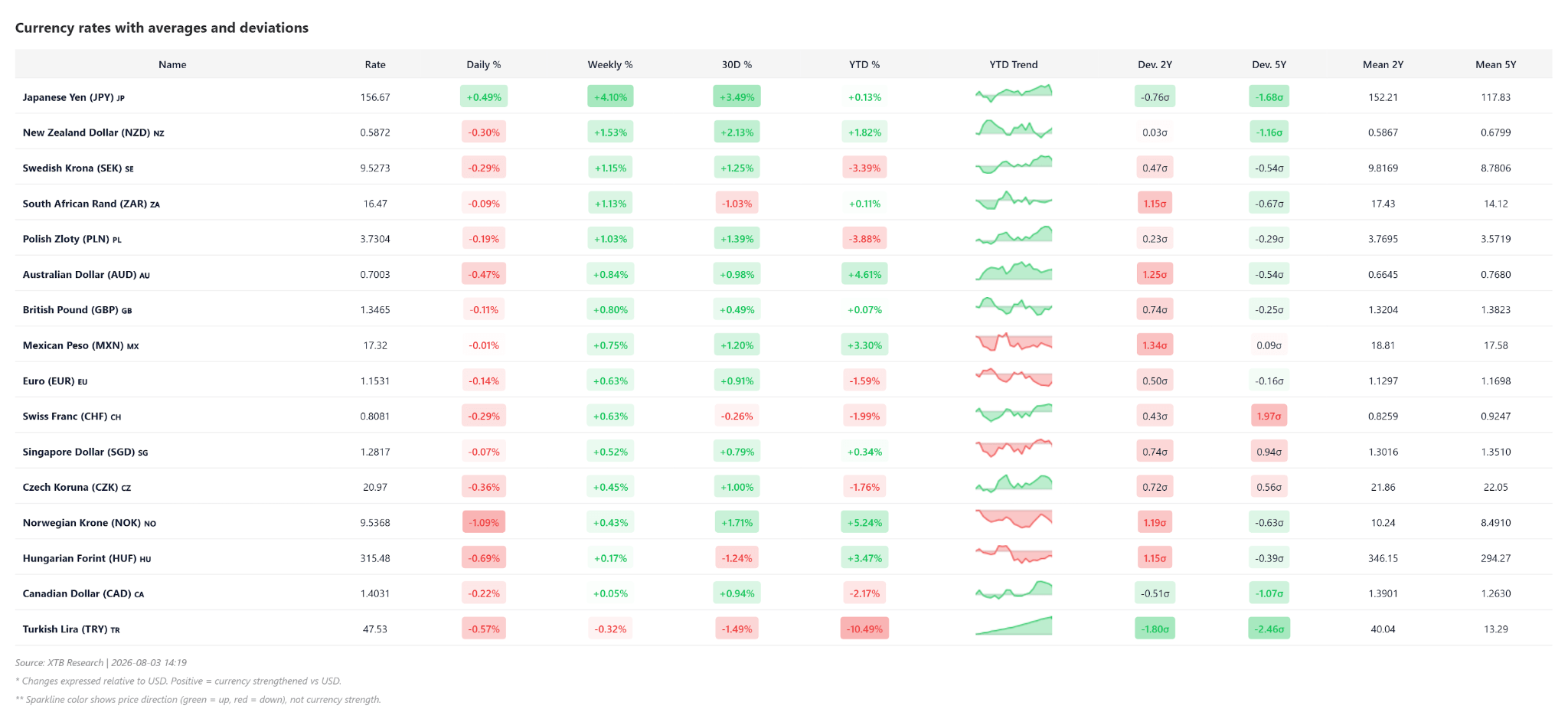
Source: Bloomberg, 3 August 2026 The US dollar has therefore come under pressure, weakening against almost every currency we analyse on a regular basis. Currencies with a higher beta (e.g. the Swedish krona or the Polish zloty) performed particularly well, as did those whose economies could suffer most from a deepening energy crisis (e.g. the South African rand or the South Korean won). At the very top of the list was, of course, the Japanese yen, which was bolstered last Thursday by the first joint currency intervention by the United States and Japan since 2011.
US dollar (USD)
The dollar is being weighed down by both the fall in energy commodity prices (of which it is a net exporter) and a dovish revision to market expectations regarding the Fed’s interest rate path. The Federal Open Market Committee (FOMC) decided last week to hold rates steady. The vote was 9 to 3. Only three policymakers voted in favour of a rate rise, and Warsh was not among them (the others were Beth Hammack, Neel Kashkari and Lorie Logan). During the conference itself, the Fed Chair stuck to his decision not to provide forward guidance. Although he spoke for nearly 45 minutes, few of the words that came out of his mouth were of any great significance from a market perspective. He avoided answering both questions regarding the justification for the pause and those concerning the current economic situation.
He mainly emphasised that the energy shock is hampering the committee’s work, and that the rise in CAPEX among hyperscalers should translate into future economic growth. This is largely consistent with his past comments on AI, when he argued that the productivity surge driven by artificial intelligence would, over time, have a disinflationary effect. The question is being raised once again as to whether Kevin Warsh is a dove in hawk’s clothing. The market seems increasingly sceptical that hawkish statements will be followed by concrete action, leading to a pullback in bets on interest rate rises. It currently assigns a probability of just over 60 per cent to a rate rise in September. Prior to the meeting, this was fully priced in. Chart 2: Market pricing of interest rate rises ahead of the FOMC decision (2026–2027)
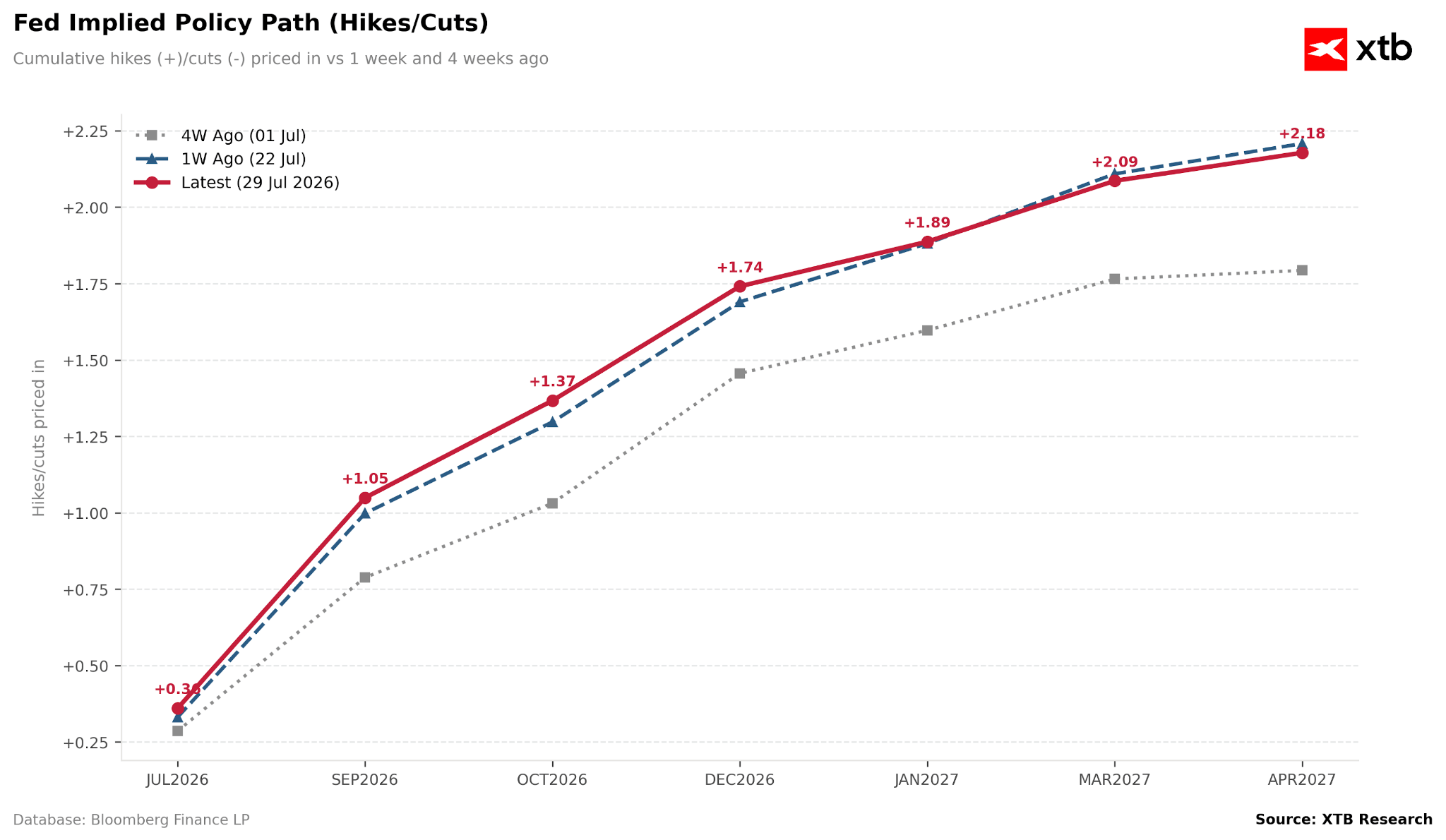
Source: XTB Research, 29 July 2026 Chart 3: Market pricing of interest rate rises following the FOMC decision (2026–2027)
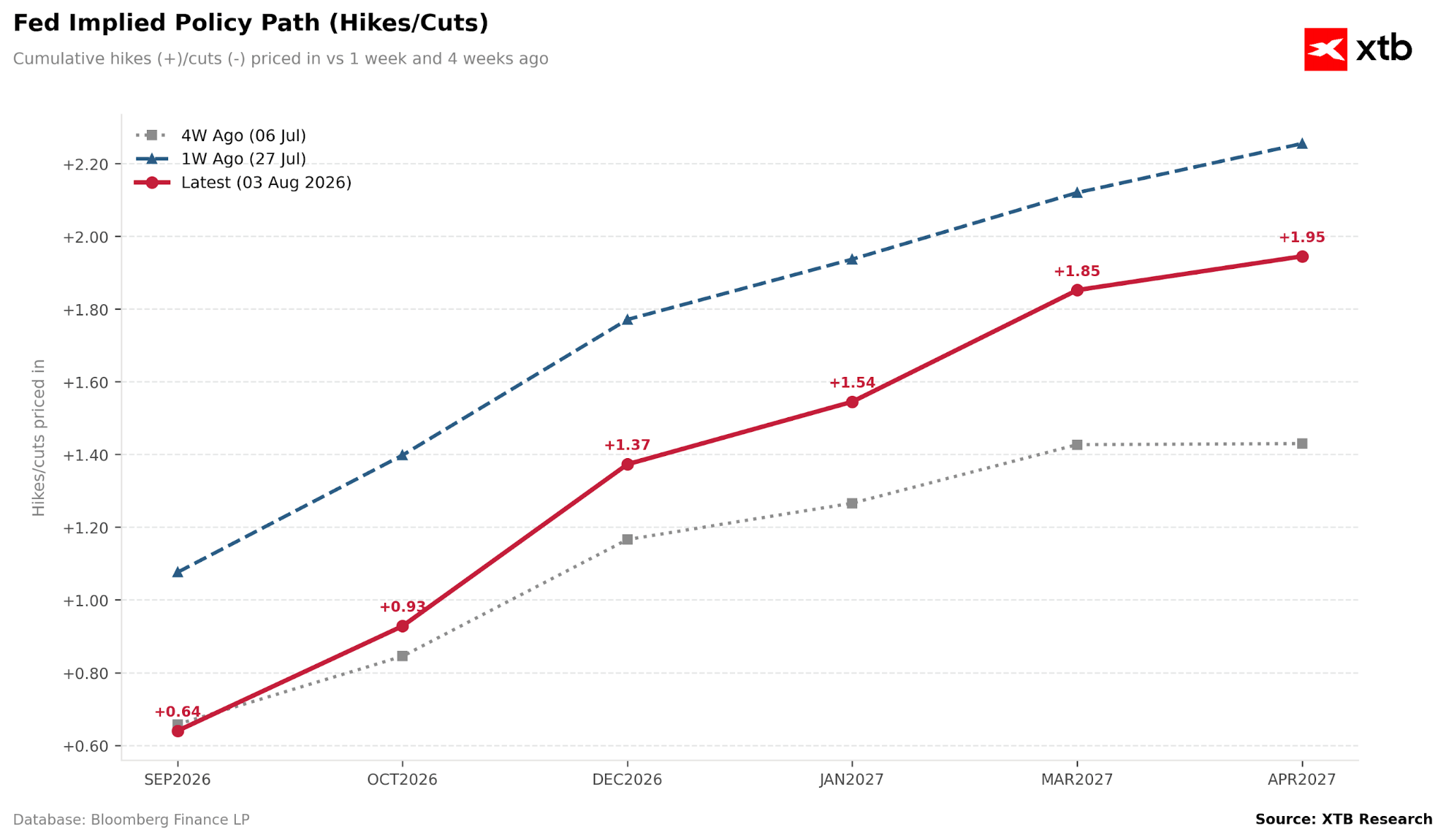
Source: XTB Research, 3 August 2026 It is worth recalling that almost exactly a year ago, he openly sided with the president, stating on FOX News that Donald Trump’s frustration with Powell’s conduct of monetary policy was entirely justified, and criticising the institution for being too slow to cut interest rates and for placing too much emphasis on historical economic data.
Euro (EUR)
In the eurozone, attention last week was focused not on monetary policy but on macroeconomic data. There are increasing signs that, following the pause in July, the time has come for a rate rise. The probability of a rate rise in September is estimated at almost 90 per cent. In recent days, both GDP growth (up 0.4 per cent quarter-on-quarter, compared with expectations of 0.2 per cent) and core inflation (2.5 per cent, consensus 2.4 per cent) have come in higher than expected. Both figures are consistent with further monetary tightening.
G10
Chart 4: Exchange rates of selected currencies [vs. USD]
Source: Bloomberg, 3 August 2026
Japanese yen (JPY)
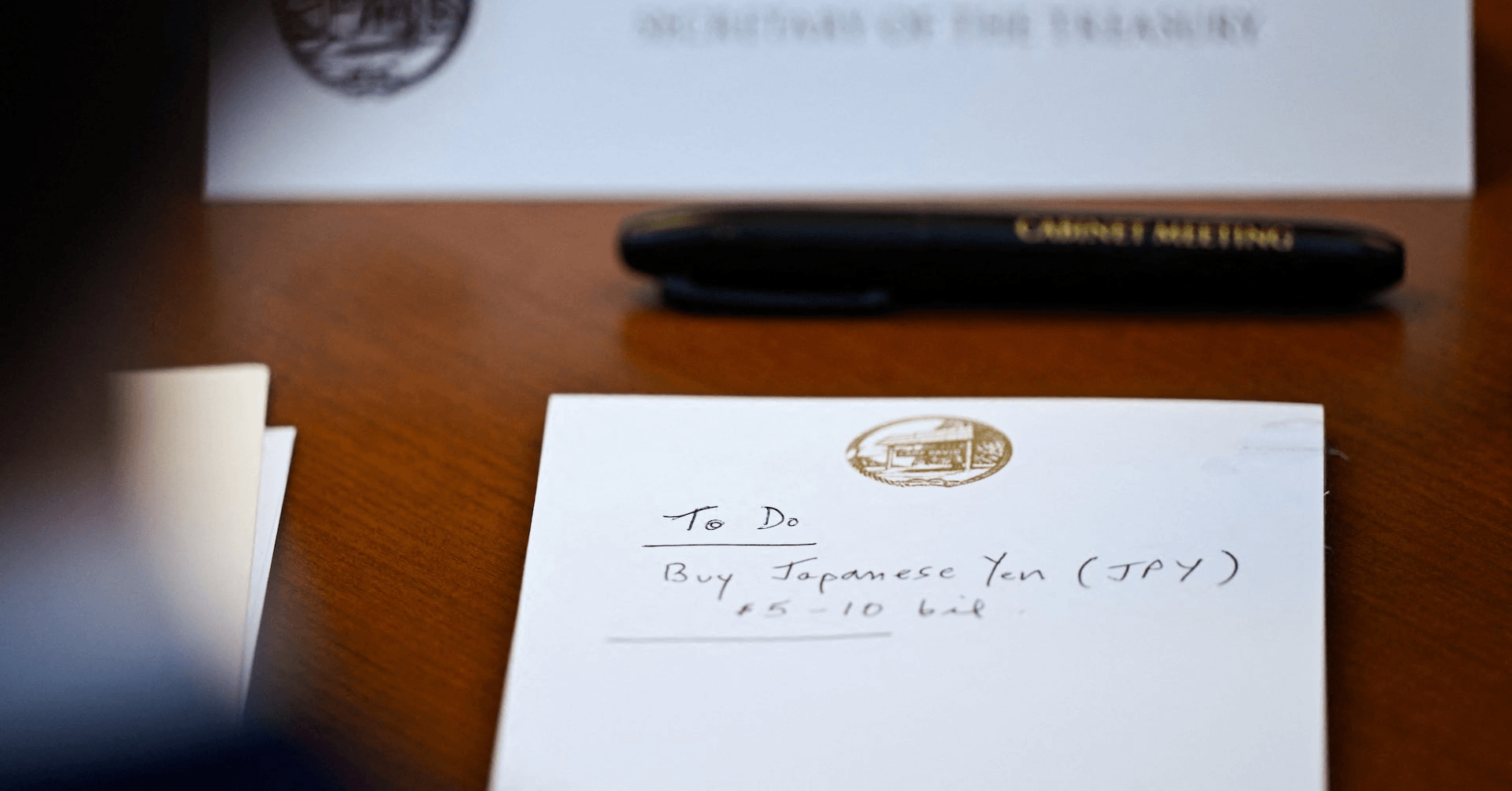
After reaching its highest level since 1986 (163.99), the USDJPY pair experienced a very sharp fall. This move was driven by the first coordinated intervention by the US and Japan since 2011. At that time, the yen had weakened following a massive earthquake. As emphasised by the US Treasury Secretary, Scott Bessent, and the Japanese Finance Minister, Satsuki Katayama, both sides remain ready to take further measures to stabilise the exchange rate. According to data provided by the Bank of Japan, the scale of the Japanese intervention may have reached as much as 59 billion dollars, which would be an unprecedented move (in terms of the scale of a single-day intervention). Although we cannot estimate the scale of US operations using official data, there are strong indications that it amounted to between 5 and 10 billion dollars. This is at least what is suggested by a note left by Scott Bessent during a meeting in Maryland.
Source: Reuters President Trump confirmed the US intervention at the weekend: “Japan has been very good to us, except, of course, for the attack on Pearl Harbour. (…) Their yen is weakening and they needed a bit of help. And we are always ready to help Japan.” Today, Minister Katayama published an official letter confirming the intervention.