





The euro is trading near 1.1380 against the US dollar, remaining below the 1.1400 level as a more hawkish Federal Reserve outlook and continued Middle East tensions support demand for the dollar.
The latest move leaves EUR/USD close to levels where the decline could become technically stretched, while the monetary-policy outlook remains the dominant fundamental driver. Markets are increasingly pricing the possibility of another Federal Reserve rate increase in October, while expectations for further European Central Bank tightening remain considerably less certain.
With German inflation and retail-sales data due later in the week, incoming European data could become increasingly important for determining whether the euro can stabilise or whether the dollar retains control.
Market Snapshot
| Factor | Current Position |
|---|---|
| EUR/USD | Around 1.1380 |
| Key Psychological Level | 1.1400 |
| Immediate Support | 1.1355 / 1.1325 |
| Technical Support | Around 1.1340 |
| Initial Resistance | 1.1430 |
| Major Resistance | 1.1525–1.1530 |
| Upper Resistance | Around 1.1708 |
| EUR/USD RSI | Near 27 |
| Fed October Hike Pricing | Approximately 65.9% |
| ECB October Hike Pricing | Approximately 45% |
Current EUR/USD Price Action
EUR/USD has fallen below 1.1400 and is trading around 1.1380, extending a decline that has already taken the pair to approximately 1.1358.
The move has exceeded some previous expectations for the extent of the euro’s decline, but the technical picture now suggests that the sell-off is becoming stretched. The RSI near 27 places the pair in oversold territory, increasing the potential for a corrective rebound even while the broader near-term trend remains under pressure.
The key question is whether EUR/USD can reclaim 1.1400 and stabilise, or whether sellers push the pair through the next major support levels.
Federal Reserve Rate Expectations
The US dollar continues to benefit from increasingly hawkish Federal Reserve expectations.
Recent comments from Fed officials have emphasised persistent inflation risks and the strength of the US economy. Cleveland Fed President Beth Hammack warned that prolonged inflation could cause elevated prices to become increasingly accepted, while Philadelphia Fed President Anna Paulson indicated that some further tightening may be warranted.
Markets are currently pricing approximately a 65.9% probability of another Fed rate increase in October, up from 57.6% a week earlier and 9.4% a month earlier.
This shift in expectations has strengthened the interest-rate support for the dollar.
ECB Policy Outlook
The European Central Bank raised its deposit rate by 25 basis points to 2.50% at its September meeting.
However, expectations for another increase remain less established. Markets are pricing roughly a 45% probability of a further 25-basis-point ECB hike in October, leaving incoming European economic data with considerable potential to shift expectations.
This creates an important policy divergence for EUR/USD. If US rate expectations continue rising while expectations for additional ECB tightening remain limited, the relative yield advantage could continue favouring the dollar.
Middle East Risk and Safe-Haven Demand
Ongoing Middle East tensions are providing another source of support for the US dollar.
The unresolved situation surrounding Iran and the Strait of Hormuz continues to create uncertainty across energy and financial markets. Persistent geopolitical risk can encourage demand for traditional safe-haven assets, including the US dollar.
At the same time, higher oil prices can increase inflation concerns and potentially reinforce expectations for tighter US monetary policy, creating another channel through which Middle East developments can influence EUR/USD.
German Data Could Test the Euro
The next major European catalysts include German retail sales and consumer-price inflation data.
Stronger-than-expected German economic data could support expectations for further ECB tightening and provide the euro with an opportunity to stabilise.
Conversely, softer inflation or weaker consumer activity could reduce the probability of additional ECB action and leave the policy differential tilted further toward the dollar.
Technical Outlook: EUR/USD Remains Under Pressure
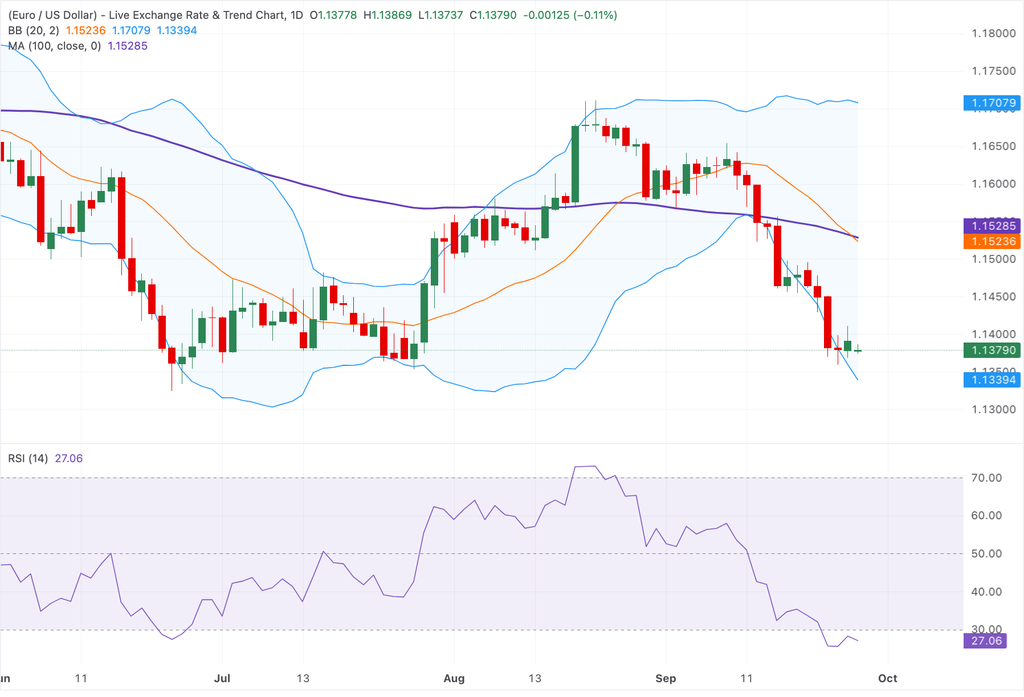
EUR/USD remains below both the 100-day simple moving average and the Bollinger Bands’ middle line, maintaining a negative technical structure.
The RSI near 27 indicates that downside momentum has become stretched and raises the possibility of a short-term corrective rebound.
On the downside, support is concentrated around 1.1355 and 1.1325, while the lower Bollinger Band is around 1.1340.
A move back above 1.1430 would provide an early indication that the immediate decline is beginning to stabilise. More substantial resistance is located around 1.1525–1.1530, followed by the upper Bollinger Band near 1.1708.
Bullish Sentiment
- Oversold conditions: An RSI near 27 indicates that the recent EUR/USD decline is becoming technically stretched.
- Strong support zone: The 1.1355–1.1325 region could provide an important area for buyers to defend.
- ECB tightening remains possible: Markets still price a meaningful probability of another 25-basis-point ECB increase in October.
- European data upside: Stronger German inflation or economic activity could increase expectations for further ECB tightening and support the euro.
Bearish Sentiment
- Hawkish Fed expectations: Markets are pricing approximately a 65.9% probability of another October Fed rate increase.
- US-European rate divergence: A widening policy differential could continue to favour dollar-denominated assets.
- Safe-haven dollar demand: Continued Middle East uncertainty could encourage investors to favour the US dollar.
- Negative technical structure: EUR/USD remains below the 100-day SMA and Bollinger middle band, keeping downside momentum intact.
Price Forecast: What Traders Are Watching
The immediate focus is whether EUR/USD can hold the 1.1355–1.1325 support area after falling below 1.1400.
A break below this zone would leave the pair vulnerable to further downside, while a recovery through 1.1430 would provide an early signal that selling pressure is beginning to moderate.
The broader direction will depend heavily on the policy differential between the Federal Reserve and ECB. Stronger US data or further hawkish Fed communication could reinforce dollar demand, while stronger German inflation and activity data could increase expectations for additional ECB tightening.
The oversold technical position also means that a short-term rebound cannot be ruled out even if the broader fundamental pressure remains negative.
Supply Outlook
For EUR/USD, supply is primarily reflected through currency positioning and the availability of euros relative to dollars in global markets.
The recent decline indicates stronger demand for dollars relative to euros, while the increasingly stretched technical position could encourage some short-covering if the pair stabilises around its current support levels.
Demand Outlook
Demand for the euro will depend heavily on European economic data and expectations for ECB policy.
Dollar demand remains supported by higher US rate expectations and geopolitical uncertainty. A continuation of this combination could keep EUR/USD under pressure, while a reduction in Fed tightening expectations could shift relative demand back toward the euro.
Market Outlook for the Coming Sessions
EUR/USD enters the coming sessions around 1.1380, below the psychologically important 1.1400 level and close to major technical support.
The fundamental picture remains centred on the widening contrast between hawkish Fed expectations and more uncertain ECB tightening expectations. Meanwhile, Middle East tensions continue to provide support for the dollar through safe-haven flows and inflation concerns.
The next important signals will come from German inflation and retail-sales data, US economic releases and further Federal Reserve communication.
For traders, the 1.1355–1.1325 support zone and 1.1430 resistance level provide important near-term reference points for determining whether the current decline is extending or beginning to stabilise.
Currency Hedger View
EUR/USD demonstrates why currency exposure cannot be viewed simply as an exchange-rate number.
Interest-rate expectations, inflation, central-bank policy, energy prices and geopolitical developments can all change the value of the euro against the dollar and directly affect international payments, business costs and investment returns.
For companies with euro or dollar exposure, understanding these relationships can be just as important as executing the currency transaction itself.
Currency Hedger combines international currency exchange, global payments and currency-market intelligence, helping businesses and individuals understand the factors influencing their currency exposure.
Analysis Louis Roche – Today Markets
Louis Roche – Today Markets