





The suspension of mutual attacks by the US and Iran is causing energy commodity prices to fall Natural gas prices in Europe (the Dutch TTF benchmark) recorded a sharp decline on Monday. The nearest expiring contract lost as much as 8.5%, dropping for a moment below 58 EUR/MWh. Last week, the price closed several times above 60 EUR/MWh. Although daily highs in March were higher, at the end of last week we saw the highest close since 2023.
Is market optimism justified?
In the short term, the price drop brings relief, but long-term market fundamentals require great caution:
- Temporary de-escalation: The suspension of fighting gave the market a breather and reduced concerns about an immediate interruption of supplies from the Persian Gulf.
- Direction of US LNG: Price differences make shipping LNG from the US to Europe currently more profitable than to Asia, which may support supplies to the Old Continent.
- Prices still at a high level: Despite Monday’s drop, gas in Europe is still more than 80% more expensive than before the outbreak of the conflict in February and 100% higher compared to the beginning of the year.
- Low storage levels: European gas storage levels are currently at just ~55%, compared to a 5-year average of ~71%.
- Drop in LNG imports: The 30-day average volume of LNG imports to Europe is as much as 23% lower than the 5-year average.
- Supplier caution: QatarEnergy is offering to sub-charter its vessels until the end of October, which suggests there is no rush to restore full traffic in the Persian Gulf.
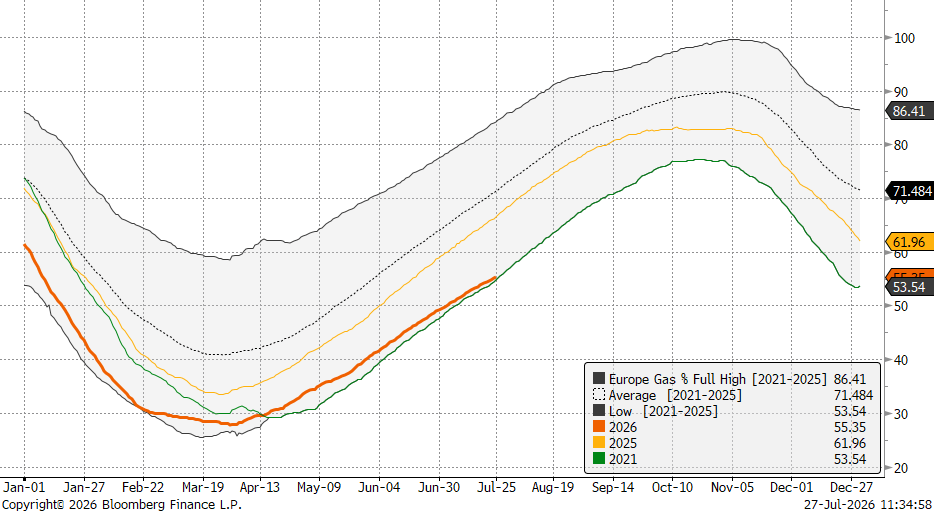
Storage filling in Europe is 55%, very similar to 2021, when prices in September reached 100 EUR/MWh. Source: Bloomberg Finance LP
Is there a risk of a return to 100 EUR/MWh?
The risk of another sharp price increase (including testing higher price levels) remains very high. Storage filling is not accelerating, and the prospects for additional imports remain limited.
- Fragility of the ceasefire: The current decline is due to the suspension of attacks, not a lasting peace agreement. As Citigroup analysts point out, the market is extremely sensitive and individual headlines can immediately reverse the trend.
- Race against time before winter: The slow pace of filling storage (55%) combined with logistical difficulties creates a risk that Europe will not manage to rebuild stocks before the heating season.
- Higher summer consumption and competition with Asia: Heat waves in Europe and Asia increase demand for energy (air conditioning), which intensifies competition for available LNG cargoes on the spot market.
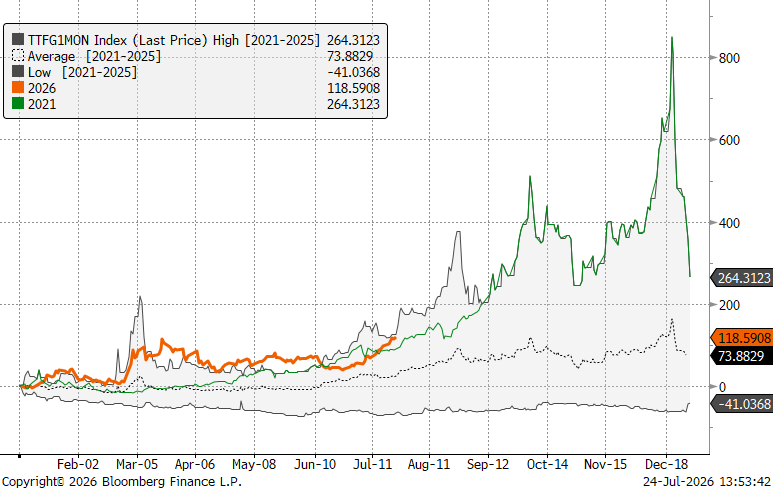
Current gas price behavior is very similar to what happened in 2021, when they reached 100 EUR/MWh in September. Source: Bloomberg Finance LP
Gas prices are key to the European economy
Although gas consumption increases extremely during the winter season and the raw material is used to the greatest extent for heating then, a large part of European industry is based on gas. This causes a significant increase in costs and a limitation of competitiveness (in the field of petrochemistry or also metal refining). Consequently, the terms of trade for the euro are almost 100% correlated with the gas price, which leads to large changes in EURUSD.
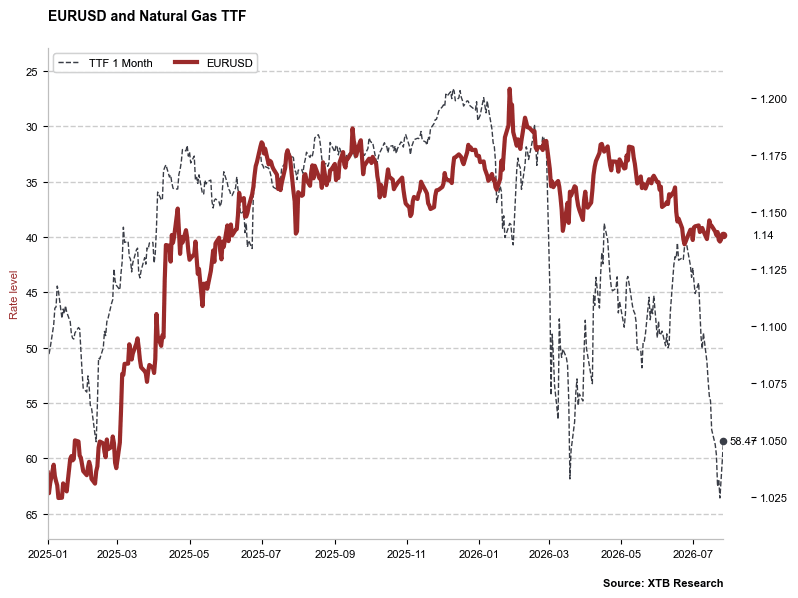
TTF and EURUSD since 2025. It is worth noting that such levels in 2025 gave us EURUSD very close to parity. Source: Bloomberg Finance LP, XTB
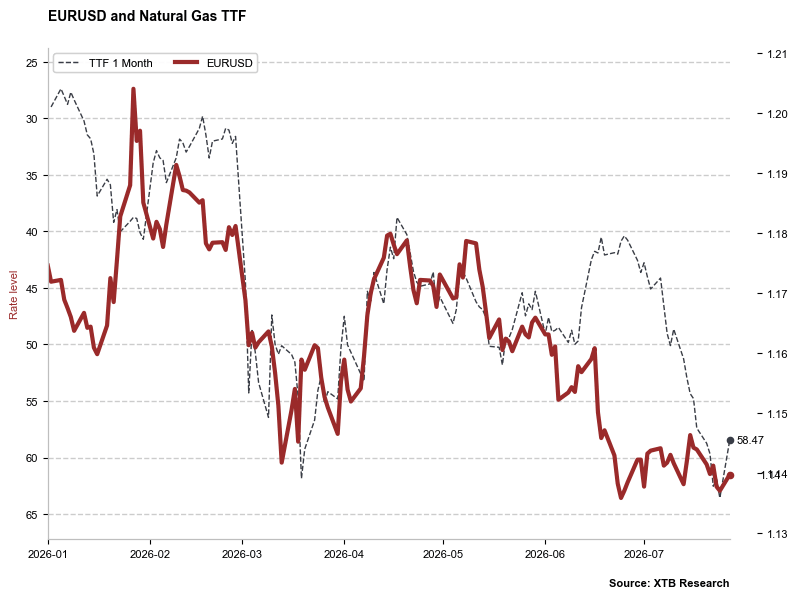
In the shorter term, a significant correlation can be seen. If gas were to fall to around 40 EUR/MWh, it would give a chance for EURUSD to be around 1.18. Source: xStation5
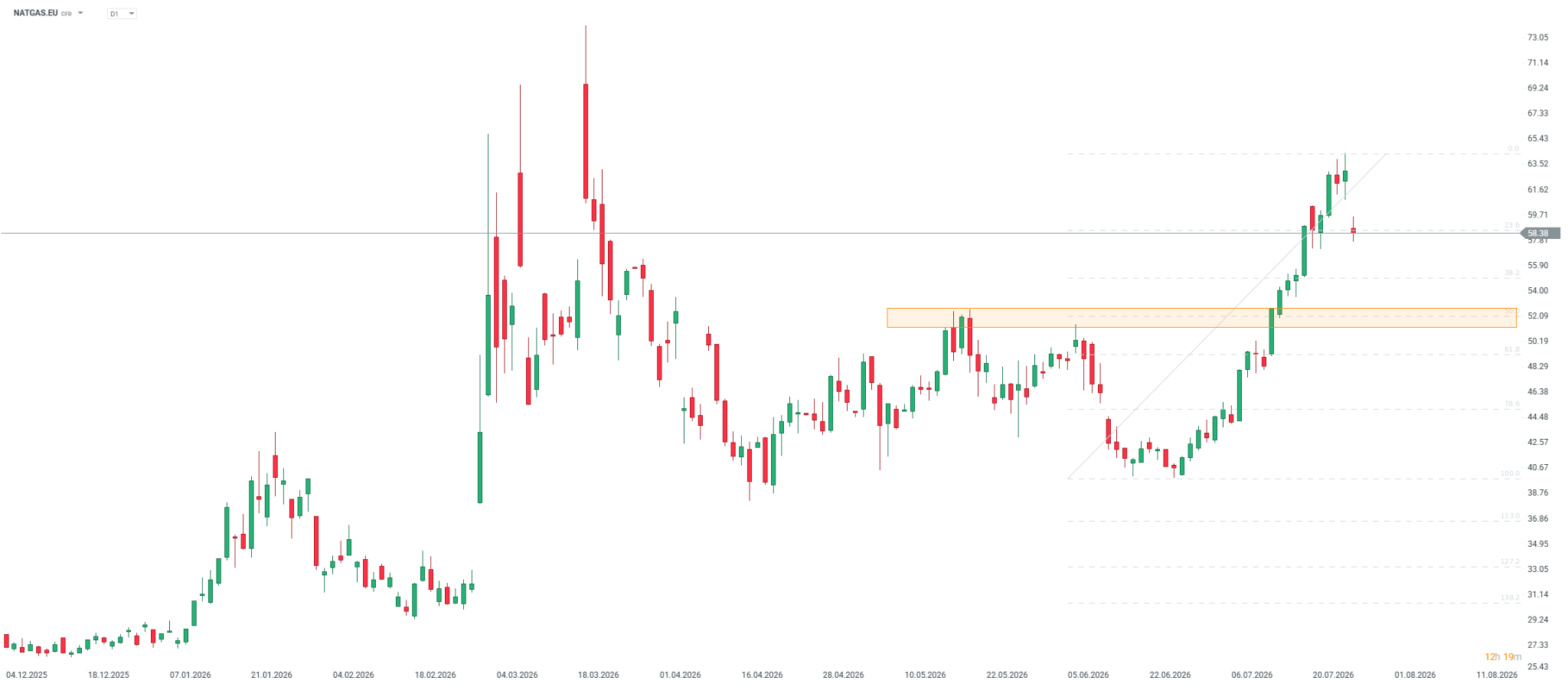
TTF is undergoing a correction today, stopping near the 23.6 retracement. Key support is at 52 EUR/MWh. Source: xStation5