




Key takeaways
- Carrefour’s stock fell by about 6 percent to 14 EUR after the company lowered its financial forecasts.
- Riots and curfews in France forced the chain to close several dozen stores and limited sales.
- Management estimates that the unrest will reduce operating profit by between 80 and 200 million euros.
Carrefour’s stock is experiencing one of the worst trading sessions in its history today. Shares of the French retail giant are falling by as much as about 6 percent, to around 14 euros, marking one of the sharpest declines since the outbreak of the pandemic in 2020 (it’s worth noting that a similar scale of decline was already seen yesterday). The company has cut its full-year earnings forecast, directly citing the weekend’s riots, looting, and curfews, which have paralyzed store operations in France.
This is a significant moment, as Carrefour is the first major retailer to dare to publicly quantify the cost of the unrest in France. Management estimates that the riots will reduce operating profit by between 80 and as much as 200 million euros. About 50 of the chain’s nearly 6,000 stores were looted and vandalized, but many more had to remain closed, resulting in fewer customers, reduced operating hours due to curfews, and rising security and logistics costs. New forecasts clearly illustrate the scale of the problem in numbers. Instead of the previously projected 25-basis-point increase in operating margin, the company now expects an improvement ranging from zero to just 15 basis points.
Adjusted earnings per share are expected to remain stable or increase only slightly, whereas just recently Carrefour was targeting growth in the high single-digit percentage range. Free cash flow, instead of rising slightly, is now expected to decline slightly. CEO Alexandre Bompard speaks openly about an unprecedented situation and enormous uncertainty regarding how consumers will behave and under what conditions stores will be able to operate at all, especially as we enter the pre-holiday period—a critical time for retail—and demand was already under pressure from rising energy costs. Importantly, Carrefour’s business was performing decently heading into the weekend. Like-store sales in the third quarter rose 2.3 percent, slightly above market expectations, with France contributing 1.2 percent and Spain and Brazil contributing 2.1 and 1.4 percent, respectively. In other words, it wasn’t the fundamentals of the business that collapsed, but rather an external shock that changed the outlook for the entire year overnight.
THIRD-QUARTER RESULTS
- LFL sales, excluding fuel and calendar effects: +2.3%; forecast: +2.06%
- France: LFL sales, excluding fuel and calendar effects, +1.2%; forecast: +1.01%
- LFL sales at hypermarkets in France, excluding fuel and calendar effects: +0.6%; forecast: +0.93%
- LFL sales at supermarkets in France, excluding fuel and calendar effects: +1.2%; forecast: +0.93%
- LFL sales at convenience stores and other formats in France, excluding fuel and calendar effects: +2.8%; forecast: +2.3%
- Belgium: LFL sales, excluding fuel and calendar effects, +2.3%; forecast +1.33%
- Spain: LFL sales, excluding fuel and calendar effects, +2.1%; forecast +1.95%
- Sales including VAT: 22.69 billion euros; forecast: 22.58 billion euros
- Sales in France (including VAT): 11.90 billion euros; forecast: 11.78 billion euros
The analysts’ reaction was just as sharp as the price drop itself and clearly reflects the scale of the surprise. Morgan Stanley downgraded its rating to neutral, arguing that the downward revision of the French forecast due to social unrest would have a lasting impact on investor confidence, and that overcoming this caution would require better visibility into French operating profit as well as a more stable picture of EPS and cash flows.
The target price there fell from 20.10 to 18.35 euros. At Jefferies, where the neutral stance was maintained, analysts note that the unexpected forecast revision lowers operating profit estimates by 6.5 percent, and EPS by nearly 6 percent, and it is explicitly acknowledged that the scale of the ultimate impact is exceptionally difficult to estimate at this time, especially given concerns over weaker September sales in France and pressure on Brazilian consumers. Barclays, while remaining positive on the company, is under no illusions and points out that Carrefour is one of the retailers most vulnerable to the unrest in France due to its extensive network and strong presence in city centers, while cutting this year’s EPS forecast by 11 percent and lowering its price target to 17 euros.
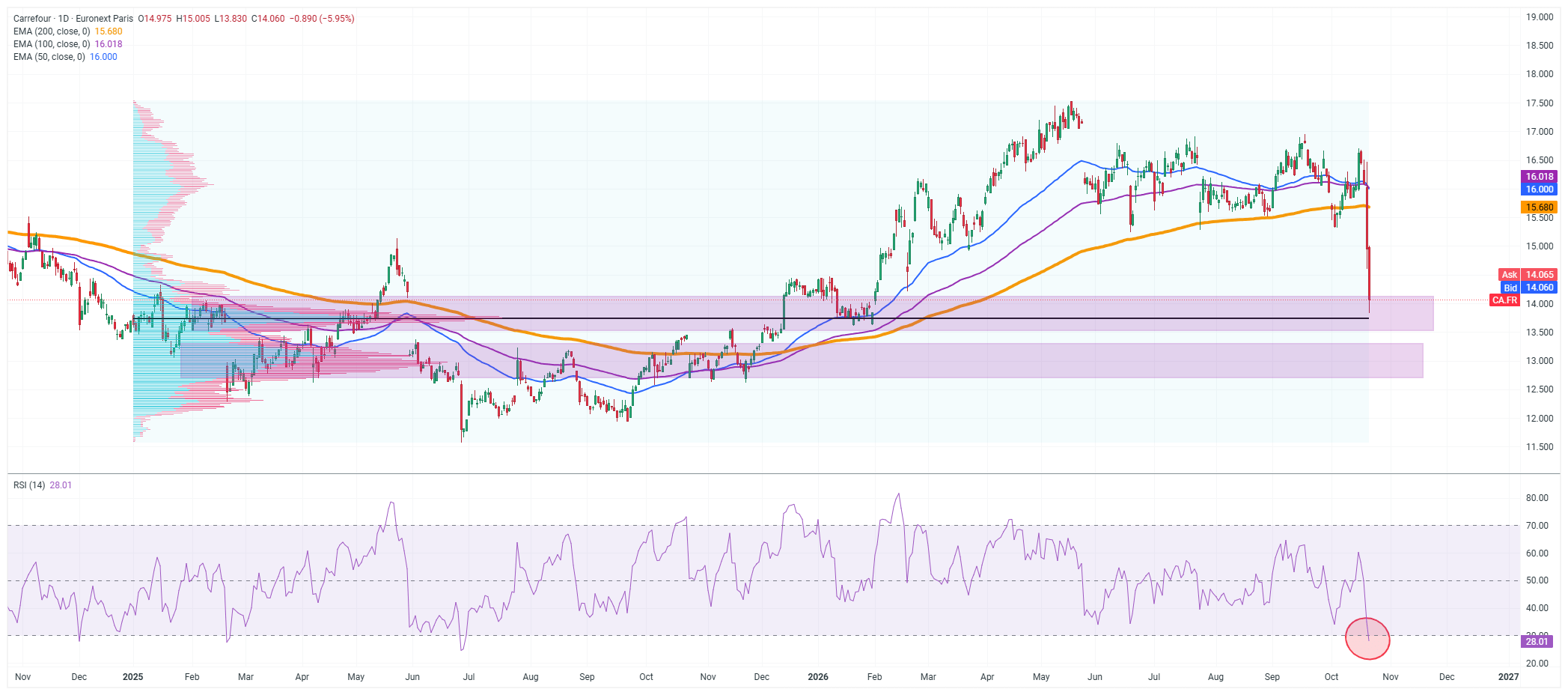
Technically speaking, today’s session was a real disaster for the chart. A price gap on massive volume sent the price below 15 euros and, in a single move, broke through all key moving averages—the 50-, 100-, and 200-session averages—at once. What was still solid, multi-month support just yesterday has now turned into resistance hanging over buyers’ heads. The RSI plummeted to around 28—the oversold zone—which highlights the sharpness of the move, but this alone is not yet a signal for a rebound until the price stabilizes above the 14-euro level it has just regained. Looking at the bigger picture, the Carrefour case is the first concrete evidence that the unrest in France is no longer just a public relations issue but is beginning to have a real negative impact on companies’ earnings.
Other stocks with exposure to the French retail sector have also come under pressure, and the real test will be the earnings reports results of the luxury groups Hermès and Kering, to be released later this week. One key question remains, one that the entire market is asking itself today: will the unrest prove to be a brief, concentrated episode, or will it drag on for weeks to come? With further protests scheduled for October 24, a swift return to normalcy is by no means guaranteed, and it is precisely the duration of the chaos that will determine how deep the final dent in French retail results will ultimately be.