






Facts
- As of 11:20 a.m. on September 23, GOLD is down 0.94%, retreating to around $4,320 per ounce.
- The rebound in gold prices following the Federal Reserve’s September 15 decision has been largely erased.
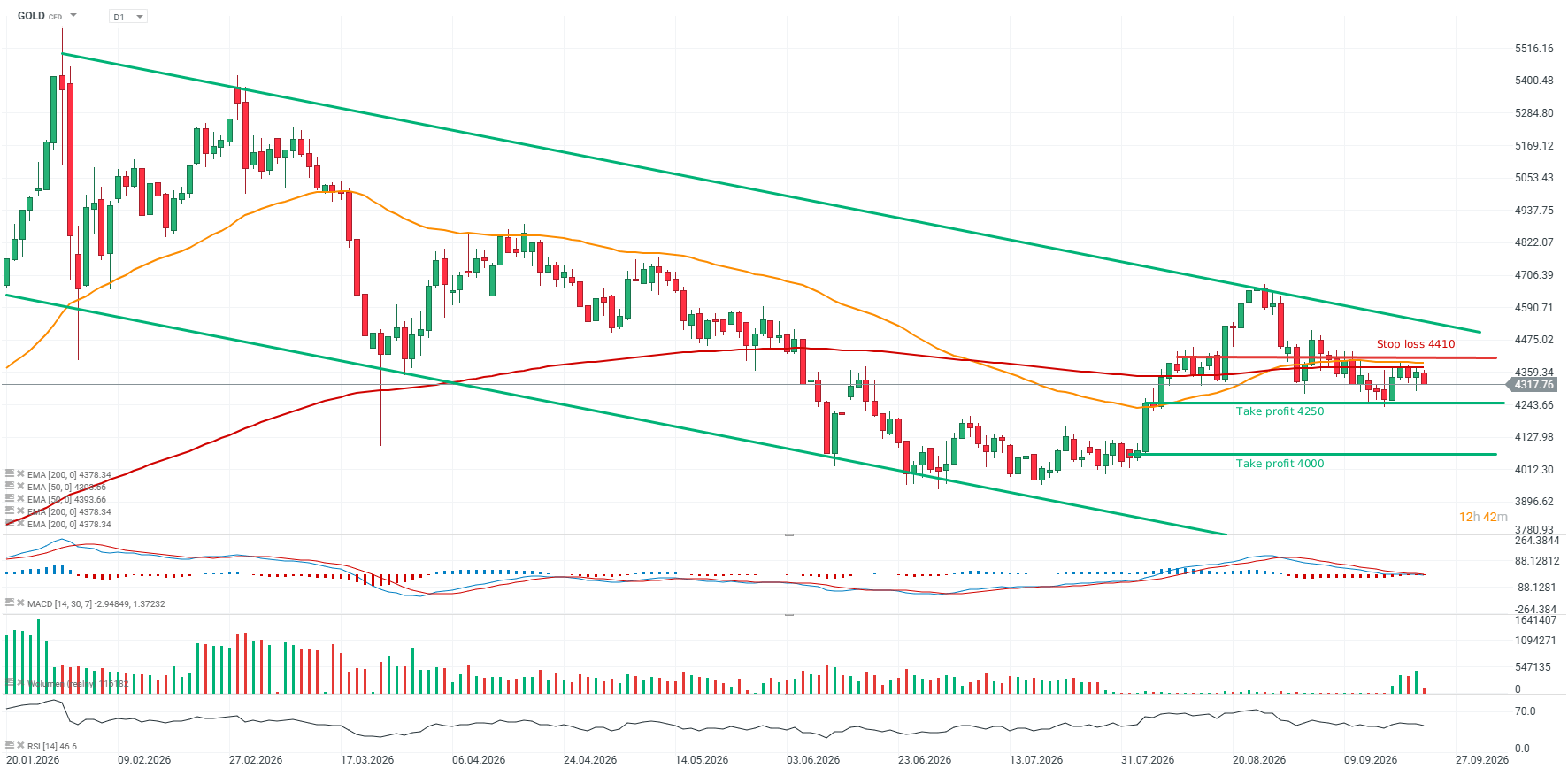
- Gold is trading below its 200-day exponential moving average (EMA200) and failed to break above this level on September 18 and 19.
- As many as 16 of 18 Fed policymakers expected at least one more rate hike in 2026 as of September.
Recommendation Short position on GOLD at the current market price.
- Take profit: 4,250; 4,000
- Stop loss: 4,410
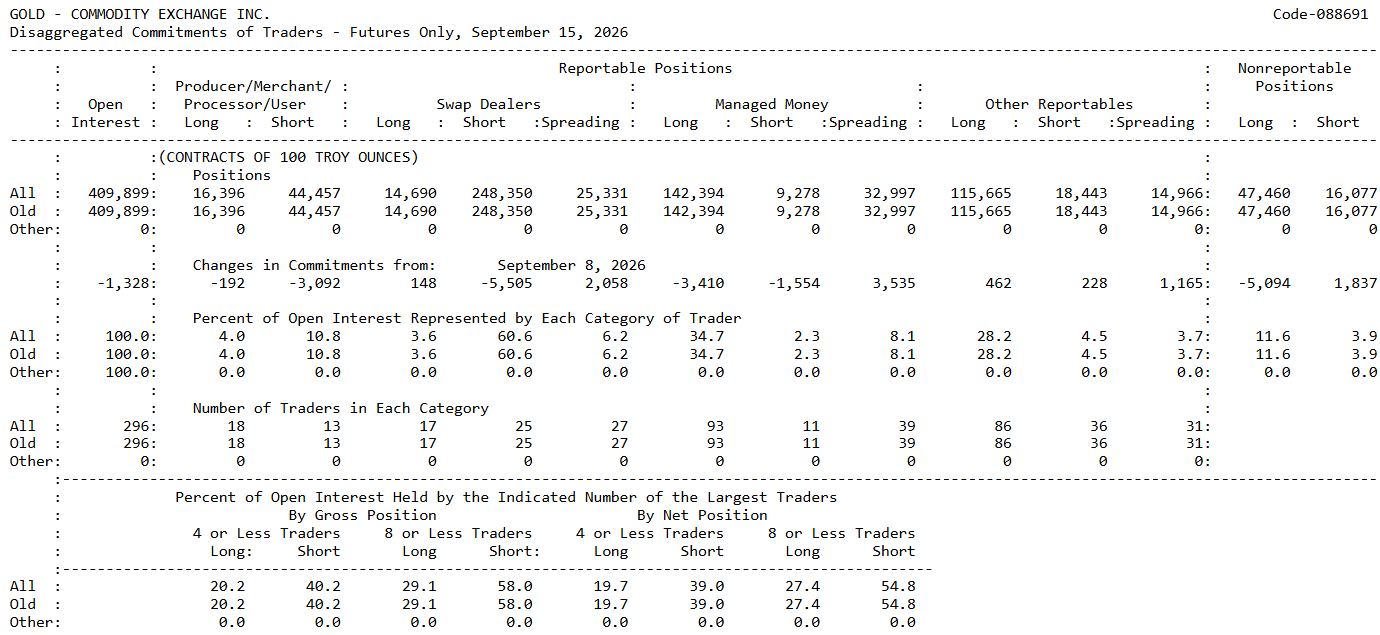
Opinion Gold is facing a growing problem: a stronger U.S. dollar and a lack of fresh upside catalysts. No new source of momentum emerged despite the pullback in oil markets, pushing the price down toward $4,320 per ounce and erasing a significant portion of the gains recorded in late summer, when the metal briefly traded above $4,600. The market is increasingly facing an unfavorable short-term environment for gold, while CFTC data show that bullish positioning ahead of the Fed decision had become extremely crowded among large speculators, potentially suggesting that some of them are now gradually exiting the market. According to the latest CoT report, large speculators (Managed Money) held 142,394 long contracts compared with just 9,278 shorts, resulting in a net position of +133,116 contracts. This points to a very strong speculative bias toward higher prices: Managed Money longs accounted for as much as 34.7% of total open interest, while shorts represented just 2.3%. Such positioning reflected strong confidence among funds in the bullish trend, but at the same time meant that the market had only a limited pool of speculative shorts that could be forced into further short covering.
- In the final week before the Fed decision, based on data as of September 15, Managed Money reduced long positions by 3,410 contracts while also closing 1,554 shorts. As a result, the net long position declined by only 1,856 contracts, from +134,972 to +133,116. This does not yet look like a sharp shift in fund sentiment. Instead, it resembles a moderate reduction in exposure and leverage following a very strong move in gold rather than an attempt to build a clearly bearish position.
- The decline in total open interest by 1,328 contracts is also important. Combined with the reduction in Managed Money longs, it suggests that some capital was leaving the market rather than large new short positions being established. As long as funds are primarily reducing longs rather than aggressively adding shorts, the CoT report points to weakening speculative momentum rather than an outright reversal. Such a reversal may, however, become more visible in subsequent data.
The most interesting signal in the report emerges when Managed Money positioning is compared with that of physical-market participants, known as commercials. The data show that Producer/Merchant and Swap Dealers remain heavily net short, but both groups clearly reduced that exposure during the first half of September.
- Producer/Merchant improved their net position from approximately -30,961 to -28,061 contracts, a change of 2,900 contracts. An even larger adjustment was recorded by Swap Dealers, whose net short position declined from around -239,313 to -233,660 contracts, an improvement of 5,653 contracts. Combined, these two commercial groups reduced their directional net short exposure by approximately 8,553 contracts over the week. This was substantially larger than the 1,856-contract decline in the Managed Money net long position.
- This should not automatically be interpreted as a signal that “commercials are buying gold.” Producers primarily use futures to hedge future production, while Swap Dealers often take the other side of client exposure and manage risk across multiple markets. A decline in their short positions therefore primarily indicates a reduced need for hedging or a reduction in existing exposure. For CoT analysis, the direction and pace of changes in these positions are therefore more important than the simple fact that commercials remain net short.
- The current setup resembles a partial market “reset”: Managed Money is taking some profits and reducing longs, while commercials are using the same phase to cover part of their short exposure. This is qualitatively different from a classic late-stage bull market, in which funds aggressively add longs while commercials respond by building even larger short positions. Here, both sides are reducing exposure, which, together with the decline in open interest, points more toward deleveraging than the establishment of a new directional trade.
The key interpretation is therefore that gold still shows very strong positioning among large speculators, although that positioning has started to lose momentum. At the same time, commercials are not using elevated speculative long exposure as an opportunity to build additional shorts. Instead, they are covering part of their existing short positions. From a CoT perspective, this is not yet a classic topping structure, but neither is it a “clean” continuation signal. Even before the Fed decision, the gold market appeared to be entering an initial phase of positioning normalization, and the Federal Reserve’s hawkish tone has intensified that process. With both technical and fundamental conditions deteriorating, including a more restrictive stance from the Fed and other central banks, we recommend a short position on GOLD with two take-profit levels at 4,250 and 4,000 and a stop-loss order at 4,410, set slightly above the EMA200 but near levels that could prove to be an important resistance area from a price-action perspective.
GOLD chart (D1 timeframe)
From a technical perspective, the situation in gold has also deteriorated noticeably. The metal failed to remain above its 200-day EMA (red line) for an extended period and continues to trade in the upper range of the downward price channel that formed around the turn of January and February 2026.
Source: xStation5
Source: CFTC Commitments of Traders