






The OECD estimates that the global economy is performing somewhat better in 2026 than expected just a few months ago, despite the energy shock triggered by the war with Iran. Support has come not only from investment related to artificial intelligence, but also from the release of part of global oil reserves, lower energy imports by China and a shift by some consumers toward alternative fuels, including coal. As a result, the impact of constrained supply from the Persian Gulf region has so far been smaller than economists initially feared. However, the organization stresses that the outlook for the global economy remains heavily dependent on whether a durable resolution to the conflict in the Middle East can be achieved.
New OECD forecasts
The OECD raised its forecast for global economic growth in 2026 to 2.9% from 2.8%, and for 2027 to 3.0% from 2.9%.
- U.S. economic growth is expected to reach 2.2% in 2026, up from 2.0% previously, and 2.1% in 2027, compared with an earlier forecast of 1.8%.
- China’s 2026 growth forecast was left unchanged at 4.5%, while the 2027 forecast was lowered to 4.2% from 4.3%.
- The OECD raised its forecast for Japan’s 2026 growth to 0.8% from 0.6%, while for 2027 it expects growth of 0.7%, down from the previous 0.8%.
- Eurozone GDP growth in 2026 was revised up to 1.0% from 0.8% in June, while the 2027 forecast remains at 1.0%, down from the previous 1.2%.
AI helps sustain growth as the world absorbs the energy shock better than expected
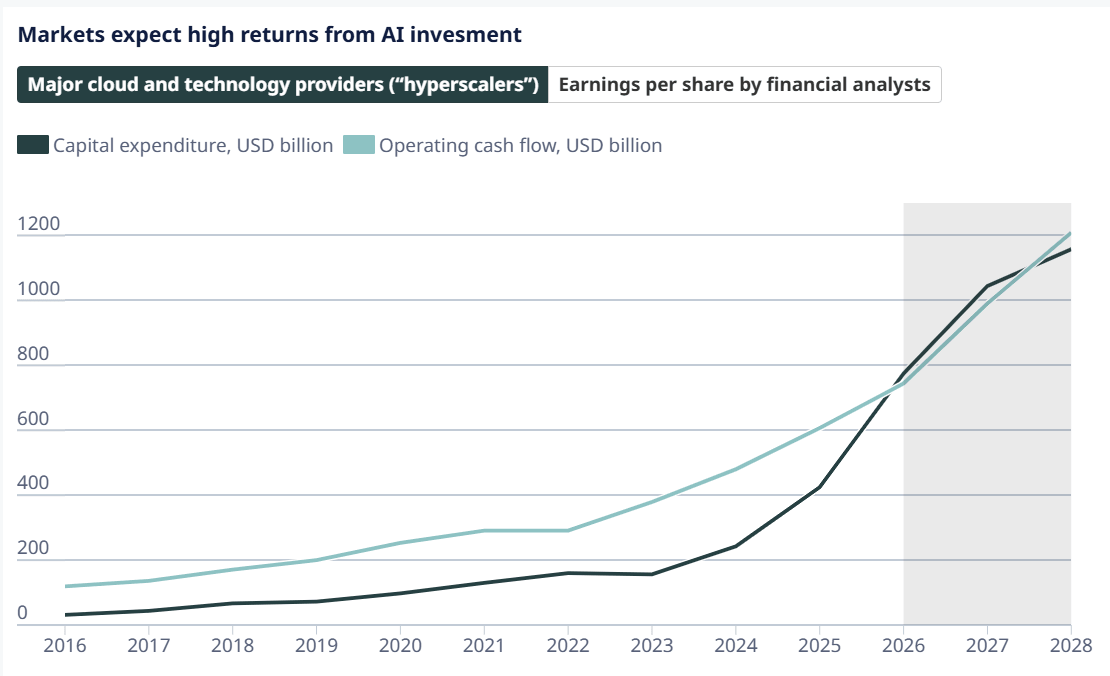
The most important positive factor remains the investment boom surrounding artificial intelligence . The OECD points out that spending on data centers, semiconductors and broader AI infrastructure has become one of the key pillars of economic resilience in 2026. The effect is particularly visible in the United States, while strong demand for technology is also supporting exports from Japan and South Korea. At the same time, the global economy has so far coped better than expected with energy supply constraints related to the war with Iran. The release of part of global oil reserves, a significant decline in Chinese energy imports and increased use of alternative fuels, including coal, have all helped. These mechanisms have softened the direct impact of reduced oil supply from the Persian Gulf region. This does not mean that the risks have disappeared. The OECD warns that renewed or more persistent disruptions to energy supplies would mean both higher inflation and weaker growth. In practice, the future direction of the global economy therefore remains heavily dependent on the durability of any potential agreement in the Middle East. As shown in the chart below, CAPEX among companies investing in AI continues to rise sharply, although the pace of growth is beginning to slow somewhat, while operating cash flows continue to expand at an almost exponential rate.
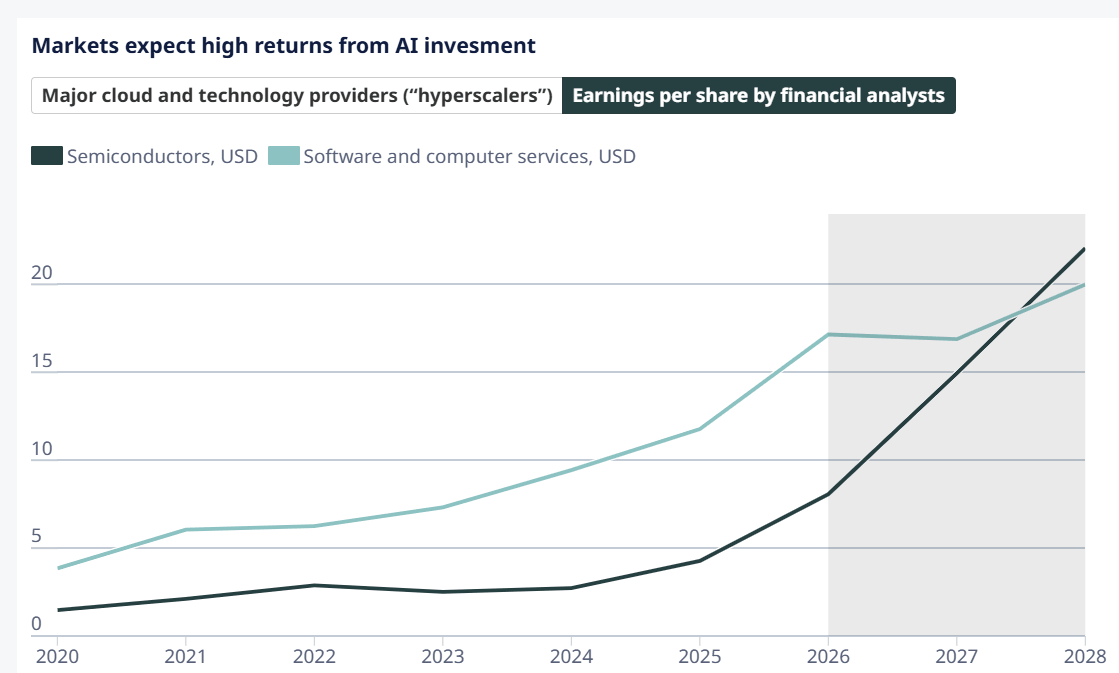
Source: OECD The semiconductor business has become clearly more profitable relative to software, which historically has not been the norm.
Source: XTB Research
Inflation remains higher, leaving central banks with less room for maneuver
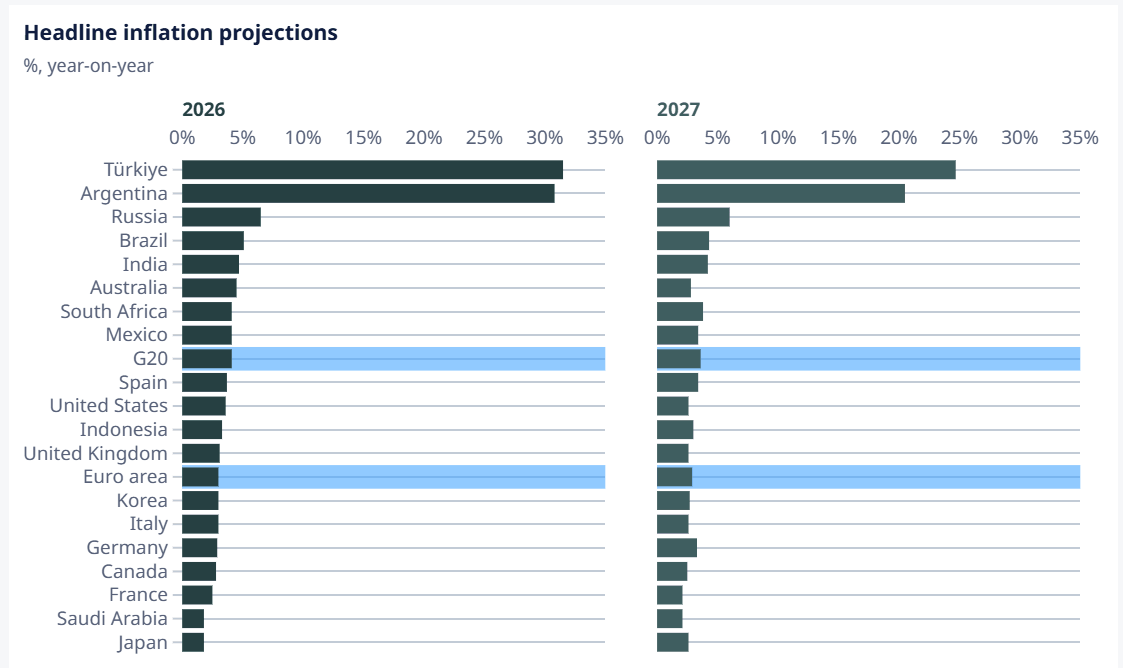
The OECD raised its inflation forecast for G20 economies. In 2026, prices are expected to rise by an average of 4.1%, compared with 4.0% projected in June, while in 2027 inflation is forecast at 3.6%, up from the previous 3.1%. This is an important change because it points to a slower disinflation process. If pressure from higher energy prices begins to spread more broadly into services, wages and core inflation, central banks may be forced to keep interest rates higher for longer. From a market perspective, this also complicates the outlook for bonds. Rising yields increase financing costs for both companies and governments, while high levels of public debt mean that a growing share of budgets must be allocated to debt servicing.
Source: OECD
OECD warns of a build-up of risks in 2027
The list of risks remains broad. In addition to further tensions in energy markets, the OECD points to an exceptionally strong El Niño, which could reduce agricultural output and push food prices higher. Other risks include a further rise in bond yields and the possibility that returns on the enormous investments currently being made in the AI sector may disappoint. If these factors were to occur simultaneously, the OECD estimates that global growth in 2027 could be as much as 0.7 percentage points lower, while inflation could be around 1.1 percentage points higher. The risks related to AI are particularly important because technology investment is currently one of the factors supporting global activity. If markets were to begin questioning future returns from spending on data centers and semiconductors, the potential impact would not be limited to technology-sector valuations alone.
U.S. benefits from the AI boom, but households face growing pressure
The OECD raised its U.S. growth forecast to 2.2% in 2026 and 2.1% in 2027. In both cases, the forecasts are higher than in June, primarily due to strong investment related to artificial intelligence. At the same time, conditions for the U.S. consumer are becoming less comfortable. The OECD points to declining purchasing power, slower growth in labor supply and the gradual depletion of household savings. Additional pressure comes from tariffs and higher energy prices, which are increasing both living costs and business expenses. U.S. inflation is expected to reach 3.6% in 2026 before falling to 2.6% in 2027. This means the Fed may continue to face an economy that is growing relatively quickly while remaining exposed to persistent price pressures.
China is slowing, but lower energy imports are helping the global market
The OECD kept its China growth forecast at 4.5% for 2026 and 4.2% for 2027. The economy is still expected to slow gradually, partly due to measures by Beijing aimed at reducing excess capacity in parts of the industrial sector. At the same time, the clear decline in Chinese energy imports was one of the factors limiting the global impact of the oil shock. Weaker demand from the world’s largest commodity importer has partly reduced price pressure at a time of constrained supply from the Middle East.
The eurozone remains one of the weakest links
Eurozone GDP growth is expected to reach 1.0% in both 2026 and 2027. The main constraints remain high energy prices and restrictive financial conditions. Rising defense spending may provide some support, although the OECD does not expect it to be sufficient to generate a meaningful acceleration across the broader economy. Eurozone inflation is expected to reach 3.0% in 2026 and 2.9% in 2027. The gas market remains a particular risk, as European storage facilities enter the heating season with inventories at their lowest level in 15 years.
The UK is performing better, while the inflation forecast falls sharply
The OECD raised its forecast for UK growth in 2026 to 1.1%, from 0.9% expected in June. Growth is expected to be supported, among other factors, by consumption and new fiscal measures aimed at households. At the same time, the inflation forecast for this year was lowered to 3.1% from 3.7%, as prices rose more slowly than previously expected. In 2027, however, growth is expected to slow to around 1.0%, compared with 1.1% forecast previously. The UK also remains vulnerable to rising bond yields, as higher financing costs add pressure to public finances.
Japan grows more slowly, but inflation may accelerate
Japan is expected to grow by 0.8% in 2026 and 0.7% in 2027. Strong business investment is being offset by higher interest rates and more expensive energy imports. Unlike most major economies, however, the OECD expects inflation in Japan to accelerate. It is projected to rise from 1.8% in 2026 to 2.6% in 2027, partly due to a tight labor market and strong wage growth.
Canada takes a clear hit from new U.S. tariffs
Canada’s growth forecast was cut to 0.9% in 2026 from 1.2% previously. For 2027, the OECD expects growth of 1.3%, compared with 1.7% projected in June. The main problem is new U.S. tariffs on Canadian exports, which are worsening the outlook for trade and investment. As a result, Canada remains one of the economies most directly exposed to changing trade conditions in North America.
Rising debt is becoming another risk for the economy
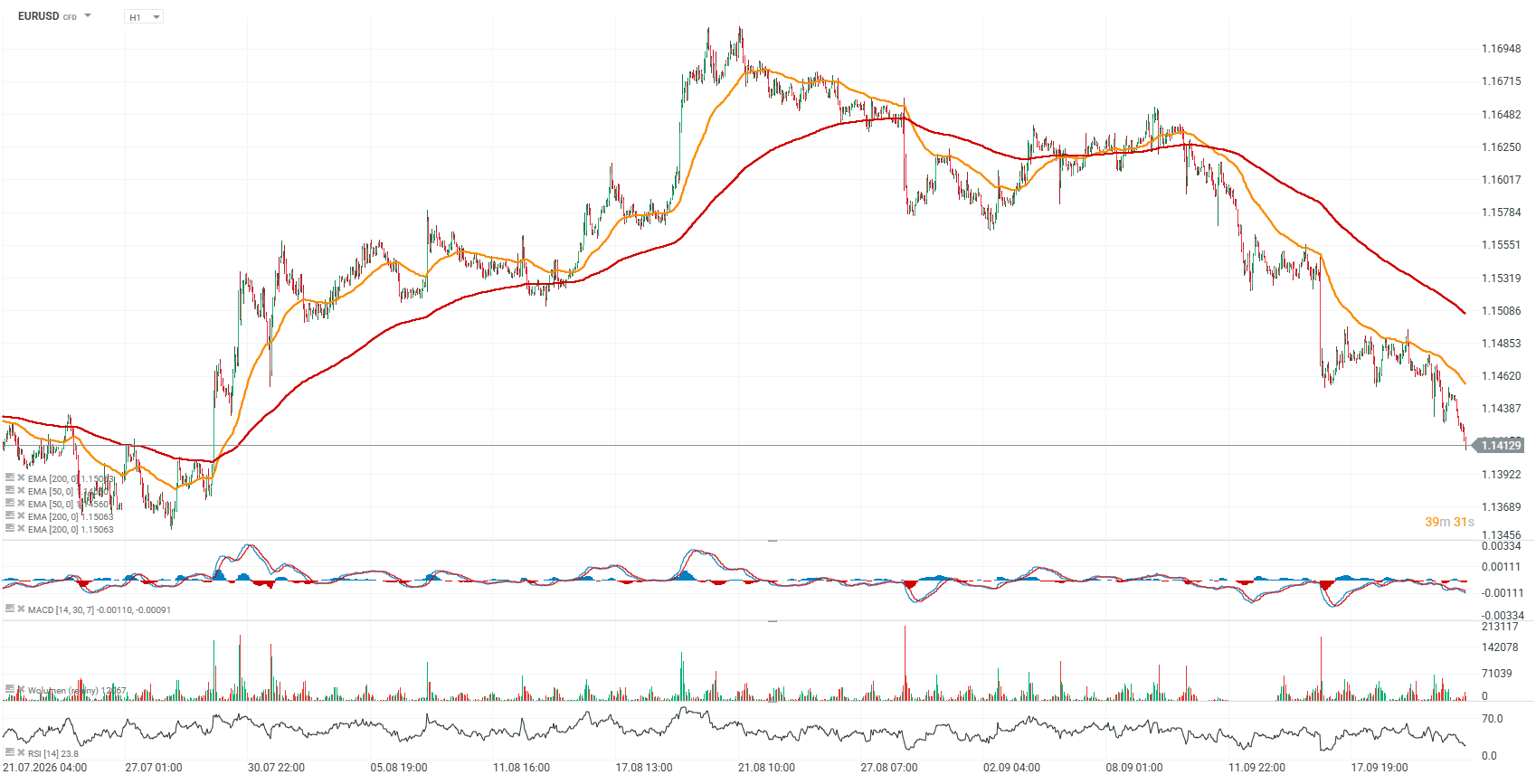
Another risk highlighted by the OECD is the growing pressure associated with public debt. High bond yields mean that advanced economies must finance their needs at significantly higher costs than just a few years ago. The IMF warns that successive economic shocks are systematically pushing debt levels higher, while governments are adjusting fiscal policy too slowly to rising debt-servicing costs. Combined with high spending on defense, the energy transition and AI infrastructure, this may further limit fiscal space in the years ahead. The overall picture presented by the OECD is therefore fairly unusual: the global economy is proving more resilient than feared after the outbreak of the war with Iran, but that resilience currently rests on strong technology investment and mechanisms that are partially cushioning the energy shock. The longer high energy prices and bond yields persist, however, the more difficult it may become to maintain this balance in 2027. The euro is weakening against the U.S. dollar despite very solid PMI readings from the European economy.
EURUSD chart (H1 timeframe)
Source: xStation5