




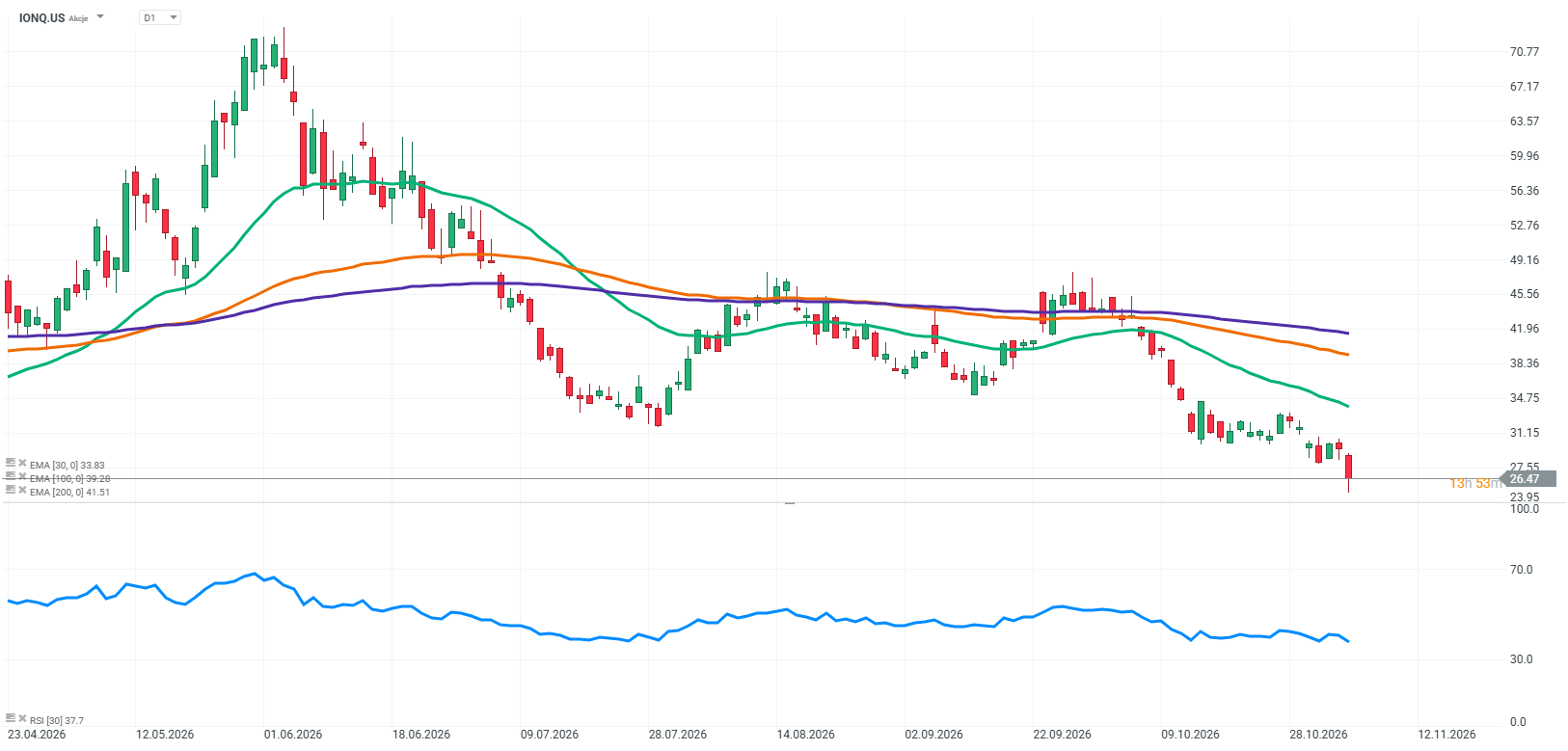
IonQ is beginning to turn quantum computing development into an increasingly substantial business. The company has raised its 2026 revenue guidance to $505–515 million, while all available capacity for its latest Superion 256 system in 2027 has already been contracted. This suggests customers are no longer simply exploring quantum technology. They are increasingly willing to pay for access to specific systems and reserve computing capacity well in advance.
IonQ previously expected revenue of $450–460 million. In the third quarter alone, the company generated $173.8 million in revenue, up 336% year over year. It was the sixth consecutive quarter in which IonQ reported record revenue. However, the impressive growth also reflects the acquisition of SkyWater, making it important to examine the two businesses separately. IonQ Platform, which includes the company’s quantum computing solutions, generated $90.3 million in revenue, representing 127% growth year over year. The remaining $83.5 million came from SkyWater Foundry Services, its semiconductor manufacturing and related services business. SkyWater significantly expands the scale of the overall group, but IonQ Platform’s performance offers a clearer picture of progress in commercializing quantum technology. Much of the attention is now focused on the Superion 256 system.
The company announced that all available capacity for 2027 has already been sold out, with orders for 2028 also beginning to fill up. In practical terms, IonQ has increasingly limited capacity available for customers interested in its latest technology. Its next challenge is to turn this contracted demand into timely system deployments and additional revenue. The company is also expanding its relationship with Nvidia. Superion 256 is expected to become the first quantum computer installed at Nvidia’s Accelerated Quantum Research Center, where it will be connected to the company’s supercomputing infrastructure. The two technologies are designed to complement each other: conventional processors and accelerators will handle most computing workloads, while quantum systems could support them in selected, more demanding tasks. Beyond quantum computers, IonQ is developing quantum networking, sensing and cybersecurity solutions. It is also pursuing government contracts.
The company has advanced to the next stage of the Quantum Benchmarking Initiative run by the US Defense Advanced Research Projects Agency (DARPA), a program with a potential value of up to $300 million. Rising revenue does not mean IonQ is close to profitability. Adjusted EBITDA loss reached $133.6 million in the third quarter. The reported net income of $564 million was largely driven by a non-cash gain from the revaluation of warrants rather than an improvement in underlying operating performance. The company does, however, have substantial resources to fund further expansion. Following a $2 billion share offering in October, IonQ had approximately $3.7 billion in cash, cash equivalents and investments.
This gives it considerable flexibility to finance research and increase production capacity, although the share offering also diluted existing shareholders. IonQ is still operating in a young market where quantum computing applications are only beginning to move beyond research and experimentation. Nevertheless, the company is already generating growing revenue from its own platform, securing customers for future systems and selling out Superion 256 capacity for 2027. The next test will be delivering on those orders while improving profitability. Demand is becoming less of an unknown for IonQ. The company now needs to prove that it can turn that demand into a profitable business.
Source: XTB Reserach