









Black Friday 2026 could deliver another record-breaking shopping season, although investors will be watching profit margins and consumer resilience more closely than headline sales figures. E-commerce continues to expand faster than traditional brick-and-mortar retail, while households in both the United States and Poland have remained relatively resilient despite elevated interest rates. Amid the ongoing sell-off in technology stocks, retailers could attract investors seeking exposure to businesses less directly tied to the global technology investment cycle. Consumer-focused companies offer an alternative source of growth, driven primarily by household spending decisions rather than capital expenditure on artificial intelligence and technology infrastructure. The National Retail Federation expects US holiday sales to exceed $1 trillion for the first time, while Adobe Analytics forecasts a record $275 billion in online spending. Polish e-commerce is also expected to deliver record sales during the holiday shopping season. Companies potentially benefiting from Black Friday include Amazon, Shopify, TJX Companies and Poland’s Allegro.
Key Takeaways
- The National Retail Federation (NRF) forecasts US retail sales growth of 4.2% YoY in November and December, reaching $1.013 trillion , compared with $972 billion a year earlier. The forecast excludes automobiles, gasoline and restaurants.
- Adobe Analytics expects US holiday online sales to increase by 6.7% YoY to $275.1 billion. Black Friday (November 27) is projected to generate $12.9 billion (+9.2% YoY), while Cyber Monday (November 30) could deliver $15.1 billion (+6.2% YoY).
- The Mastercard Economics Institute forecasts US holiday retail sales growth of 5.5% YoY , including an 11% increase in online sales and 3.6% growth in physical stores. However, inflation is expected to account for 2.8 percentage points of the overall increase. The estimates cover November 1 through December 24, excluding automobiles and gasoline.
- Salesforce projects $357 billion in global online sales during Cyber Week (+6% YoY). As much as $75.8 billion could come from transactions influenced by AI-powered tools. The forecast covers the seven-day period from November 24 to November 30.
- Mastercard expects holiday retail sales to increase by 3.4% YoY across nine European markets. Polish e-commerce sales are forecast to rise by 10.9%, compared with 4% growth in total retail sales. These are nominal figures covering November 1 through December 26.
- Allegro shares have gained approximately 112% since the beginning of 2026, compared with a rise of just under 29% in the WIG20 index. Allegro has therefore outperformed its benchmark by more than 83 percentage points, delivering nearly four times the return of Poland’s blue-chip index.
- US retail stocks have gained approximately 3.5% year-to-date in 2026, as measured by the SPDR S&P Retail ETF, compared with a 5.7% increase in the S&P 500. The retail sector has therefore underperformed the broader market by 2.22 percentage points despite forecasts of record holiday spending.
Black Friday 2026: Consumers Will Spend More, but Will They Buy More?
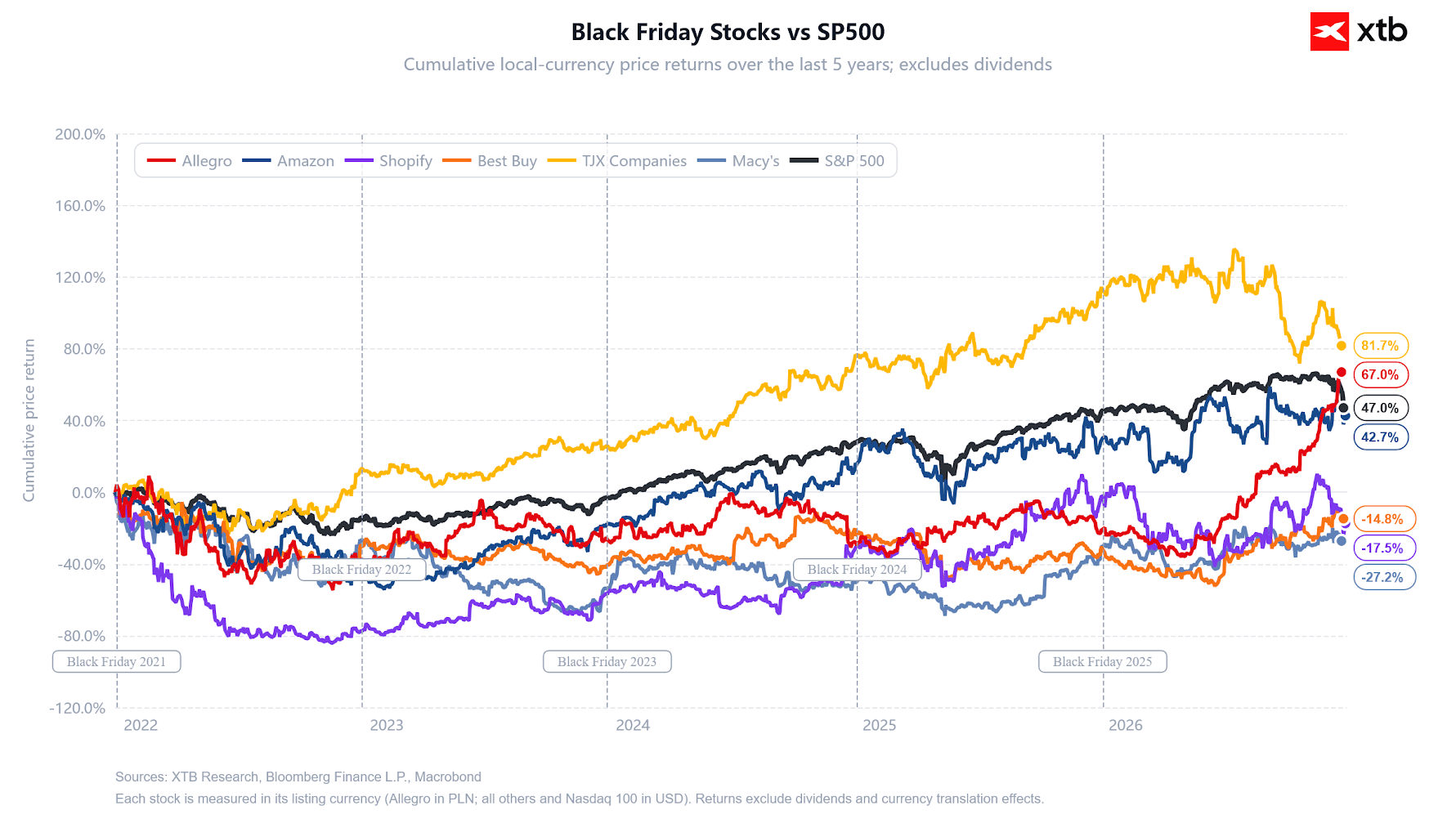
Record sales forecasts may suggest exceptional strength among American consumers, but Mastercard estimates that inflation will account for 2.8 percentage points of the projected 5.5% increase in holiday spending. Nearly half of the additional spending will therefore reflect higher prices rather than greater purchasing volumes. This distinction matters to investors because nominal revenue growth can conceal stagnation in the number of products sold. The nature of the holiday shopping season is also changing. Consumers increasingly spread their purchases over several weeks, compare prices and take advantage of promotions to buy everyday essentials. Adobe expects Cyber Week discounts to reach 30% on electronics, 29% on toys and approximately 23% on clothing and computers. However, intense price competition could put pressure on retailers’ profitability. Record sales do not guarantee record profits. A retailer could increase revenue by 10% while generating lower EBIT if the additional orders require deeper discounts, more expensive advertising and higher logistics expenses. Gross margins, inventory turnover and free cash flow will therefore be particularly important indicators during this year’s holiday shopping season. The chart below compares the returns of selected retail stocks with the S&P 500 since Black Friday in November 2021. Ultimately, only Allegro, with a 67% return, and TJX Companies, with an 81% return, managed to outperform the S&P 500’s 47% gain over the period.
Source: XTB Research
Black Friday and the Stock Market: Can Retailers Outperform the S&P 500 Again?
Historical data covering 2015–2025 indicate that selected retail stocks tended to outperform the S&P 500 ahead of Black Friday. Over the 30 trading sessions preceding the event, the analyzed basket gained approximately 14% on average, compared with 5% for the broader market. After another 30 sessions, retailers’ cumulative return had declined to 11.6%, while the S&P 500 had gained 5.7%. This suggests that investors were already pricing in a successful holiday shopping season before the biggest promotions began.
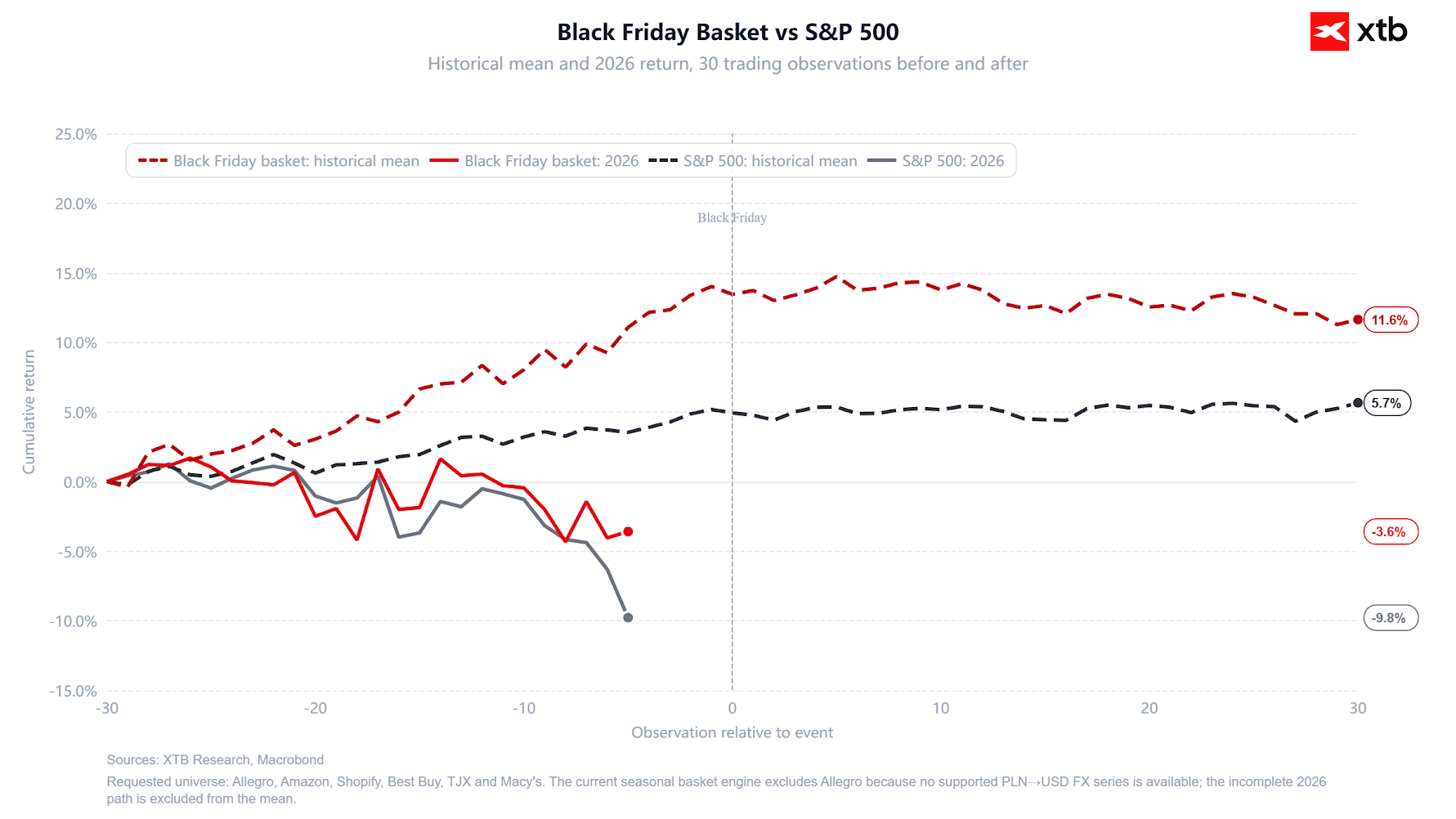
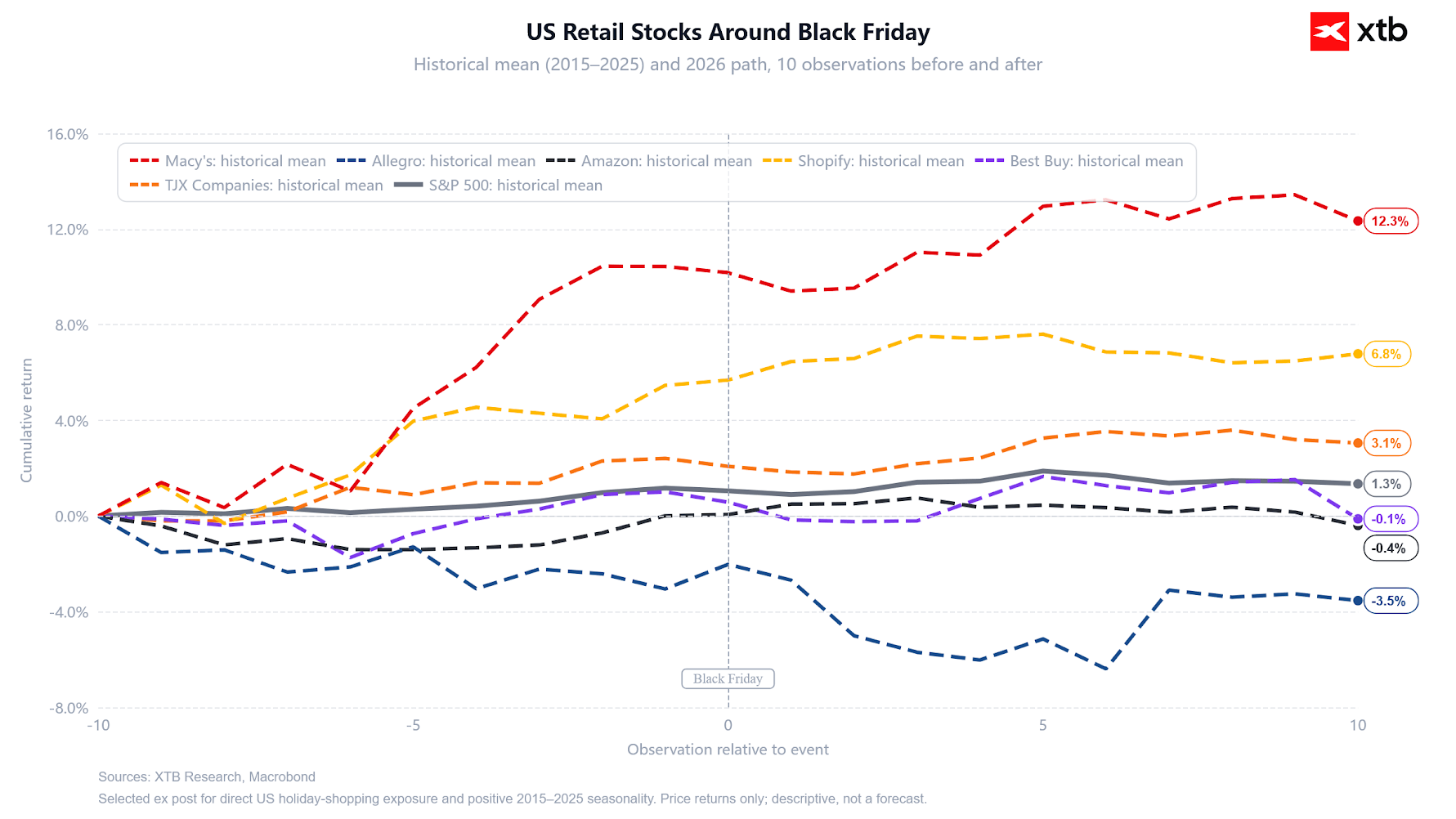
Source: XTB Research Macy’s exhibited the strongest historical seasonality, gaining an average of 12.3% over the period spanning 10 observations before and 10 after Black Friday, compared with 1.3% for the S&P 500. Shopify returned 6.8%, while TJX Companies gained 3.1%. Best Buy (-0.1%), Amazon (-0.4%) and Allegro (-3.5%) performed less favorably. These differences demonstrate that exposure to holiday consumption does not automatically translate into above-average stock market returns. This year’s market environment differs considerably from the historical pattern. Approximately five trading sessions before Black Friday, the basket of US retailers was down 3.6% from its level 30 sessions earlier, compared with a 9.8% decline in the S&P 500. Despite outperforming the broader market by 6.2 percentage points, retailers remain under pressure. The key question is whether record sales forecasts will translate into higher profit margins and upward earnings revisions, as revenue growth alone is insufficient to justify higher valuations.
Source: XTB Research
Amazon and Shopify: Who Benefits Most From Holiday Shopping?
Amazon (AMZN.US) remains one of the leading beneficiaries of global e-commerce growth, although its competitive advantage extends far beyond the scale of its retail operations. The company combines first-party retail, a third-party marketplace, logistics infrastructure and one of the world’s largest advertising platforms. Every additional dollar spent by consumers can therefore contribute to several revenue streams simultaneously. Advertising is particularly attractive. During Black Friday, third-party sellers compete more aggressively for product visibility, increasing demand for paid promotional placements. Amazon consequently generates revenue not only from consumer purchases but also from competition among merchants. However, higher order volumes increase delivery costs, seasonal employment expenses and promotional spending. The company’s first-party retail operations also remain considerably less profitable than Amazon Web Services (AWS). Shopify (SHOP.US) provides more direct exposure to growth in online transactions. In the third quarter of 2026, gross merchandise volume (GMV) reached $119.1 billion, compared with $92 billion a year earlier. Revenue increased by 32% YoY to $3.74 billion, while free cash flow reached $816 million, representing an FCF margin of 22%. Importantly, Shopify does not need to finance its merchants’ inventories, making its business model significantly less capital-intensive than traditional retail. Higher order volumes support revenue from payments, merchant services and technology infrastructure. Shopify can therefore benefit from the success of thousands of independent online stores without assuming most of the risk associated with unsold merchandise. Nevertheless, the company remains sensitive to the financial health of smaller businesses and customer acquisition costs. Shopify expects fourth-quarter revenue growth of slightly more than 30% YoY, making Black Friday an important test of whether it can sustain strong growth as its business continues to scale.
Black Friday 2026: Which Stocks Could Surprise Wall Street?
The five companies analyzed offer different types of exposure to the holiday shopping season. Amazon and Shopify benefit from e-commerce growth, Best Buy from demand for discounted electronics, TJX Companies from consumer interest in branded products at attractive prices, and Macy’s from a potential recovery in the profitability of traditional department stores. However, record sales do not guarantee above-average investment returns. Investors should consider previous share price gains, current valuations and market expectations for profit margins. The most interesting opportunities could emerge among companies whose holiday results lead analysts to raise their 2027 earnings forecasts. Ultimately, stock market performance will depend not simply on the number of orders but on the ability to convert additional revenue into sustainable profit growth.
TJX and Macy’s Face a Consumer Spending Test
For US retailers, Black Friday will provide an important test of discretionary spending. TJX Companies (TJX.US) and Macy’s (M.US) operate different business models. TJX benefits from demand for discounted branded merchandise, while Macy’s depends more heavily on holiday purchases of clothing, cosmetics and gifts. These differences become particularly important when consumers are increasingly price-sensitive. TJX enters the holiday season with solid fundamentals. In the third quarter of fiscal 2027, comparable-store sales increased by 4%, while revenue reached $16 billion (+6% YoY). The company forecasts further comparable sales growth of 2–3%. Its off-price business model allows it to acquire branded merchandise on attractive terms, although a 0.2-percentage-point decline in adjusted pretax profit margin to 12.5% demonstrates that the company is not entirely immune to cost pressures.
Best Buy and Macy’s: Will Holiday Discounts Improve Profitability?
Best Buy (BBY.US) is particularly exposed to Black Friday because consumers frequently postpone purchases of electronics and computers until the biggest promotional events. In its results released on November 24, the company reported comparable sales growth of 6.1% and a 10.8% increase in US online sales. It also raised its full-year comparable sales growth outlook to 3.4–4%, while adjusted operating margin improved from 4% to 4.4%. Macy’s, meanwhile, could benefit from improving consumer spending and its ongoing business restructuring. In the second quarter of 2026, the group’s comparable sales increased by 2.7%, while Bloomingdale’s recorded growth of 11.3%. The company’s next earnings report is scheduled for December 2, although it will cover a period preceding Black Friday. Investors will focus particularly on management’s holiday outlook, inventory levels and margin expectations, as even moderate sales growth combined with higher profitability could support the company’s valuation.
Shopify: Global E-Commerce Growth Without Inventory Risk
Shopify (SHOP.US) offers direct exposure to the expansion of global online commerce. In the third quarter of 2026, the platform’s GMV reached $119.1 billion, compared with $92 billion a year earlier. Revenue increased by 32% YoY to $3.74 billion, while free cash flow totaled $816 million, equivalent to an FCF margin of 22%. The company expects revenue to grow by slightly more than 30% in the fourth quarter. Shopify’s competitive advantage lies in its ability to generate revenue from transactions across thousands of online stores without financing their inventories. Rising GMV supports revenue from payments and merchant services, creating opportunities to scale the business efficiently. However, shareholders will be watching whether Shopify can maintain profitability amid elevated growth expectations, as the prospect of record Black Friday sales may already be partially reflected in its share price.
Amazon: Could Artificial Intelligence Transform Black Friday?
Black Friday 2026 could mark a significant increase in the role of artificial intelligence in online shopping. Adobe Analytics forecasts a 130% YoY increase in traffic referred to US online retailers by AI-powered tools, while Salesforce estimates that AI-influenced transactions could reach $75.8 billion during Cyber Week. These forecasts include AI-driven product recommendations rather than exclusively purchases completed by autonomous shopping agents. Amazon (AMZN.US) could benefit from both higher consumer spending and intensifying competition among merchants seeking customer attention. In the third quarter of 2026, third-party seller services generated $46.5 billion in revenue (+9% YoY), while advertising revenue reached $19.6 billion (+11%). The combination of marketplace operations, logistics and advertising gives Amazon multiple opportunities to monetize seasonal demand. Risks include higher order fulfillment costs and the possibility that external AI platforms could increasingly capture online shopping traffic.
Black Friday 2026 in Poland: Allegro Faces a Potentially Record-Breaking Shopping Season
Polish e-commerce enters this year’s holiday shopping season with some of the strongest growth prospects in Europe. According to the Mastercard Economics Institute, online sales in Poland are expected to increase by 10.9% YoY in nominal terms between November 1 and December 26, 2026, compared with 4% growth for total retail sales. This represents the second-highest forecast growth rate among the nine economies surveyed, behind only Spain (+11.2%). Consumer interest in promotions also remains strong. According to an ING Bank Śląski survey, 63% of respondents plan to shop during Black Weeks, compared with 49% a year earlier. Interestingly, as many as 83% of those intending to participate deliberately postpone at least some purchases until the promotional period. Allegro (ALE.PL) stands out in the Polish market. Its domestic GMV increased by 14.7% YoY to PLN 18.6 billion in the third quarter, more than twice the pace of nominal Polish retail sales growth (+6.1%). Advertising revenue rose by 34.3% to PLN 453 million, while adjusted EBITDA in the Polish business increased by 19.2%. The growing importance of advertising is particularly interesting ahead of Black Friday, when merchants compete more aggressively for product visibility. At the same time, a 0.44-percentage-point decline in take rate indicates that Allegro is partly supporting transaction growth at the expense of monetization from those transactions.
How Much GMV Could Allegro Generate on Black Friday 2026?
Assuming Allegro’s quarterly GMV in Poland reaches PLN 21–22 billion, Black Friday alone could account for approximately PLN 420–660 million in transaction value if 2–3% of quarterly sales were concentrated on that single day. This would imply daily GMV approximately twice to nearly three times the average daily level for the quarter. However, this is an illustrative analytical scenario rather than company guidance or a forecast derived from historical daily transaction data. It is also important to distinguish GMV from Allegro’s revenue. GMV represents the value of merchandise sold through the platform, not the revenue recognized by the company. Allegro primarily earns money from commissions, advertising and additional services. From shareholders’ perspective, an especially favorable outcome would be GMV growth accompanied by even faster expansion in advertising revenue, whose share of transaction value reached 2.43% in the third quarter. Such a revenue mix could support improving profitability.
Could Black Friday Determine Allegro’s Share Price Direction?
Black Friday will be an important indicator of consumer demand, but not necessarily a reliable predictor of the entire quarter’s performance. In 2025, Allegro reported a relatively weak November, followed by a strong rebound in December sales. Ultimately, Polish GMV increased by 8.6% YoY to PLN 18.9 billion in the fourth quarter. This illustrates how consumers can shift purchases between November and December, meaning a successful promotional campaign does not automatically generate additional demand across the entire holiday season. From a valuation perspective, profitability remains the key consideration. In the fourth quarter of 2025, the Polish business recorded an adjusted EBITDA-to-GMV margin of 5.59%, compared with a record 6.6% in the third quarter of 2026. Although the comparison covers different periods, it illustrates the seasonal pressure associated with promotional and logistics costs. The most convincing signal for investors would therefore be double-digit GMV growth accompanied by continued strength in advertising revenue and limited pressure on margins. The quality of growth, rather than a single day’s sales record, could ultimately determine Allegro’s share price reaction.
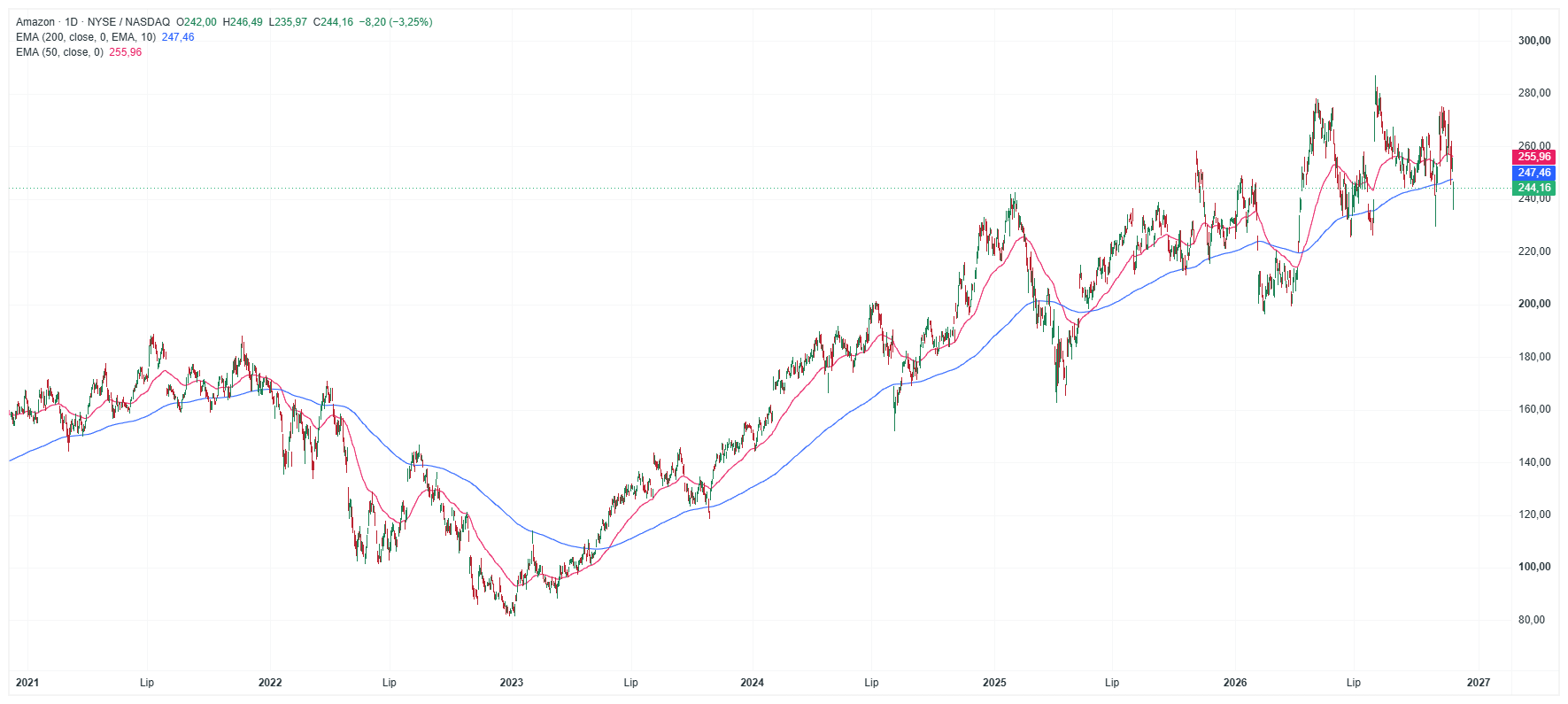
Allegro (ALE.PL) and Amazon (AMZN.US) Stock Price Charts
Allegro shares have experienced an exponential rally this year and are now trading at levels last seen in September 2021. By mid-March 2027, investors should have a clearer picture of how much the company earned during the fourth quarter, traditionally its strongest seasonal period. Market expectations may be relatively demanding, and the fourth-quarter report could serve as an important barometer of consumer spending across the Polish economy and, more broadly, household activity in Central and Eastern Europe (CEE).
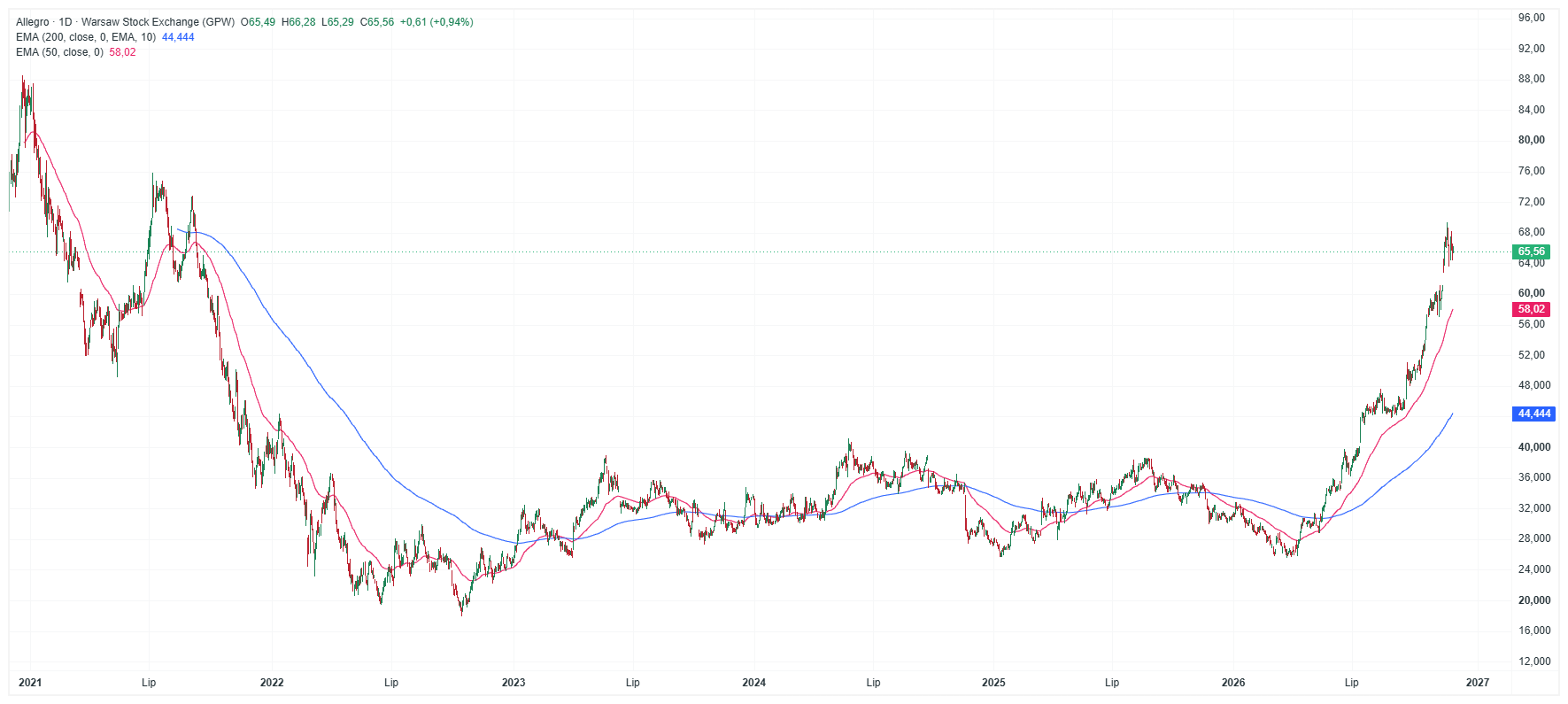
Source: XTB Between 2021 and 2026, Amazon shares delivered substantially higher returns than Allegro. However, over the past 12 months, the US giant has significantly underperformed one of Central and Eastern Europe’s leading e-commerce companies. Amazon is expected to release its fourth-quarter 2026 results in early February 2027. Given that Amazon Web Services, rather than retail, is the company’s main engine of profitability, consumer sales are less important to Amazon’s overall financial performance than its cloud business. Nevertheless, as with Allegro, the holiday shopping season will provide a valuable indication of consumer sentiment in the United States.
Source: XTB Eryk Szmyd Financial Markets Analyst, XTB





