









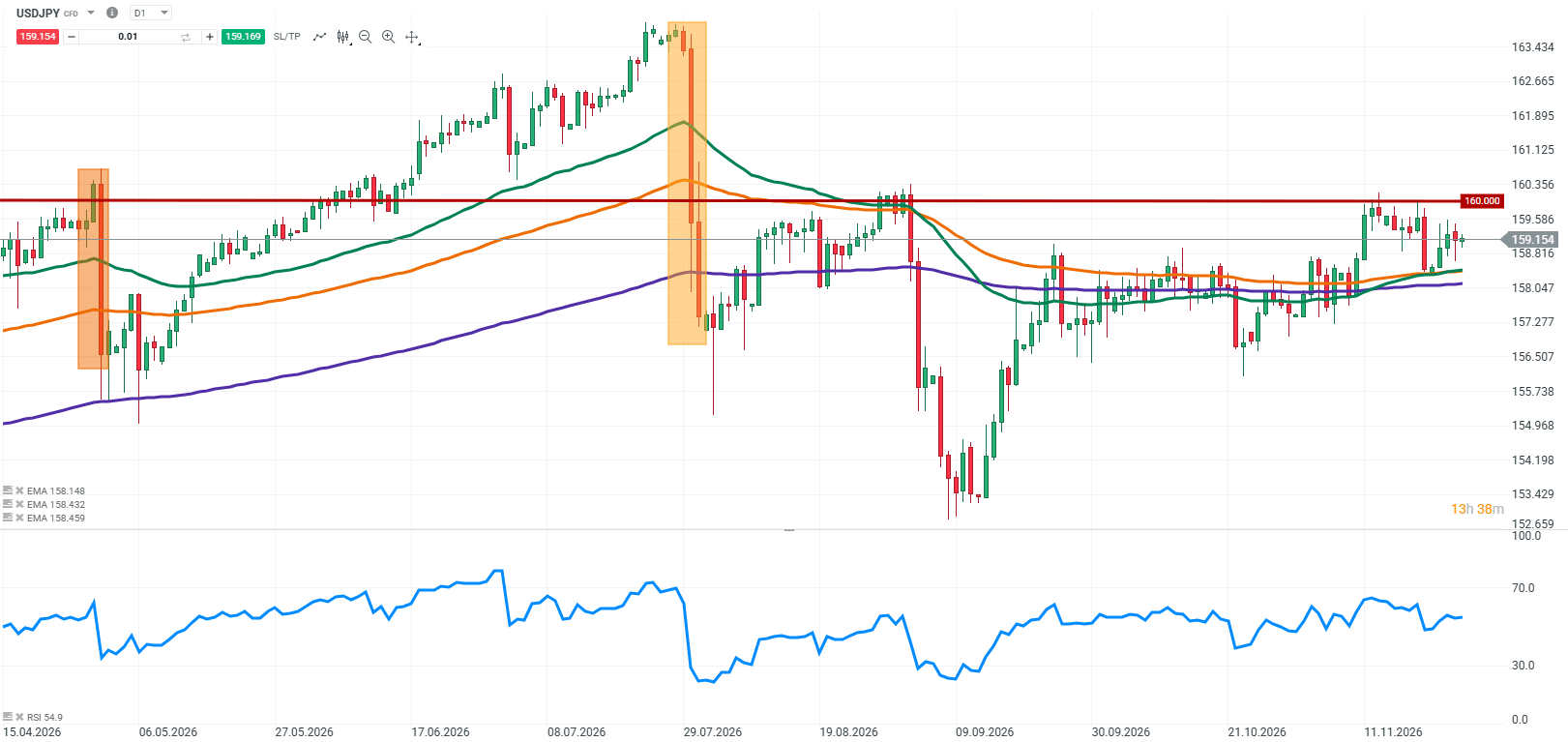
USDJPY is once again approaching the 160 level, and the prospect of further monetary tightening on both sides of the Pacific is not enough to sustainably reverse the pressure on the yen. Both the Fed and the Bank of Japan are sending increasingly hawkish signals, although the economic conditions and starting points for monetary policy in the two economies remain different. Attention is now turning to the December policy meetings, as markets are increasingly positioning for further rate hikes.
Source: XTB Research
Fed: Inflation Remains Persistent, While the Economy Shows Little Sign of Weakness
The PCE data released yesterday confirmed that price pressures in the US remain elevated. In October, both headline and core PCE increased by 0.3% month-on-month, while core PCE accelerated to 3.3% year-on-year, up from 3.1% a month earlier. This is significant because the core PCE index remains one of the Fed’s key benchmarks for assessing the persistence of inflationary pressures. The picture was further reinforced by GDP data. The second estimate of US economic growth in the third quarter was revised upwards to 4.3% on an annualised basis, compared with 2.2% in the second quarter. Such a strong reading shows that the economy continues to maintain a robust growth pace, limiting the arguments for monetary easing. The Fed therefore has room to keep financial conditions restrictive for longer and even continue raising rates if inflation does not begin to ease more noticeably. Against this backdrop, a 25-basis-point rate hike in December is now fully priced into market expectations. However, attention is increasingly shifting towards the outlook for 2027. Persistent inflation, combined with strong economic growth, means that the prospect of further monetary tightening is no longer just a distant risk.
BOJ: Increasingly Hawkish Signals Ahead of the December Meeting
The Fed’s hawkish stance is not an isolated development. In Japan, pressure is also mounting for a faster normalisation of monetary policy. Bank of Japan board member Naoki Tamura has called for an acceleration in the pace of rate hikes, arguing that the central bank should respond early enough to the risk of inflationary pressures becoming entrenched. In his view, interest rates should gradually move towards the neutral level, estimated at around 2%. However, Tamura did not commit to a December rate decision, stressing that incoming data would need to be assessed ahead of the meeting. The current policy rate stands at 1.25%, and markets are increasingly considering the possibility of a hike to 1.50% as early as 18 December. Additional arguments for further tightening include the risk of higher inflation driven by a weak yen, rising commodity prices and growing demand for goods used in the artificial intelligence sector. Tamura’s comments suggest that support is growing within the central bank for a faster normalisation of monetary policy. A similar outlook has been expressed by former BOJ board member Makoto Sakurai, who expects three further rate hikes, bringing the policy rate to 2% by mid-2027. In his view, the next move could come as early as December. Such forecasts are consistent with the increasingly hawkish outlook for Japanese monetary policy, although the final decision will depend on how the current board assesses incoming economic data.
USDJPY: The Yen Remains Under Pressure
Despite the shift in the BOJ’s communication, the yen has failed to regain sustained strength. Further rate hikes in Japan could gradually improve its unfavourable position, but the normalisation process will take time. Meanwhile, US interest rates remain high, and the resilience of the American economy continues to support the attractiveness of the dollar. This combination is still making it difficult for USDJPY to reverse its broader trend sustainably. The exchange rate has once again moved close to the 160 level, which is significant not only from a technical perspective but also because of the risk of intervention by Japanese authorities. Previous interventions have triggered sharp, although often short-lived, yen appreciation. However, this does not mean that 160 represents a fixed threshold at which intervention should automatically be expected. The pace of yen depreciation and whether the move is one-sided and abrupt may be more important factors.
What Comes Next?
In the short term, the growing likelihood of a December BOJ rate hike could limit further upside in USDJPY. If the central bank does decide to raise rates, the yen could strengthen, particularly if its accompanying statement signals a willingness to continue tightening monetary policy in the coming months. However, a rate hike alone may not be enough to trigger a sustained trend reversal. Much will depend on whether the BOJ’s hawkish stance is confirmed by subsequent decisions and whether US economic data continue to justify the Fed’s restrictive monetary policy. Another risk factor is the possibility of currency intervention as USDJPY approaches 160. Any response from Japanese authorities could trigger a sharp correction, but without a clear shift in underlying fundamentals, it is difficult to assume that intervention alone would lead to a sustained strengthening of the yen. For now, the balance of forces continues to favour the dollar, although USDJPY’s approach towards the psychological 160 threshold increases the risk of sharp market movements.
Key Takeaways
- USDJPY is once again approaching the 160 level, while the yen remains under pressure despite increasingly hawkish BOJ communication.
- October core PCE accelerated to 3.3% year-on-year, confirming that inflation in the US remains persistent.
- US GDP grew by 4.3% on an annualised basis in the third quarter, reducing concerns about an economic slowdown.
- Markets have fully priced in a 25-basis-point Fed rate hike in December and are increasingly considering the possibility of further tightening in 2027.
- Naoki Tamura supports a faster pace of BOJ rate hikes and a gradual move towards the neutral interest rate level of around 2%.
- A December BOJ rate hike to 1.50% is increasingly being considered by market participants.
- The resilience of the US economy and persistently high Fed interest rates continue to limit the potential for a sustained strengthening of the yen.
- The 160 level remains a key area to watch due to the risk of Japanese currency intervention.





