




Infrastructure development takes place in cycles. This is because large-scale projects require certain conditions and justifications, such as funding or synergies with the rest of the economy – and these justifications arise cyclically. This rule applies to roads, railways, schools and hospitals, but also to IT infrastructure, including AI. Whilst the timeframes, scale and resources may vary, the underlying mechanisms remain the same. This is why companies producing computer components, including DRAM, are cyclical companies. The market is keen to see the current market trend as a break from this pattern, but at present there is nothing to suggest that ‘this time will be any different’. Over time, the memory chip market also appears to have recognised the fragility of the growth scenario for the sector, which triggered devastating sell-offs. At the peak of the sell-off, memory chip companies lost between 40–60 per cent; today, they are ‘only’ 20–30 per cent below their most recent peak. The key questions regarding the industry’s future prospects are:
- What actually triggered the correction
- Where does the company stand fundamentally today
- What are the prospects for the memory market over the next few years?
The question regarding the memory market is not ‘whether’ the cycle will repeat itself, but ‘when’ and ‘how’ this will happen. However, current valuation levels are already significantly weighed down by concerns about the sustainability of profits, whilst for companies with such strong growth momentum, the risk of inaccurate forecasts is very high and very costly.
Revision of expectations
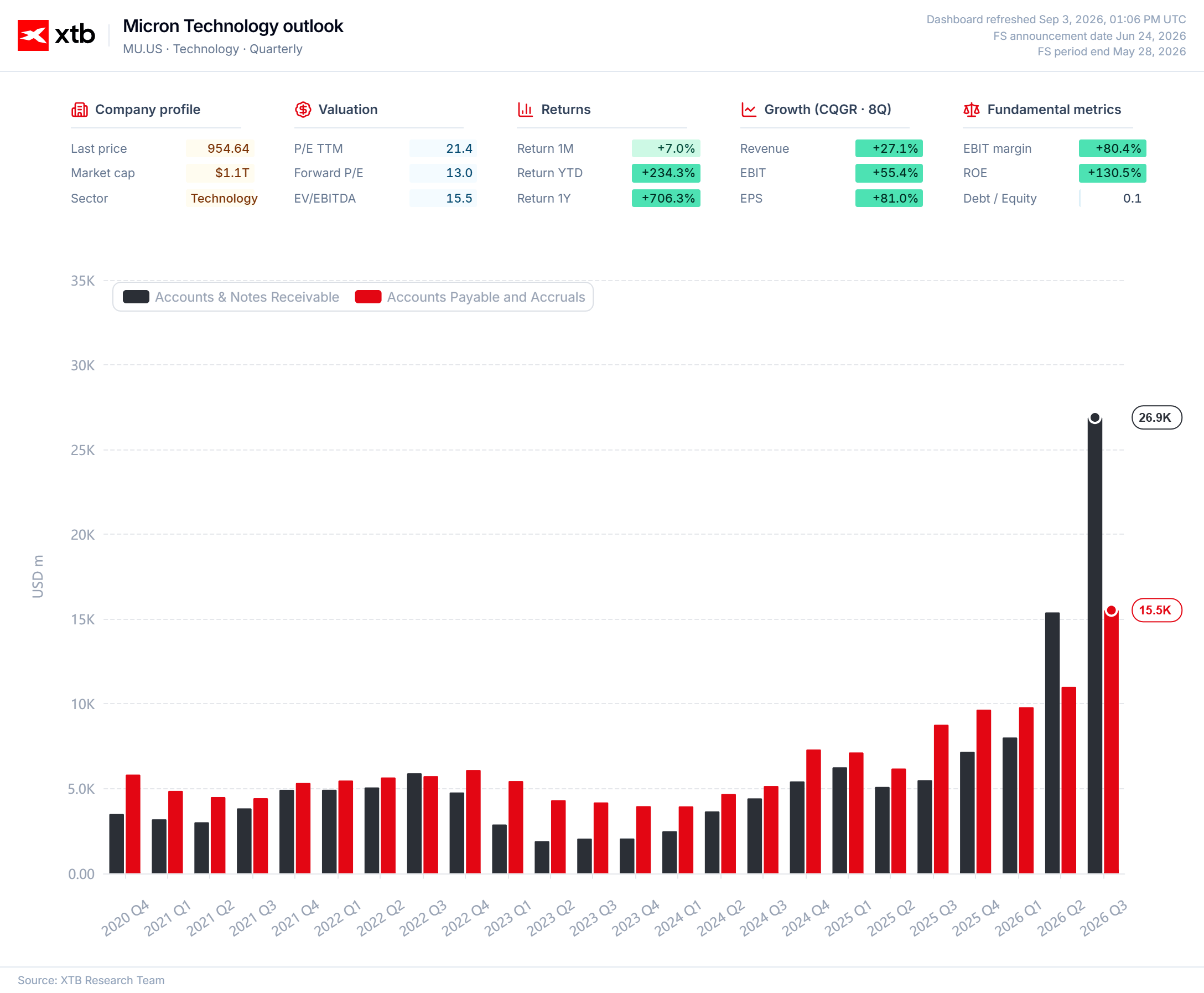
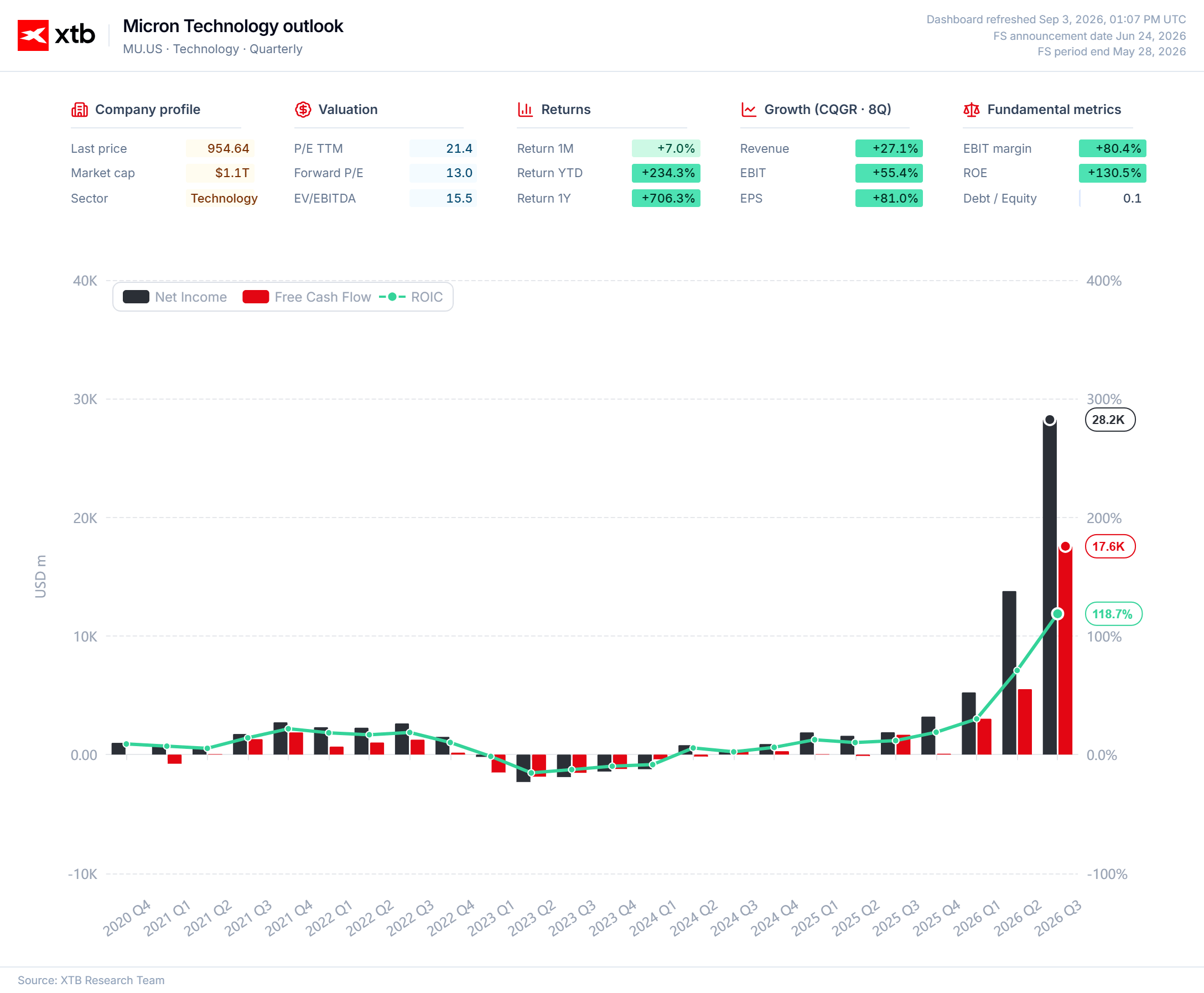
Importantly, the sell-off in June and July was not a sudden revision of expectations regarding the company, driven by a thorough fundamental analysis. The sell-off was mainly triggered by the unwinding of leverage on memory companies, which (primarily) retail investors had built up over recent months. This movement was further exacerbated by a temporary deterioration in sentiment and the outlook for the entire ‘AI’ sector. This means that it was not earnings or expectations that fell – but the price-to-earnings (P/E) ratio. Currently, companies in the sector have P/E ratios ranging from a conservative ~22 for Micron to a suspiciously low ~7 for SK Hynix.
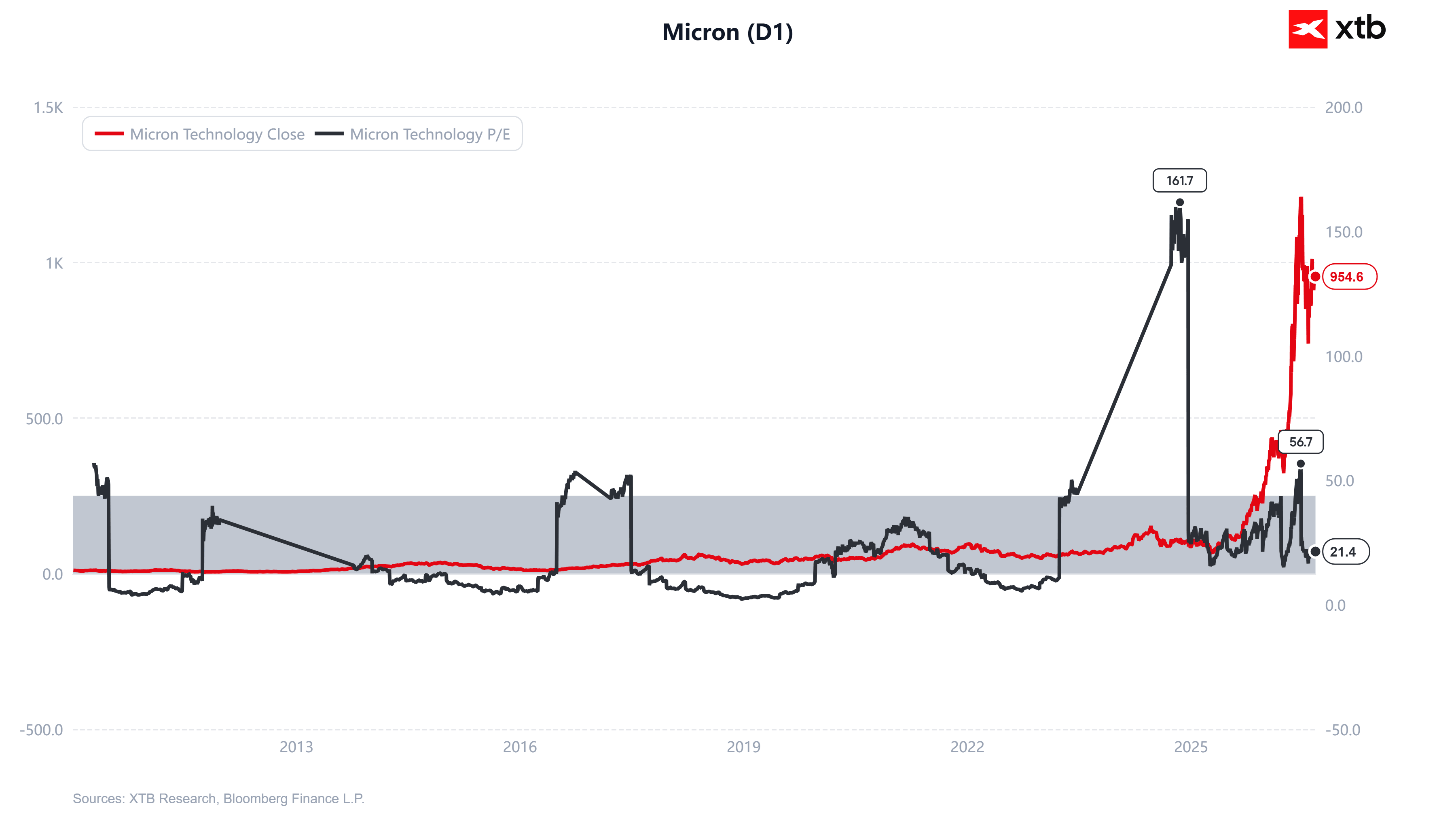
A low price-to-earnings ratio is no guarantee of growth; moreover, a low price-to-earnings ratio without any obvious signs of problems at the company – such as poor results or debt – implies hidden risks or, more broadly, investor unease. However, if such a low multiple appears in the valuation of a company with such extreme growth momentum as, for example, Micron or SK Hynix, this creates an asymmetric risk of having to make a sudden and drastic upward revision to expectations. The next test of current valuations will be Micron’s results on 30 September, which will allow us to assess which growth scenario the company is currently following and whether it is consistent with its valuation.
Not all memories are the same
In a sense, a huge proportion of the company’s terminal value lies in the RAM market. The problem with basing one’s assumptions on the behaviour of this market is that such an approach may be doomed to failure due to its complexity and volatility. Firstly, it is a completely mistaken assumption that we have to wait until new factories come on stream for the supply of memory on the market to increase – this is not the case. The supply of HBM memory should not be measured in dollars, but in bits. The effective supply of bits can be increased by improving yields, changing the production mix, ‘node shrink’, better HBM packaging and expansion into the Chinese market. At the same time, software optimisation is hampered by the correlation between the increase in computing power and memory requirements. Currently, HBM (high-bandwidth memory) accounts for approximately 20 per cent of the global (input) volume of silicon wafers, and this is set to rise to around 30 per cent by the end of 2027 (a key figure to monitor). However, this type of memory currently accounts for around 10 per cent of the total number of DRAM ‘bits’ reaching the market, and this figure is set to rise to 15 per cent over time. This is significant because it means that simply by optimising production methods, it is currently possible to squeeze out a few extra per cent of bit supply, which could eliminate a significant proportion of the shortages anticipated by the market.
China
Another weakness in the current forecasts for memory and semiconductor companies is China. CXMT currently has a processing (input) capacity of around 300,000 wafers per month and plans to reach around 600,000 within a few years at most. At the same time, Chinese manufacturers:
- They don’t need to worry about the margin,
- They do not have to compete for capital
- Nor do they need to compete at the very top level. Taking over the less advanced memory segments will suffice.
Since the last correction in the memory sector, significant but difficult-to-verify reports have emerged suggesting that China is finally set to acquire “Immersion” DUV lithography machines. Should China acquire significant quantities of these machines, CXMT would likely be one of the first recipients. ‘Immersion’ DUV machines are not sufficient to enter the HBM memory segment, but they significantly improve the ‘yield’ of DRAM/LPDDR memory. AI models are evolving much faster than the hardware on which they run. New compression and computing techniques, along with changes to existing architecture, are sufficient to significantly reduce memory requirements. Subsequent generations and the synergy of various solutions from outside the HBM industry have already been able to realistically reduce costs and bottlenecks by an order of magnitude. We should not expect this process to suddenly come to a halt, nor that memory companies will, in an unprecedented manner, maintain equally unprecedented growth and profit margins at the expense of the rest of the sector.
Contracts
It is also worth looking at accounting policies and the complexities of memory supply contracts, as this is an aspect the market seems to understand the least. Many contracts signed by, for example, Micron contain a number of clauses relating to maximum and minimum prices, deposits and CAPEX financing. What does this mean in practice? Maximum and minimum prices protect both suppliers and customers. The market thrives on volatility, but companies do not necessarily do so. Optimising production processes and AI models will support supply, but the impact on contracts will be delayed. The moment new production capacity actually comes on stream, revenues may fall suddenly and drastically without warning, masked by previous batches of contracts that are out of step with market realities.
“Tech-stack”
A ‘tech stack’ is a group of subsystems and products within the much larger process of building, training and using AI models. These include, amongst others:
- Computational layer
- Data layer
- Software layer
- Energy layer
- Cloud layer
- Ect.
And many others. The key point is that demand for memory is not only cyclical, but is also inextricably linked to other elements of the technology stack. At present, many investment projects have slowed down or come to a standstill as a result of memory shortages.
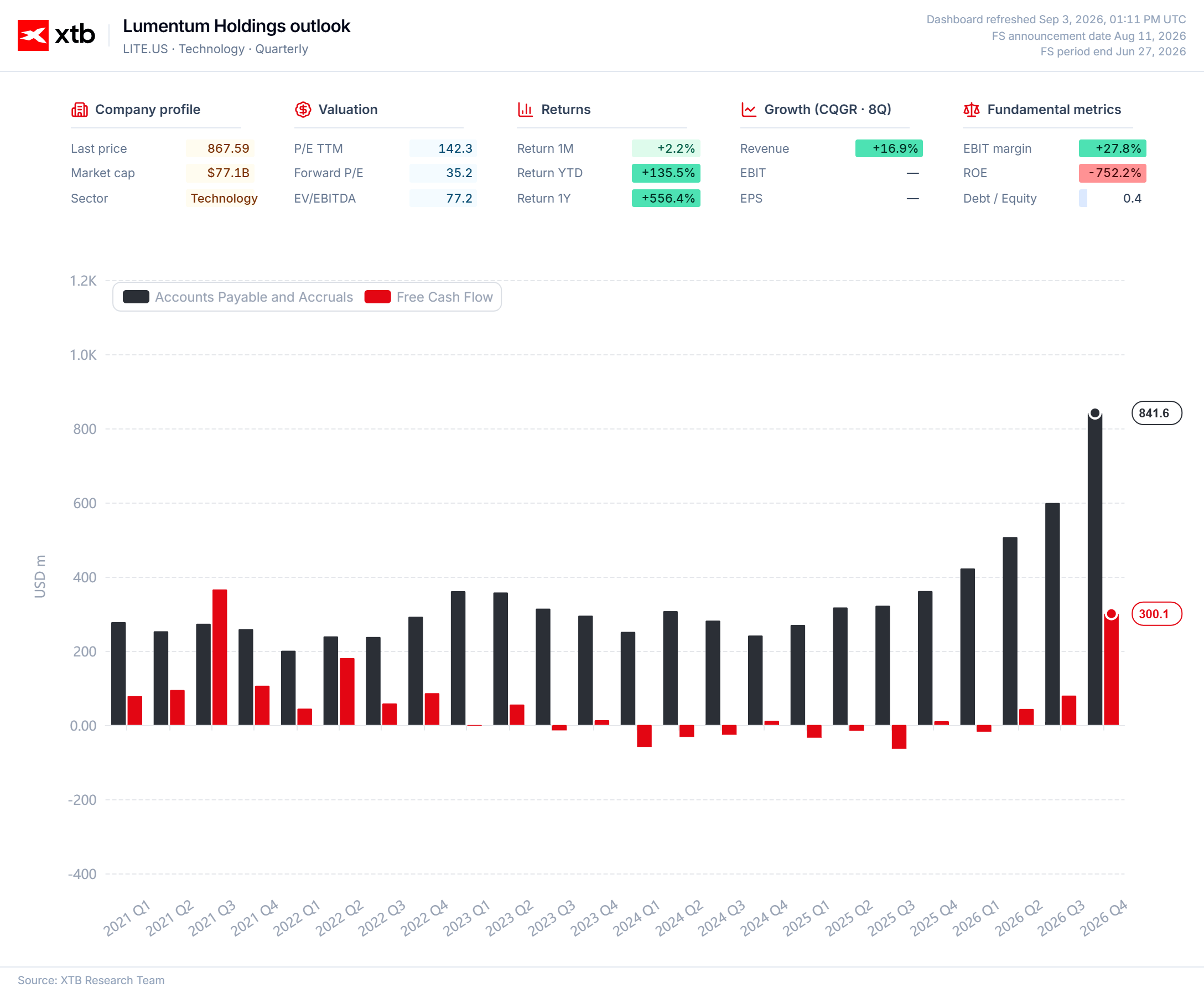
This shortage is currently being addressed on the supply side, which will cause the bottleneck to spread to the rest of the ecosystem and various ‘stacks’ – this is not speculation; IBM’s latest results have demonstrated this unequivocally and emphatically. At present, other stacks, such as switches and software, remain under-invested. This will lead to a further shortage further down the investment cycle, and this shortage will trigger a build-up in the memory module market. This means that not only will the current shortage not persist despite the rise in investment, but there is a very strong likelihood that it will turn into a surplus more quickly than most people can imagine. This suggests that current forward valuation indicators may not represent an opportunity, but rather a harbinger of a scenario that has played out many times before.