




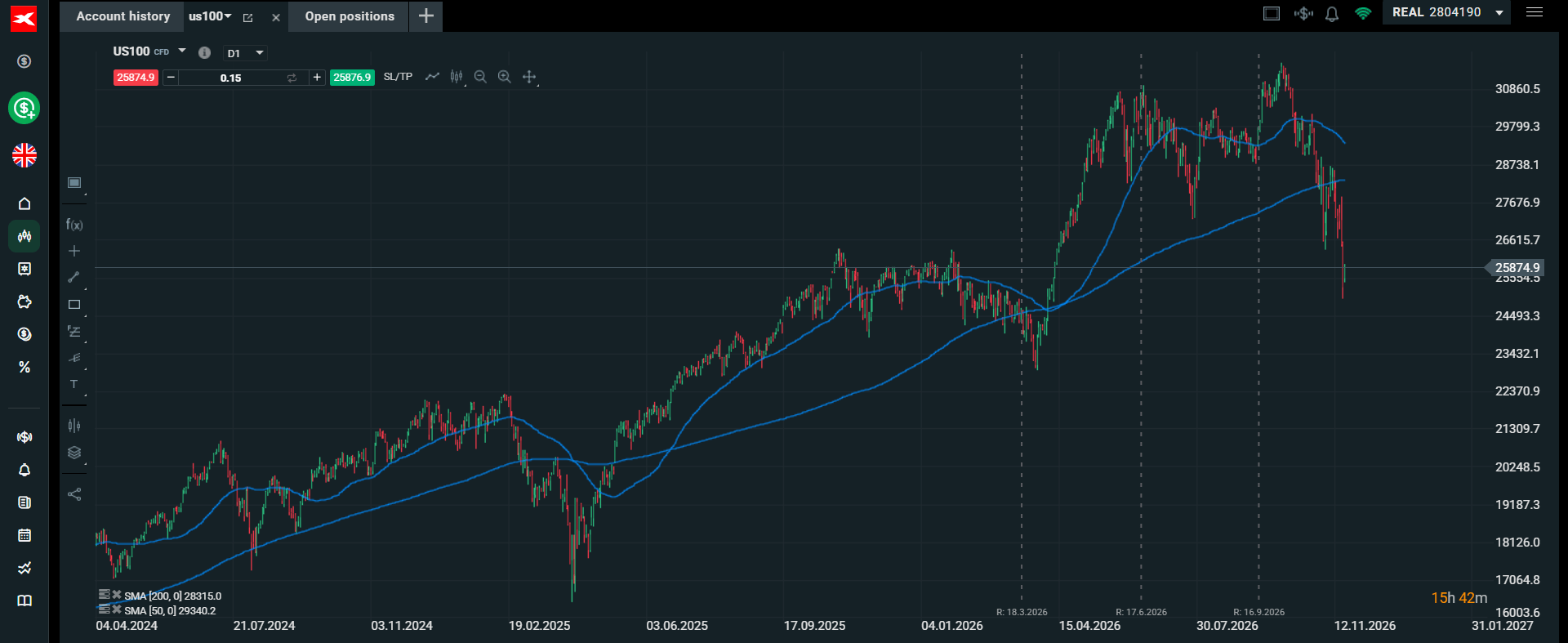
Global financial markets entered the new trading week showing tentative signs of recovery after last week’s severe technology-led sell-off wiped trillions of dollars from equity valuations. US equity futures pointed towards a stronger opening, with the Nasdaq 100 expected to rebound by approximately 2.8%, while gold gained more than 3% and the US dollar weakened as demand for traditional safe-haven assets eased.
The recovery follows an exceptionally difficult week for global equities. The S&P 500 fell nearly 10%, putting it on track for its second-worst November performance in the index’s history. The Nasdaq endured a seven-session losing streak, while the Dow Jones recorded losses exceeding 1% on every trading day of the week.
Technology stocks and companies linked to artificial intelligence infrastructure were at the centre of the sell-off. Nvidia, Anthropic and the so-called neocloud providers faced growing investor scrutiny over AI valuations, financing structures and the sustainability of infrastructure spending.
However, early trading this week suggests investors are beginning to reassess the extent of the correction. Nvidia rose more than 6% in pre-market trading, Anthropic gained over 3%, and CoreWeave advanced approximately 7%.
The central question for investors is whether last week’s decline represented a temporary correction in an otherwise strong market or the beginning of a more prolonged reassessment of the AI investment cycle.
Market Snapshot
| Market indicator | Latest development |
|---|---|
| S&P 500 | Fell nearly 10% last week |
| Nasdaq 100 | Futures indicate an expected 2.8% rebound |
| Nasdaq Composite | Recorded a seven-session losing streak |
| Dow Jones | Lost more than 1% each trading day last week |
| Nvidia | Up more than 6% in pre-market trading |
| Anthropic | Up more than 3% |
| CoreWeave | Up approximately 7% |
| Gold | Gained more than 3% |
| US dollar | Weakened as safe-haven demand eased |
| Fed rate expectations | No probability of a 50bp hike; 11% probability of no change |
| Key economic releases | Global November PMIs, US PCE and second estimate of GDP |
Market Recovery: Relief Rally or the Beginning of a Reversal?
The initial recovery in US equity futures suggests that investors may be looking to buy stocks following last week’s aggressive selling.
The speed and scale of the decline pushed several major indices into oversold territory, creating conditions for a technical rebound. Technology shares, which experienced some of the heaviest losses, are leading the early recovery.
However, a stronger opening does not necessarily mean the correction is over.
The market has experienced a significant change in sentiment, with investors increasingly questioning the valuations, financing arrangements and future profitability of businesses connected to artificial intelligence.
Although the immediate selling pressure appears to have eased, uncertainty surrounding the AI investment cycle could continue to produce volatile trading conditions.
The possibility of a short-lived recovery remains particularly relevant. If investors regain confidence and risk appetite returns, equities could extend their rebound. If concerns surrounding AI financing and future earnings persist, Monday’s gains could prove temporary.
Asian Markets: Authorities Help Stabilise Sentiment
Asian markets experienced a more measured decline than initially feared, following the sharp losses across US equities on Friday.
South Korea’s Kospi, which has significant exposure to the technology and AI investment cycle, fell approximately 3%. China’s main equity index managed to post a gain after authorities intervened to limit the fallout from the US market sell-off.
Japanese markets were closed for a public holiday.
The relative resilience across parts of Asia provided some reassurance that the global equity rout was not immediately accelerating into another wave of indiscriminate selling.
Nevertheless, the Kospi’s decline highlights the vulnerability of markets with substantial exposure to semiconductor manufacturers and the wider AI ecosystem.
AI Demand Remains Strong, but Investor Scrutiny Is Increasing
One of the central arguments supporting a market recovery is that demand for AI computing capacity has not fundamentally changed.
Major technology companies and hyperscalers remain committed to their investment plans for the coming quarters. Demand for data processing, computing infrastructure and AI capabilities continues to underpin the longer-term investment case.
However, the cost of financing AI infrastructure has become a much greater concern.
Investors are increasingly questioning whether the enormous capital expenditure required to build the AI ecosystem will generate sufficient returns. The relationship between chip manufacturers, cloud providers, infrastructure businesses and AI developers is also receiving greater scrutiny.
The market is therefore entering a different phase of the AI investment cycle. Strong demand alone may no longer be sufficient to justify valuations. Investors are likely to place greater emphasis on financing arrangements, cash flow generation, profitability and the ability of companies to convert AI demand into sustainable earnings.
Chart 1: Freefall for the Nasdaq
Nvidia and Anthropic: The Companies at the Centre of the Debate
Nvidia and Anthropic have become particularly important to the market’s assessment of the AI investment cycle.
Nvidia’s shares suffered a significant decline despite the company reporting $115 billion in revenue for the previous quarter and generating more than $40 billion in free cash flow. Its share price reportedly fell 26% during the week of those results, highlighting the extent to which market sentiment had deteriorated.
Concerns surrounding a reported SEC investigation added to the pressure, with Nvidia falling 14% on Friday.
Anthropic has also attracted increased attention following its record-breaking IPO. Its valuation, reported at well above $1.5 trillion in the supplied market commentary, has become a focal point for investors assessing the future earnings potential of the AI sector.
The company’s future financial performance may increasingly be treated as an indicator of broader AI demand, particularly given the importance of Anthropic and OpenAI to the computing ecosystem.
Together, these companies are central to the debate over whether the AI investment boom can sustain its current scale.
Oracle and OpenAI: Financing Concerns Add to Market Uncertainty
Oracle has emerged as another important source of uncertainty following its announcement that it had secured full financing for its contracts with OpenAI.
The arrangement involves a reported $300 billion, five-year cloud computing commitment designed to provide large-scale AI infrastructure and computing capacity.
Oracle subsequently indicated that it expected positive free cash flow in fiscal 2028.
However, the announcement did not eliminate investor concerns. Critics questioned the extent to which the arrangement depends on Nvidia and whether the financing structure exposes Oracle to significant financial obligations.
The concern is that if the AI ecosystem experiences a slowdown, companies financing large infrastructure commitments could face substantial exposure.
Oracle’s ability to fund the arrangement, maintain cash flow and deliver the infrastructure required by OpenAI will therefore remain an important consideration for investors.
Neocloud Providers Face Growing Financial Pressure
Smaller AI infrastructure and neocloud businesses are also experiencing increased scrutiny.
Companies such as CoreWeave have been particularly exposed to concerns surrounding the financing of AI infrastructure. CoreWeave’s share price has reportedly fallen more than 60% over the previous six months.
The business model of several neocloud providers relies heavily on access to Nvidia hardware and financing arrangements that support rapid infrastructure expansion.
This has raised concerns about circular financing within parts of the AI ecosystem, where investment, chip purchases and computing contracts are closely interconnected.
If financing becomes more expensive or demand expectations weaken, some smaller infrastructure providers could struggle to meet their obligations.
The financial health of these businesses is increasingly important because a deterioration in the neocloud sector could affect confidence across the wider technology investment landscape.
Earnings Strength Contrasts With the Equity Sell-Off
Despite the scale of last week’s market decline, underlying corporate earnings remain relatively strong.
The blended earnings growth rate for the S&P 500 was reported at 34.7% excluding the Magnificent Seven, while the Magnificent Seven recorded earnings growth of approximately 27% for the previous quarter.
Valuations have also adjusted considerably.
The S&P 500’s forward price-to-earnings ratio has fallen to approximately 17.7, its lowest level in three years according to the supplied commentary. Nvidia’s 12-month forward P/E ratio was reported at approximately 7.5.
Growth stocks have also moved below value stocks on valuation for the first time since the financial crisis, representing an unusual shift in market positioning.
These figures suggest that the recent sell-off has gone beyond a straightforward reassessment of corporate earnings.
Instead, investors appear to be demanding a greater risk premium for technology companies and questioning whether current earnings expectations can be maintained.
Federal Reserve Outlook: Rate Expectations Shift After Market Turmoil
The equity sell-off has also influenced expectations for Federal Reserve monetary policy.
Investors are increasingly questioning whether further aggressive interest rate increases would be appropriate if financial market weakness begins to affect business confidence, household spending and economic growth.
According to the CME FedWatch figures cited in the supplied commentary, markets were assigning no probability to a 50-basis-point rate increase next month, while the probability of the Federal Reserve leaving rates unchanged had risen to 11%.
This represents a shift in expectations as investors consider the potential economic consequences of tighter financial conditions.
However, inflation remains an important consideration. The upcoming US Personal Consumption Expenditures report, particularly core PCE, will provide a further indication of underlying price pressures and could influence expectations for the next Federal Reserve decision.
The second estimate of US GDP will also be closely watched for signs of economic resilience.
Thanksgiving Week: A Potential Pause for Financial Markets
The US Thanksgiving holiday could provide investors with a much-needed pause following several weeks of volatile trading.
Reduced trading activity around the holiday may limit liquidity, although thinner markets can also exaggerate price movements when significant news emerges.
The key issue is whether the market can stabilise before the holiday period or whether renewed selling pressure develops.
The correction has already moved beyond individual technology stocks and affected broader equity indices. That transition is particularly important because a prolonged decline could begin to influence business and consumer confidence.
If financial market weakness becomes sufficiently severe, the consequences could extend beyond technology valuations and eventually affect corporate investment, employment and economic growth.
Bullish Sentiment
- Oversold market conditions: The scale of last week’s decline has created the potential for a technical recovery, with US equity futures already indicating a stronger opening.
- AI infrastructure demand remains intact: Hyperscalers continue to support investment plans, and there is currently no clear evidence in the supplied commentary that demand for computing capacity has diminished.
- Strong corporate earnings: S&P 500 companies continue to report substantial earnings growth, challenging the argument that the recent market decline is being driven by deteriorating fundamentals.
- Lower oil prices: Brent crude has fallen approximately 15% over the past month, providing potential support for inflation expectations and corporate costs.
- Improving technology sentiment: Early gains in Nvidia, Anthropic and CoreWeave suggest that investors may be returning to selected AI-related positions.
- Potentially less aggressive Fed policy: Reduced expectations for further aggressive rate increases could help stabilise risk appetite.
Bearish Sentiment
- AI financing concerns: Investors are increasingly questioning how the enormous investment required for AI infrastructure will be financed and whether it can generate sustainable returns.
- Nvidia regulatory uncertainty: Concerns surrounding the reported SEC investigation have added another layer of uncertainty to the semiconductor sector.
- Oracle and OpenAI exposure: The reported $300 billion cloud arrangement has raised questions about financing obligations and the interconnected nature of the AI ecosystem.
- Neocloud financial risks: Heavy reliance on Nvidia financing and infrastructure investment could leave smaller AI computing providers vulnerable if capital becomes more expensive.
- Concentration of AI demand: The dependence of a substantial part of the AI ecosystem on Anthropic and OpenAI creates potential vulnerability if either company’s growth disappoints.
- Broader economic consequences: A prolonged equity correction could weaken business and consumer confidence, potentially affecting investment, spending and future earnings.
- Technical damage: The Nasdaq’s seven-session losing streak and the S&P 500’s nearly 10% decline highlight the severity of the recent deterioration in market sentiment.
The Week Ahead: Economic Data and Market Events to Watch
The coming sessions will be dominated by the interaction between corporate sentiment, economic data and expectations for Federal Reserve policy.
Global November PMIs
The first November purchasing managers’ index releases will provide an early indication of whether lower energy prices are helping improve business confidence.
Stronger-than-expected readings could reassure investors that the global economy remains resilient despite recent financial market turbulence. Disappointing figures, however, could reinforce concerns about slowing economic activity.
US PCE Inflation
The Personal Consumption Expenditures report will be particularly important, with core PCE providing a key measure of underlying inflation pressures.
The data could influence expectations for the Federal Reserve’s next policy decision, especially as investors reassess the economic implications of further monetary tightening.
US GDP
The second estimate of US GDP will provide an updated assessment of economic growth.
A resilient reading could help counter concerns that the equity sell-off reflects deteriorating economic fundamentals. A weaker result could increase fears that tighter financial conditions are beginning to affect economic activity.
AI Corporate Developments
Investors will continue monitoring Nvidia, Anthropic, Oracle, OpenAI and the wider neocloud sector.
Further information about financing arrangements, computing demand and future profitability could have a significant influence on technology shares and broader market sentiment.
Market Outlook for the Coming Sessions
Financial markets have started the week on a more positive footing, but the recovery remains fragile.
The initial rebound in US equity futures, together with gains in major AI-related stocks, suggests that investors are beginning to take advantage of lower valuations following last week’s aggressive sell-off.
However, the underlying concerns have not disappeared. AI financing structures, the sustainability of infrastructure spending and the concentration of demand among a relatively small number of companies will remain important themes.
The coming economic releases could help determine whether the market stabilises into Thanksgiving. Strong global PMIs, resilient US GDP and reassuring inflation data would provide a more supportive environment for equities. Conversely, weaker data or further negative AI developments could quickly revive selling pressure.
For now, the most likely near-term environment is one of continued volatility, with the potential for a relief rally but limited confirmation that the broader correction has ended.
The central question is no longer simply whether AI demand will continue growing. Investors increasingly want evidence that the enormous capital being committed to the sector can generate sustainable cash flows and profits.
Last week’s sell-off may therefore mark a turning point in how AI companies are valued, even if the longer-term investment theme remains intact.
The recovery has started, but the market still needs to prove that the worst of the sell-off is behind it.
Currency Hedger
Periods of heightened market volatility can create significant foreign exchange exposure for businesses operating across international markets. Currency Hedger provides tailored currency solutions, multi-currency accounts and hedging strategies to help businesses manage exchange-rate risk.
Open a Currency Hedger account
Disclaimer
This article is provided for informational and market analysis purposes only. It does not constitute investment advice, financial advice, trading recommendations or an offer to buy or sell any financial instrument. Financial markets and derivatives can be volatile, and trading involves significant risk. Readers should conduct their own research and seek independent professional advice before making investment decisions.