




Global financial markets enter a potentially pivotal week, with investors assessing the aftermath of the technology sell-off, the outlook for artificial intelligence investment, US political uncertainty and a packed calendar of economic data.
The focus shifts towards the US Midterm elections, the latest employment figures, global manufacturing and services activity, European inflation and the Bank of England’s interest-rate decision. Corporate earnings from major technology companies will also test whether last week’s sharp losses represent a temporary correction or the beginning of a more significant reassessment of the AI investment cycle.
Markets are beginning November on a more positive footing, with US equity futures pointing towards a recovery. Lower oil prices, following signs that Washington may allow diplomatic efforts to resolve the Middle East conflict more time, are also helping sentiment.
However, the coming sessions could produce significant movements across equities, currencies, bonds and commodities as investors reposition ahead of several major events.
Global Markets Snapshot
| Market driver | Latest position / outlook | Market significance |
|---|---|---|
| Nasdaq 100 futures | Pointing towards a stronger open | Potential technology-sector recovery |
| S&P 500 futures | Indicating a positive start | Broader equity sentiment improving |
| FTSE 100 | Expected to open slightly lower | European market performance remains mixed |
| Brent crude | Down nearly 3% in the latest update | Easing geopolitical risk premium |
| US 10-year Treasury yield | Fell 6 basis points to 4.93% last week | Bond-market positioning remains important |
| US Q3 GDP | 3.4% annualised growth | Resilient economic backdrop |
| US consumer confidence | Increased 7 points in October | Supports the domestic demand outlook |
| Gold | Around $3,898 in the source update | Traditional safe-haven demand remains weak |
| US Midterm elections | Results expected Tuesday into Wednesday | Potential implications for policy and regulation |
| Bank of England | Rate decision expected Thursday | Important for sterling and UK bonds |
Technology Stocks: Can the AI Trade Recover?
Technology stocks will remain central to market sentiment after last week’s sharp sell-off in several major AI-related companies.
Investors are reassessing the scale of spending on artificial intelligence infrastructure and whether the enormous capital commitments made by technology companies will generate sufficient returns.
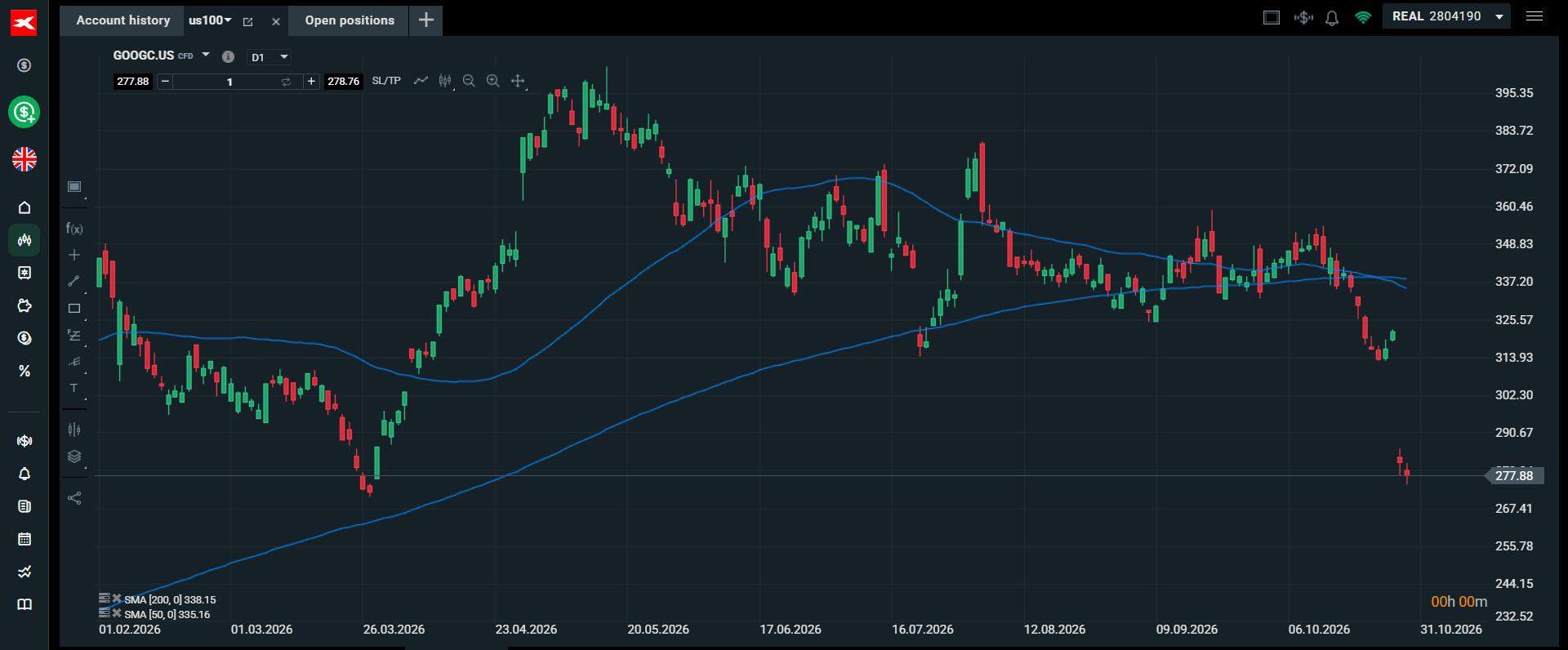
Alphabet shares fell more than 12% on Thursday and struggled to recover during Friday’s session. Intel experienced an even sharper decline, with its share price falling by nearly a third in one trading session.
Both companies are among the names investors will be watching for signs of a recovery as November trading begins.
However, the latest weakness has exposed concerns extending beyond individual earnings reports. Investors are increasingly questioning the financial sustainability of companies spending heavily on AI infrastructure, particularly businesses relying on debt to finance expensive computing capacity.
Neocloud Companies Face Growing Financial Pressure
Companies operating GPU-leasing data centres have emerged as a particularly vulnerable part of the AI investment chain.
Businesses such as CoreWeave and Nebius have committed substantial capital to computing infrastructure, with significant reliance on debt financing.
The concern is that GPU hardware may have a shorter commercial lifespan than initially anticipated. If computing equipment becomes outdated more quickly, the revenue generated over its useful life may not justify the original investment.
Credit default protection costs have also increased for some AI-related companies, indicating growing concern about credit risk.
CoreWeave’s share price has fallen approximately 60% over the past year, while Nebius has declined nearly a quarter over the past three months, according to the source update.
The important question this week is whether the recovery in technology shares is accompanied by an improvement in credit-market conditions. A rebound in equities without stabilisation in corporate credit risk could indicate that investor confidence remains fragile.
AI Investment Becomes a Longer-Term Patience Trade
The latest earnings season reinforces the view that AI investment returns may take longer to materialise than some investors originally expected.
Major technology companies continue to commit enormous amounts of capital to AI infrastructure, but the commercial benefits are not being realised evenly across the sector.
Microsoft remains an important example of the distinction between investment spending and cash generation. The company reported $18.6 billion in free cash flow for the previous quarter, according to the source update, yet its shares still declined by more than 1% on Friday.
For investors, the focus is shifting away from headline AI spending towards monetisation, profitability, cash flow and the ability to generate sustainable returns on invested capital.
US Equities: Earnings Resilience Offers Support
Despite the pressure on selected technology stocks, the broader US equity market has demonstrated greater resilience than the headlines might suggest.
The S&P 500 declined approximately 0.5% last week, while the Magnificent Seven fell around 2%. Tesla moved in the opposite direction, gaining approximately 7%.
Corporate earnings remain an important source of support.
Chart 1: Alphabet shares sunk last week
Around 60% of S&P 500 companies had reported third-quarter results in the source update, with more than 80% exceeding earnings expectations.
Technology remains one of the sectors contributing to the earnings outperformance.
This creates a more complicated market picture than a straightforward technology-sector sell-off. Investors are questioning valuations and future AI returns, but the underlying earnings performance across much of the US market remains relatively strong.
The coming sessions will test whether this earnings resilience can attract buyers back into equities.
US Midterm Elections: Political Uncertainty Could Influence Markets
The US Midterm elections are one of the most important political events on this week’s calendar, with voting taking place on Tuesday and results expected through Tuesday night and Wednesday.
The outcome could influence the direction of US economic policy over the next two years, particularly in relation to regulation, technology, artificial intelligence, cryptocurrency and foreign policy.
Prediction markets referenced in the source update indicate a substantial probability of Democrats gaining control of both chambers of Congress. However, such probabilities should be treated cautiously, as political forecasting markets can be wrong.
Why the Midterms Matter for Financial Markets
A change in congressional control could influence the regulatory environment facing technology and cryptocurrency businesses.
A Democratic victory could increase expectations of tighter regulation in selected sectors, potentially affecting technology valuations and investment sentiment.
Foreign policy could also become an important consideration. Any political developments that increase the possibility of diplomatic progress in the Middle East could influence oil prices and broader inflation expectations.
For equity investors, however, the removal of political uncertainty may itself be supportive. Markets often respond positively when a prolonged period of uncertainty reaches a conclusion, even when the immediate political outcome is not necessarily favourable to every sector.
The election results will therefore be important not only for US equities but also for the dollar, Treasury markets, oil and gold.
Bank of England: Interest-Rate Decision in Focus
The Bank of England’s interest-rate decision on Thursday is another major event for financial markets.
The source outlook points to a high probability of an interest-rate increase, with markets also pricing in the possibility of further tightening in the following months.
The decision will be particularly important for sterling and UK government bonds.
Higher interest rates can support a currency by improving its relative yield attractiveness, although the effect depends on whether the decision is already reflected in market pricing and what policymakers signal about future monetary policy.
What Traders Will Be Watching
The decision itself will be important, but the accompanying commentary and voting split could have a greater influence on the pound.
Investors will be assessing:
- The number of dissenting policymakers: A larger group favouring tighter policy could reinforce expectations of further rate increases.
- Inflation concerns: Policymakers’ assessment of persistent inflation and second-round effects will be important.
- Private-sector wage growth: Continued subdued wage growth could reduce the pressure for additional tightening.
- Future rate expectations: Guidance on the possibility of further increases could influence sterling and gilt yields.
If the Bank signals that further rate increases are less certain than markets currently expect, sterling could come under pressure.
Conversely, a more hawkish message could provide support for the pound, although higher borrowing costs may weigh on UK economic activity and bond prices.
Global Economic Data: PMI, Inflation and US Payrolls
Economic releases will provide another major source of market direction.
October purchasing managers’ index reports, US ISM surveys, European inflation figures and US employment data will be closely monitored.
The data will help investors assess whether global economic activity is maintaining momentum and whether inflationary pressures remain sufficiently persistent to influence central-bank policy.
US Payrolls: A Critical Test for Federal Reserve Expectations
US employment figures will be particularly important because of their potential influence on Federal Reserve interest-rate expectations.
The source update indicates that markets were pricing in a 72% probability of a December rate increase, according to the CME FedWatch tool.
A stronger-than-expected employment report could reinforce expectations of tighter monetary policy, potentially supporting the dollar and putting pressure on equities and government bonds.
A weaker report could have the opposite effect, reducing expectations of further tightening and potentially supporting risk assets.
However, payroll growth will need to be assessed alongside wage growth and other labour-market indicators. A single employment figure may not be sufficient to change the broader policy outlook.
European Inflation and Manufacturing Activity
European inflation data will also be important as investors assess the outlook for the European Central Bank.
Economic growth across the region remains weaker than in the United States. France recorded negative third-quarter growth in the source update, highlighting the challenges facing parts of the European economy.
Nevertheless, European equity markets demonstrated resilience, with the CAC 40 gaining approximately 2% last week.
The latest inflation and PMI figures will help determine whether this relative equity strength can continue despite the region’s weaker economic backdrop.
US Treasury Yields: Safe-Haven Demand Under Scrutiny
The US 10-year Treasury yield fell six basis points to 4.93% last week as investors assessed the technology sell-off and broader market uncertainty.
Treasuries provided some support during the equity weakness, although the movement was relatively moderate compared with the pressure experienced by selected technology shares.
This raises an important question: are investors becoming less willing to use US government debt as a traditional safe haven, or was last week’s equity weakness simply a normal adjustment following disappointing corporate earnings?
The distinction matters.
If Treasury demand strengthens as risk appetite deteriorates, it could indicate a more defensive shift in investor positioning. If bond demand remains relatively subdued, the equity sell-off may be viewed as more sector-specific rather than a sign of a wider financial crisis.
The coming economic releases, particularly payrolls and inflation data, could influence Treasury yields by changing expectations for Federal Reserve policy.
Oil Prices: Diplomatic Developments Weigh on Energy Markets
Oil prices have moved lower as reports suggest that Washington may be willing to give diplomatic efforts more time to resolve the conflict involving Iran.
Brent crude declined by nearly 3% in the latest update, providing some support to broader market sentiment.
The possibility of reduced geopolitical escalation could lower the risk premium embedded in energy prices.
This is particularly important for inflation expectations. Lower energy prices can reduce transport and production costs, potentially easing pressure on consumers and businesses.
However, the outlook remains uncertain. Any renewed military escalation or disruption to regional energy supplies could quickly reverse the recent decline.
For central banks, the direction of oil prices will remain an important consideration when assessing the persistence of inflationary pressures.
Gold and Bitcoin: Traditional and Digital Safe Havens Under Pressure
Gold declined approximately 3% last week and was trading around $3,898 in the source update, while Bitcoin also experienced losses.
Chart 2: The gold price drops to its lowest level in over a year
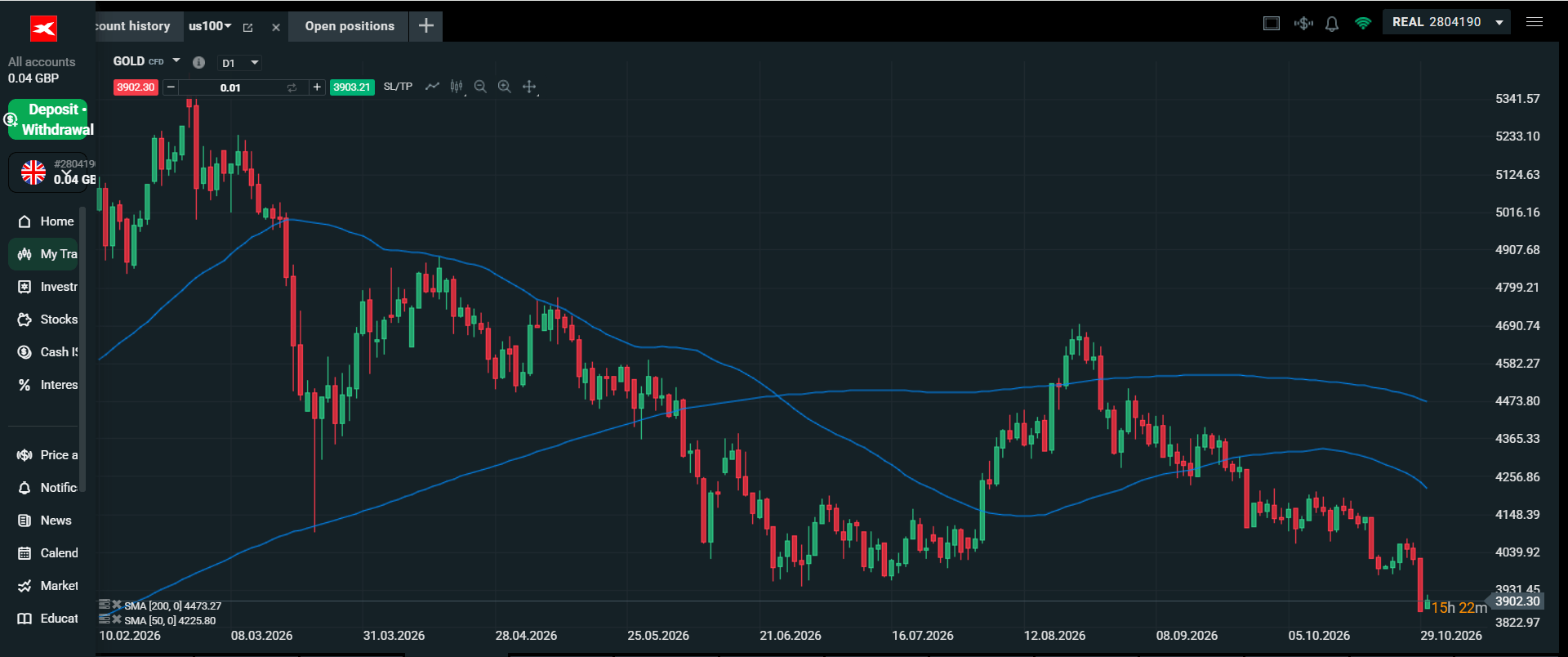
The weakness in gold is notable because the metal often attracts defensive demand during periods of financial uncertainty.
However, the latest movements suggest that investors have not moved uniformly into traditional safe-haven assets despite the pressure on technology shares.
Bitcoin also came under pressure following reports of a major security incident involving Binance, adding another source of uncertainty to digital-asset sentiment.
The coming sessions will show whether investors return to defensive positions or continue to favour selective opportunities in equities and other risk assets.
Bullish Sentiment: Factors Supporting Markets
- Strong corporate earnings: More than 80% of reporting S&P 500 companies exceeded earnings expectations in the source update.
- Potential technology recovery: Lower opening prices following last week’s sell-off may attract renewed buying interest.
- Resilient US economic growth: Third-quarter GDP growth of 3.4% annualised suggests the US economy remains relatively strong.
- Improving consumer confidence: The Conference Board’s October indicator increased by seven points.
- Lower oil prices: Reduced energy costs could ease inflationary pressure and support consumer and business sentiment.
- Political uncertainty approaching a conclusion: The Midterm elections could remove an important source of uncertainty for investors.
Bearish Sentiment: Factors Weighing on Markets
- AI investment concerns: Investors are increasingly questioning the returns on substantial capital expenditure by major technology companies.
- Neocloud credit stress: Higher credit-default protection costs highlight concerns about debt-financed AI infrastructure.
- Potentially tighter monetary policy: Expectations of further interest-rate increases could pressure equity valuations and bond prices.
- Political and regulatory uncertainty: The Midterm outcome could influence technology, cryptocurrency and wider economic policy.
- Weak European growth: Economic conditions in parts of Europe remain fragile, particularly in France.
- Geopolitical risk: Any breakdown in diplomatic efforts involving Iran could push oil prices higher and revive inflation concerns.
Currency Market Outlook: Dollar, Euro and Sterling in Focus
Foreign-exchange markets face several potential catalysts this week, particularly the US payrolls report, the Bank of England decision and developments surrounding the US Midterm elections.
US Dollar
The dollar’s direction will depend heavily on US employment data and changing expectations for Federal Reserve policy.
A strong payrolls report could reinforce expectations of tighter monetary policy and provide support for the dollar. Weaker employment figures could reduce those expectations and create downward pressure.
Political developments and changes in global risk appetite will also influence demand for the US currency.
British Pound
Sterling faces a particularly important week because of the Bank of England’s interest-rate decision.
A rate increase accompanied by hawkish guidance could support the pound. However, if policymakers signal that additional tightening is less likely, sterling could lose some of its recent support.
The UK economic outlook and the government’s longer-term fiscal plans will remain relevant to bond-market sentiment.
Euro
The euro will be influenced by European inflation data and the latest economic activity indicators.
Stronger-than-expected data could support the currency by improving confidence in the regional outlook. Conversely, weaker activity and subdued inflation could reinforce expectations of a more cautious monetary-policy approach.
The performance of European equity markets relative to the United States may also influence capital flows into the single currency.
Market Outlook for the Coming Sessions
The week ahead presents a substantial number of potential catalysts across financial markets.
Technology earnings and the AI investment debate will determine whether the recent equity sell-off develops into a broader correction or attracts renewed buying interest. The US Midterm elections could influence expectations for regulation, foreign policy and economic decision-making.
Meanwhile, the Bank of England’s decision and US employment figures will be particularly important for currencies and bond markets.
Oil prices will remain sensitive to developments in the Middle East, while European inflation and global PMI data will provide further insight into the strength of the international economic environment.
The central market question is whether improving sentiment at the beginning of November can be sustained when investors are confronted with the next round of corporate earnings, political developments and economic data.
A recovery in equities supported by strong earnings and improving credit conditions would provide a more convincing signal of renewed confidence. However, if AI-related credit stress persists and central-bank expectations become more hawkish, volatility could remain elevated.
Key Events to Watch This Week
| Event | Expected timing | Markets affected |
|---|---|---|
| US Midterm elections | Tuesday into Wednesday | US equities, USD, bonds, oil |
| US payrolls | During the week | USD, Treasury yields, equities |
| Bank of England interest-rate decision | Thursday | GBP, gilts, UK equities |
| Global October PMI reports | During the week | EUR, GBP, Asian currencies, equities |
| US ISM surveys | During the week | USD, bonds, equities |
| European inflation data | During the week | EUR, European bonds |
| Apple earnings | During the week | Technology shares, Nasdaq |
| Palantir earnings | During the week | AI and technology sentiment |
Today Markets Analysis
The coming week is likely to be defined by the interaction between political developments, central-bank expectations and the changing outlook for technology investment.
The US equity market has demonstrated resilience despite the sharp falls in selected AI-related shares, supported by a relatively strong third-quarter earnings season and robust economic growth.
However, the growing concerns surrounding AI infrastructure spending and debt financing should not be overlooked. Investors are increasingly demanding evidence that capital expenditure will translate into sustainable profitability and cash flow.
For currencies, the Bank of England decision and US employment figures represent two important potential sources of volatility. For commodities, the outlook for oil will remain closely tied to geopolitical developments and the possibility of diplomatic progress involving Iran.
Markets may begin November with a recovery, but the strength and durability of that recovery will depend on the evidence delivered throughout the week.
Currency Hedger View
This week’s economic calendar creates several potential risk points for businesses with international payment obligations, foreign-currency revenues and commodity-linked costs.
Interest-rate decisions, employment figures and political developments can influence exchange rates quickly. Businesses with upcoming payments in US dollars, euros or sterling should consider how adverse movements could affect procurement costs, operating margins and cash flow.
The combination of currency and commodity exposure is particularly important for importers, manufacturers, energy businesses and international distributors.
Currency Hedger encourages businesses to review:
- Upcoming foreign-currency payments and receipts.
- Exposure to USD, EUR and GBP movements around major economic announcements.
- The potential impact of changing interest-rate expectations.
- Commodity-linked procurement costs and energy-price exposure.
- Whether forward contracts or staged hedging could provide greater certainty over future costs.
A structured approach to currency and commodity risk management can help businesses reduce uncertainty and make more informed financial decisions during periods of heightened market volatility.
Open an account: https://currencyhedger.numito.com/onboarding
Visit Currency Hedger: https://currencyhedger.com/
Disclaimer
This article is provided for general market commentary and informational purposes only. It does not constitute investment advice, financial advice, trading advice or a recommendation to buy or sell any financial instrument, currency or commodity. Market conditions, economic forecasts and political developments can change rapidly. Any projections or expectations discussed are uncertain and should not be treated as guaranteed outcomes. Businesses and investors should assess their individual circumstances and seek appropriate professional advice before entering into trading or hedging arrangements.