









Nasdaq 100 futures (US100) are once again facing intense selling pressure, with Monday’s rebound triggered by Jensen Huang’s return as Nvidia CEO increasingly looking like a short-lived rally within a broader market correction. The index fell nearly 2% during Tuesday’s session, while Nvidia shares plunged almost 6%, and US100 futures are down nearly another 2% today. Investors are once again focusing on the profitability of massive AI data center investments, rising financing costs, and regulatory risks. Concerns are being amplified by today’s sharp sell-off in Asian semiconductor stocks, particularly in South Korea and Taiwan. The next major market catalyst could be the US PCE inflation report (1:30 PM GMT), which will influence expectations for the Fed’s future monetary policy decisions. A softer-than-expected reading could provide some relief for equity markets and support a rebound in US100, while elevated inflation, particularly on a monthly basis, could put additional pressure on the index.
Nvidia and the AI sector are driving another wave of selling
- Nvidia (NVDA.US) lost nearly 6% yesterday, giving back part of Monday’s 31.5% rally. Huang’s return has failed to eliminate concerns about the long-term profitability of AI investments. Anthropic (ANT.US) declined almost 6.5% to $81, falling below its IPO price, while CoreWeave plunged nearly 12%, reflecting growing uncertainty surrounding AI infrastructure valuations and financing.
- Dell (DELL.US) reported a 103% year-over-year increase in quarterly revenue to $54.9 billion, but its shares failed to rally following the earnings release. The company’s AI server order backlog reached $132.3 billion, confirming exceptionally strong infrastructure demand, although these results do not resolve questions about the returns that customers will ultimately generate from their AI investments.
- Selling pressure remains particularly concentrated in technology stocks, with the heavy weighting of megacap companies dragging major equity indices lower. On Tuesday, the Dow Jones gained 0.9%, while the Russell 2000 advanced 0.6%, suggesting that investors are rotating capital between market segments rather than abandoning equities altogether.
- Today’s PCE inflation report could determine the direction of the next major market move, as persistent price pressures would increase the likelihood of interest rates remaining elevated for longer. For technology companies, this translates into higher discount rates and additional pressure on valuations based heavily on expected future cash flows.
US100 Chart (Daily Timeframe)
Looking at the US100 chart, the current sell-off from approximately 31,700 to 25,000 points is comparable in magnitude to the April 2025 correction, when the index lost nearly 26%. In absolute terms, Friday’s local low represented a decline of approximately 6,700 points from the recent peak. This exceeds the roughly 6,000-point decline recorded during the first quarter of 2025, when the Nasdaq 100 fell from around 22,300 to below 16,500 points. The 27,000-point area remains a key resistance zone for Nasdaq 100 futures, having been tested during yesterday’s session. Failure to reclaim this level could leave the index vulnerable to another decline toward the 25,000-point support area. Conversely, a sustained recovery above 26,800 points, near Tuesday’s session highs, would provide an initial indication of improving sentiment and could create conditions for a potential rebound, particularly if the index establishes a durable bottom around 25,000 points. For now, nearly half of Monday’s gains have already been erased, highlighting the fragility of the recent recovery.
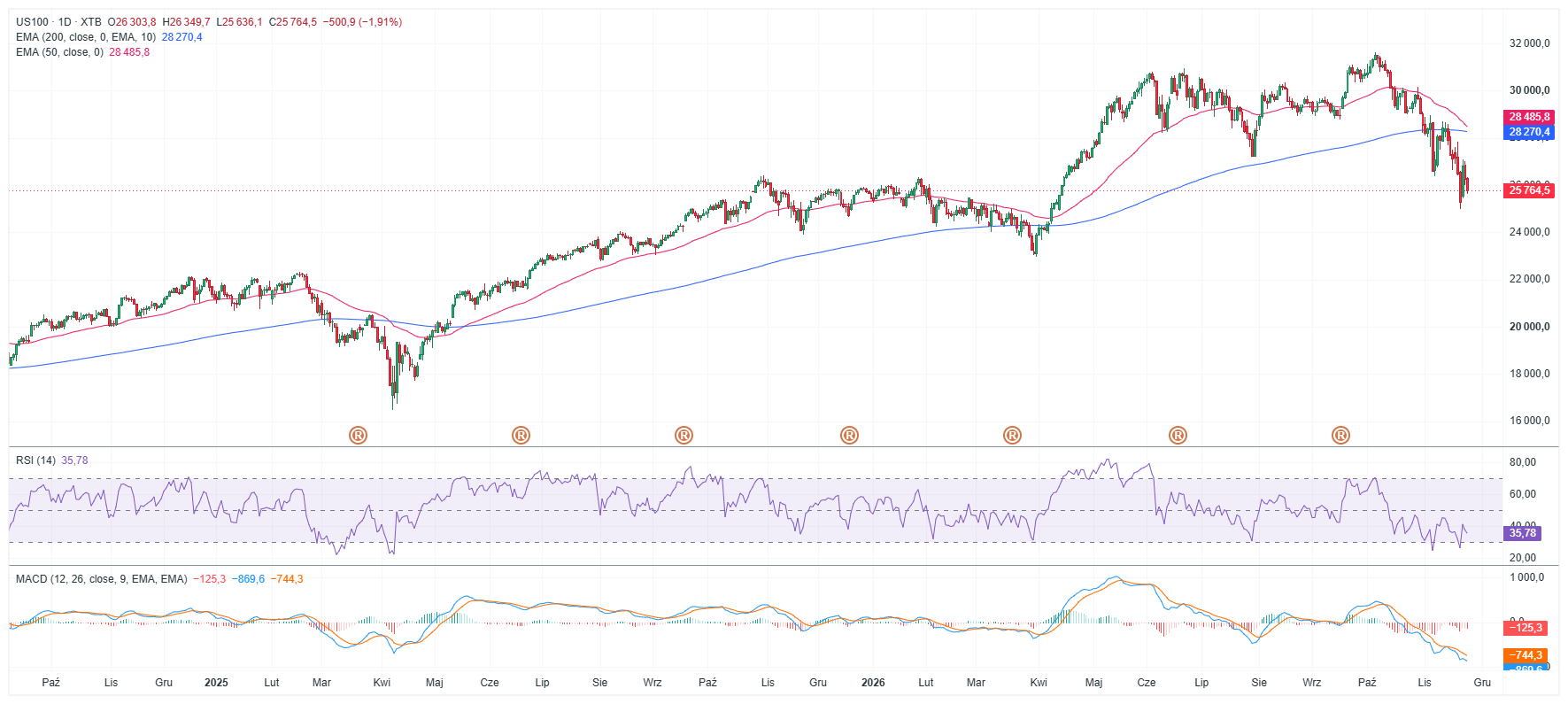
Source: XTB





