




Brent crude prices remain under pressure, falling by more than 1% this week, although the pace of the recent sell-off has started to slow. After losing approximately 17% over the past month, oil has shown signs of stabilisation as traders weigh renewed geopolitical risks in the Middle East against concerns about a potential global supply surplus.
Prices have traded between approximately $85.80 and $92.00 per barrel this week, with Tuesday’s low marking the weakest level since late August. However, the subsequent rebound, supported by a smaller-than-expected increase in US crude inventories, suggests that selling pressure may be easing.
The market is now approaching an important period for direction. Ongoing tensions involving Saudi Arabia, Iran and the Strait of Hormuz remain a source of supply risk, while Sunday’s OPEC+ meeting could introduce further uncertainty over production levels for 2027.
For the coming week, Brent could remain range-bound, with $86 providing an important support area and $95 acting as a major resistance threshold, provided there are no significant new geopolitical developments.
Oil Market Snapshot
| Market indicator | Latest position |
|---|---|
| Brent weekly performance | Down more than 1% |
| Monthly performance | Down approximately 17% |
| Weekly trading range | $85.80–$92.00/barrel |
| Key near-term support | $86/barrel |
| Key near-term resistance | $95/barrel |
| First technical resistance | $94.20 – 200-day SMA |
| Second technical resistance | $100.50 – 50-day SMA |
| Lower technical support | $88.11 and $87.70 |
| US crude inventory build | 1.1 million barrels |
| Market expectation for inventory build | 1.5 million barrels |
| Main upcoming catalyst | OPEC+ meeting on 2027 output |
Current Brent Crude Price Action: Oil Attempts to Stabilise After Heavy Losses
Brent crude has experienced a substantial correction, falling approximately 17% over the past month following heavy losses earlier in November.
However, this week’s price action suggests that the market may have established a temporary low. Prices moved within a range of approximately $85.80 to $92.00 per barrel, with Tuesday’s decline taking crude to its weakest level since late August.
The subsequent recovery has been notable. Gains on Tuesday and Wednesday more than offset Monday’s losses, indicating that buyers are becoming more active around the recent lows.
US inventory data also provided some support. Crude stocks increased by 1.1 million barrels, below the market expectation of 1.5 million barrels. Although inventories continued to rise, the smaller-than-anticipated build helped ease concerns about near-term supply availability.
The slowdown in selling pressure does not yet confirm a broader bullish reversal. Nevertheless, the market appears to be transitioning from a sharp downward move towards a period of consolidation.
Middle East Geopolitical Risks Keep an Oil Risk Premium in Place
Geopolitical developments remain central to the outlook for crude oil, particularly given the strategic importance of Saudi Arabian energy infrastructure and shipping routes through the Persian Gulf.
Saudi Arabia: Houthi Threats Raise Infrastructure Concerns
Yemen’s Houthis announced attacks targeting Saudi Arabia’s Ras Tanura refinery and Riyadh’s financial district.
Any escalation involving major Saudi energy infrastructure could renew concerns about regional oil supply security. Ras Tanura is particularly important because disruption to significant refining and export infrastructure could affect market sentiment even before any measurable change in physical supply occurs.
Traders will therefore be watching for confirmation of further attacks, damage assessments and any response from Saudi authorities.
Strait of Hormuz: Shipping Security Remains in Focus
Reports from Iran suggested that tankers had struck mines in the Strait of Hormuz on Wednesday. However, there was no evidence confirming these claims, and the market largely disregarded the reports.
The Strait of Hormuz remains a critical route for international energy shipments. Any verified disruption to tanker movements could quickly increase the geopolitical risk premium embedded in crude prices.
For now, the absence of confirmed disruption has limited the market’s reaction. However, the situation remains an important risk to monitor.
Diplomacy: Potential Peace Progress Could Weigh on Prices
There is currently no formal agreement to end the war, although tensions have eased considerably since the US Midterm elections earlier this month.
US Vice-President JD Vance reportedly discussed a possible peace agreement with Qatar’s prime minister, who has played an important mediating role in the conflict.
Any meaningful diplomatic progress could reduce concerns about regional escalation and remove part of the geopolitical premium from oil prices.
This creates a potentially bearish counterweight to the risks surrounding Saudi infrastructure and Gulf shipping routes.
OPEC+ Meeting: 2027 Production Policy Could Pressure Brent
The upcoming OPEC+ ministerial meeting on Sunday represents another major event for the oil market.
Ministers are expected to discuss production policy for 2027, with Iraq and Kazakhstan seeking higher capacity estimates. The UAE is no longer a member of the group, adding another consideration to the organisation’s future supply arrangements.
The possibility of an increase in production could weigh on Brent prices, particularly while the market is already concerned about a potential global surplus.
If OPEC+ signals a willingness to increase supply, traders may interpret the decision as an additional bearish factor for the coming months.
Conversely, a cautious approach to production increases could help limit downside pressure and provide some support to prices.
The market reaction will depend not only on the headline decision but also on the credibility of production commitments and expectations for actual barrels entering the market.
US Crude Inventories Provide Limited Support
The latest US inventory figures offered some relief to oil markets after the recent sell-off.
Crude inventories increased by 1.1 million barrels, compared with expectations for a build of 1.5 million barrels. The smaller-than-expected increase suggests that the immediate supply picture was not as bearish as anticipated.
As the market moves deeper into the winter months, traders will increasingly assess the relationship between refinery activity, seasonal demand and available crude supplies.
However, one inventory report is not sufficient to establish a sustained improvement in fundamentals. Further data will be needed to determine whether US stock levels are beginning to provide meaningful support.
Bullish Oil Market Factors
- Saudi infrastructure risks: Threats involving the Ras Tanura refinery could increase concerns about regional energy supply security.
- Strait of Hormuz exposure: Any verified disruption to tanker movements would raise the risk premium attached to crude.
- Smaller US inventory build: The 1.1-million-barrel increase was below the expected 1.5 million barrels, providing limited near-term support.
- Slowing selling pressure: The rebound from Tuesday’s low suggests that the market may be approaching a temporary price floor.
- OPEC+ restraint: If ministers avoid announcing a substantial supply increase, the market could find support.
Bearish Oil Market Factors
- Potential OPEC+ supply increase: Higher production commitments for 2027 could add to concerns about excess global supply.
- Diplomatic progress: A credible peace agreement could reduce the geopolitical risk premium currently supporting oil prices.
- Recent price weakness: Brent remains approximately 17% lower over the past month, reflecting the scale of the recent bearish move.
- Global surplus concerns: Expectations of ample supply could continue to restrict the potential for a sustained recovery.
- Technical resistance: Several important moving-average levels remain ahead of the market, potentially limiting upside momentum.
Brent Crude Price Forecast: Can Oil Recover Above $95?
The near-term outlook for Brent is relatively neutral, with the market likely to remain caught between geopolitical supply risks and concerns about a potential surplus.
In the absence of unexpected geopolitical developments, prices could oscillate within a relatively narrow range over the coming week. The $86 area represents an important support threshold, while $95 is a significant resistance level.
A sustained break above $95 would improve the technical outlook and suggest that the recent recovery has greater momentum. However, buyers will need to overcome additional resistance levels before a more convincing bullish trend can develop.
On the downside, renewed selling pressure could bring lower support areas into focus, particularly if OPEC+ signals higher production or diplomatic progress reduces regional risk concerns.
The broader direction will depend on whether geopolitical developments continue to support prices or whether concerns about additional supply regain control of market sentiment.
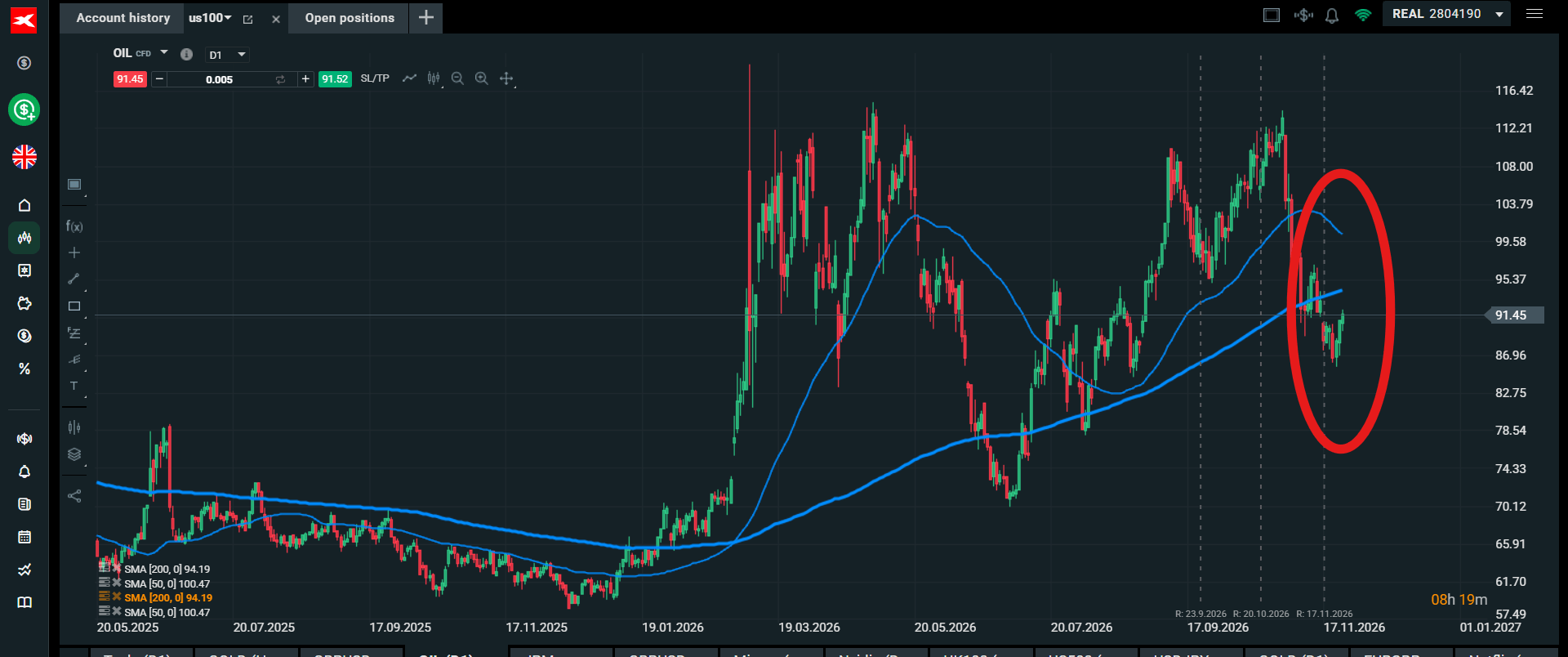
Chart 1: Brent crude oil
Supply Outlook: Gulf Risks Compete With Surplus Concerns
The oil supply outlook remains divided between two opposing forces.
On one side, the threat of disruption to Saudi infrastructure and shipping routes through the Strait of Hormuz could increase the risk premium attached to crude. Even without confirmed supply losses, heightened uncertainty can influence trading behaviour.
On the other side, the possibility of additional OPEC+ production in 2027 could reinforce concerns about excess supply.
The upcoming ministerial meeting will therefore be particularly important. Any indication that producers intend to increase output could limit the recovery, while a more cautious production strategy may help stabilise the market.
Demand Outlook: Winter Consumption and US Inventory Trends
As the market moves deeper into winter, traders will be monitoring seasonal energy consumption and US inventory movements more closely.
The latest inventory build was smaller than expected, providing some reassurance about near-term market conditions. However, continued stock increases could reinforce bearish sentiment if demand fails to absorb available supply.
The coming weeks will be important in determining whether seasonal demand can help offset concerns about a wider global surplus.
Market Outlook for the Coming Sessions
Brent crude appears to be moving towards a consolidation phase following its sharp decline over the past month. The recent rebound suggests that the market may have found temporary support, but a sustained recovery remains unconfirmed.
The immediate focus will be Sunday’s OPEC+ meeting, developments involving Saudi Arabia and the Strait of Hormuz, and any progress towards a diplomatic agreement.
For the coming week, the $86–$95 range provides a useful reference for the near-term outlook. A break above resistance could improve sentiment, while a move below support would expose the market to further losses.
Trading conditions may also be affected by thinner liquidity around the US Thanksgiving holiday. In addition, Sunday’s OPEC+ meeting creates the possibility of a price gap when markets reopen. The expiry of January futures on Monday could add further volatility.
BRENT CRUDE TECHNICAL ANALYSIS – DAILY INTERVAL
The technical picture for Brent remains relatively neutral following the latest rebound. Although selling pressure has eased, the market needs to overcome several important resistance levels before a return to a sustained bullish trend can be considered.
The first major resistance is $94.20, corresponding to the 200-day simple moving average. A sustained move above this level would provide an initial indication that the recovery is strengthening.
The next major resistance stands at $100.50, corresponding to the 50-day simple moving average. A move towards this level would represent a more substantial recovery, although the market would need improving fundamentals to support such a move.
On the downside, the technical levels around $88.11 and $87.70 are important areas to monitor. A break below $87.70 could expose the $81–$82 region.
The daily Relative Strength Index (RSI) is hovering near oversold territory, leaving room for a short-term recovery. However, oversold conditions alone do not confirm a trend reversal.
Key Brent crude levels to monitor:
- $100.50: Second major resistance – 50-day SMA.
- $95.00: Important near-term resistance threshold.
- $94.20: First major technical resistance – 200-day SMA.
- $93.00: Near-term support reference identified in the current market outlook.
- $88.11: Lower technical support.
- $87.70: Important downside threshold.
- $81–$82: Potential downside area if $87.70 breaks.
- $86.00: Key support area in the near-term trading outlook.
Today Markets Analysis
Brent crude is showing early signs of stabilisation after a significant monthly decline, but the market remains exposed to competing geopolitical and fundamental forces. The upcoming OPEC+ meeting could determine whether supply concerns intensify, while developments in the Gulf could quickly restore a stronger geopolitical risk premium.
For traders, the coming sessions will be less about the recent rebound itself and more about whether Brent can sustain gains above its key technical resistance levels. Until there is clearer evidence of tighter supply or stronger demand, a range-bound market remains a reasonable near-term expectation.
Currency Hedger, a contributor to Today Markets’ market coverage, provides foreign exchange risk management, international payments and currency solutions for businesses operating across global markets.
Explore Currency Hedger at https://currencyhedger.com/ or open an account.
Disclaimer: This article is provided for informational and educational purposes only and does not constitute investment advice, financial advice or a recommendation to buy or sell any financial instrument. Crude oil and futures trading involve substantial risk and may not be suitable for all investors. Market prices, forecasts and technical levels can change without notice. Investors should conduct their own research and consider their financial circumstances and risk tolerance before making investment decisions.