









Nickel prices have gained almost 3%, extending their recovery for a second consecutive session as the market assesses the possibility of tighter Indonesian production controls in 2027. However, despite growing industrial demand and continued expansion in electric vehicle manufacturing, the fundamental outlook remains challenging, with global production expected to exceed consumption.
On November 25, the three-month London Metal Exchange (LME) nickel contract traded at approximately $15,200 per tonne, while LME warehouse inventories stood near 276,000 tonnes. The central issue for the market is whether Indonesia, now the dominant force in global nickel production, will implement meaningful restrictions on mining output and whether those measures will be sufficient to reduce refined nickel supply.
The International Nickel Study Group (INSG) expects the global surplus to widen in 2027. This leaves nickel facing a difficult balancing act: long-term demand growth offers support, but persistent oversupply and elevated inventories continue to restrict the potential for a sustained price recovery.
Nickel Market Snapshot
| Market indicator | Latest information |
|---|---|
| LME three-month nickel price | Approximately $15,200/tonne |
| Recent price performance | Almost 3% gain |
| LME warehouse inventories | Nearly 276,000 tonnes |
| 2026 global production forecast | 3.87 million tonnes |
| 2027 global production forecast | 4.07 million tonnes |
| 2026 global consumption forecast | 3.85 million tonnes |
| 2027 global consumption forecast | 4.00 million tonnes |
| 2027 projected market surplus | 69,000 tonnes |
| Key support zone | $15,000/tonne |
| Secondary support | $14,200/tonne |
| Potential recovery target | $17,000/tonne |
Current Nickel Price Action: Buyers Attempt to Defend $15,000
Nickel has recovered for a second consecutive session, gaining almost 3% as prices rebound from a key technical support area around $15,000 per tonne.
The recovery suggests that buyers are attempting to establish a stronger footing following the latest period of weakness. Nevertheless, the move has yet to resolve the broader supply concerns weighing on the market.
LME inventories of approximately 276,000 tonnes remain a significant obstacle. Elevated exchange stocks indicate that substantial quantities of metal remain available to the market, reducing the urgency for consumers to compete for immediate supply.
For a sustained bullish reversal to develop, the current recovery will need to be supported by stronger industrial demand, evidence of reduced production and a consistent decline in exchange inventories.
Indonesia’s Nickel Production Remains the Main Market Risk
Indonesia remains the most influential factor in the global nickel supply outlook. The country’s expansion of mining operations, nickel pig iron (NPI) smelters and high-pressure acid leaching (HPAL) facilities has transformed the international market, increasing the availability of nickel for stainless steel production and battery manufacturing.
This rapid expansion has also placed considerable pressure on higher-cost producers in Australia and other producing regions.
The proposed tightening of Indonesian nickel ore production quotas for 2027 could provide an important catalyst for prices. The country’s 2026 RKAB quotas were previously increased to approximately 290–300 million wet metric tonnes of ore.
However, the effectiveness of any restrictions will depend on how they affect actual refined nickel production. Smelters may be able to draw on existing inventories or import additional ore from the Philippines, potentially limiting the impact of lower domestic mining quotas.
Investors will therefore need to distinguish between announced production restrictions and measurable reductions in the amount of nickel reaching the global market.
Global Nickel Surplus Expected to Widen in 2027
The INSG forecasts global nickel production to increase from 3.87 million tonnes in 2026 to 4.07 million tonnes in 2027. Consumption is also expected to grow, rising from 3.85 million tonnes to approximately 4 million tonnes.
Despite this increase in demand, production is projected to exceed consumption by a wider margin.
| Global nickel balance | 2026 forecast | 2027 forecast |
|---|---|---|
| Production | 3.87 million tonnes | 4.07 million tonnes |
| Consumption | 3.85 million tonnes | 4.00 million tonnes |
| Market surplus | 19,000 tonnes | 69,000 tonnes |
The projected 2027 surplus represents approximately 1.7% of expected consumption. Although relatively small compared with total global demand, this imbalance could be enough to keep prices under pressure, particularly if inventories remain elevated.
It also means that relatively modest changes in production could have a meaningful effect on the market. If Indonesian restrictions reduce output more significantly than currently anticipated, the projected surplus could narrow and improve the outlook for nickel prices.
Electric Vehicle Demand Faces Competition From LFP Batteries
The long-term expansion of electric vehicle manufacturing remains an important source of potential nickel demand. However, the relationship between EV sales and nickel consumption is becoming more complicated as battery technology evolves.
Lithium iron phosphate (LFP) batteries do not require nickel, unlike nickel-containing nickel manganese cobalt (NMC) and nickel cobalt aluminium (NCA) chemistries.
The growing adoption of LFP technology therefore limits the amount of additional nickel consumption generated by rising electric vehicle production.
This does not eliminate the long-term demand opportunity for nickel, particularly where manufacturers continue to use nickel-rich battery chemistries. However, investors should avoid assuming that increasing EV sales will automatically translate into proportional growth in nickel demand.
The market will increasingly depend on the balance between battery chemistry, stainless steel production and the expansion of industrial applications.
Nickel Inventories and the LME Futures Curve
Elevated exchange inventories remain one of the most important obstacles to a sustained recovery.
With LME warehouse stocks approaching 276,000 tonnes, existing supplies can continue to satisfy industrial demand even if production growth begins to slow. This creates a challenge for bullish investors, as a reduction in new production may not immediately translate into tighter physical availability.
The LME futures curve also provides useful information about market conditions.
November 25 quotations showed the December 2027 nickel contract offered at approximately $15,850 per tonne, compared with around $15,200 per tonne for the three-month contract.
This contango structure is consistent with relatively ample near-term availability. However, the difference between contract prices also reflects financing and storage costs, meaning the futures curve should be assessed alongside physical inventories and demand conditions.
A sustained reduction in both LME and Shanghai Futures Exchange (SHFE) inventories, accompanied by stronger prices and a narrowing contango, would provide more convincing evidence that the market is moving towards a tighter supply-demand balance.
Bullish Nickel Market Factors
- Indonesian production restrictions: Tighter 2027 mining quotas could slow the expansion of global nickel supply and reduce the projected surplus.
- Industrial demand growth: Higher consumption from stainless steel manufacturers and other industrial users could help absorb excess production.
- Battery sector expansion: Continued demand for nickel-containing NMC and NCA batteries provides a longer-term source of consumption.
- Inventory reductions: A sustained decline in LME and SHFE warehouse stocks would indicate improving physical market conditions.
- Technical recovery: The rebound from approximately $15,000 per tonne suggests buyers are attempting to defend an important support area.
Bearish Nickel Market Factors
- Indonesian production expansion: Continued growth in mining and processing capacity could keep global supply above consumption.
- Widening market surplus: The INSG expects the surplus to increase from approximately 19,000 tonnes in 2026 to 69,000 tonnes in 2027.
- Elevated exchange inventories: Large existing stocks reduce the urgency for consumers to secure additional metal.
- LFP battery adoption: Increasing use of nickel-free battery technology limits the potential impact of rising EV sales on nickel demand.
- Weakness among higher-cost producers: Persistent oversupply could continue to pressure producers in Australia and other regions, encouraging further cost reductions and investment cuts.
Nickel Price Forecast 2027: Can Prices Reach $17,000?
Nickel’s outlook for 2027 will depend heavily on whether Indonesia introduces production restrictions that materially reduce global supply.
In a bullish scenario, lower Indonesian output, stronger Chinese industrial activity and declining exchange inventories could gradually improve the supply-demand balance. With the projected surplus representing approximately 1.7% of expected consumption, relatively modest changes in production could have a significant influence on prices.
Under these conditions, a sustained move above the $15,000 support area and a break through the 23.6% Fibonacci retracement of the latest downward move could strengthen the technical recovery. A gradual advance towards $17,000 per tonne would then become a potential upside objective.
However, the bearish scenario remains relevant. If Indonesian production continues expanding, stainless steel demand weakens and LFP battery adoption increases further, the market could remain oversupplied. In that environment, nickel may struggle to establish a lasting upward trend, leaving prices vulnerable to renewed selling pressure.
The projected $17,000 level should therefore be viewed as a potential recovery target rather than an assured price outcome.
Supply Outlook: Indonesia Holds the Key
The global supply outlook will be dominated by Indonesian mining policy, ore availability and smelter utilisation.
Investors should monitor the country’s 2027 RKAB quota decisions and assess whether any restrictions translate into lower actual production. The ability of smelters to use existing ore inventories or source material from the Philippines could determine how effective the measures ultimately become.
If production growth slows meaningfully, the global surplus could narrow. If restrictions prove less effective than anticipated, the market may continue to face excess supply throughout 2027.
Demand Outlook: Stainless Steel and Battery Production
Stainless steel manufacturing remains an important source of nickel consumption, making Chinese industrial activity a key indicator for the market.
The battery sector provides an additional source of demand, but the increasing adoption of LFP technology means that EV growth alone may not be sufficient to absorb rising global production.
The combination of industrial activity, battery chemistry and manufacturing demand will therefore be essential in determining whether consumption can keep pace with supply.
Market Outlook for the Coming Sessions
Nickel’s near-term recovery has improved market sentiment, but the broader fundamental picture remains challenging. Prices are attempting to stabilise around $15,000 per tonne, while elevated inventories and the projected 2027 surplus continue to limit bullish conviction.
The immediate technical focus is whether buyers can maintain support around $15,000 and overcome the 23.6% Fibonacci retracement of the latest downward move. Failure to sustain the recovery could bring the secondary support area around $14,200 back into focus.
A stronger break above the relevant Fibonacci resistance would improve the prospect of a gradual move towards $17,000 over the longer term.
For now, the market remains caught between the possibility of Indonesian supply restrictions and the reality of substantial global production capacity. The next major directional signal is likely to come from evidence of changes in Indonesian output and a sustained movement in exchange inventories.
NICKEL TECHNICAL ANALYSIS – 1D INTERVAL
Nickel prices have rebounded after reaching a key support zone around $15,000 per tonne, which coincides with the consolidation range established during 2025. Together with the $14,200 level, this area represents the most important near-term support region.
For bullish traders, the next challenge is a break above the 23.6% Fibonacci retracement of the latest downward move. A sustained move through this level could strengthen the recovery and open the way towards $17,000 per tonne in 2027.
However, the technical outlook remains dependent on the underlying fundamentals. Persistent oversupply, elevated warehouse inventories and uncertainty surrounding Indonesia’s proposed production restrictions could restrict further gains.
A failure to hold the $15,000 support area would weaken the recovery and increase the risk of a move towards $14,200.
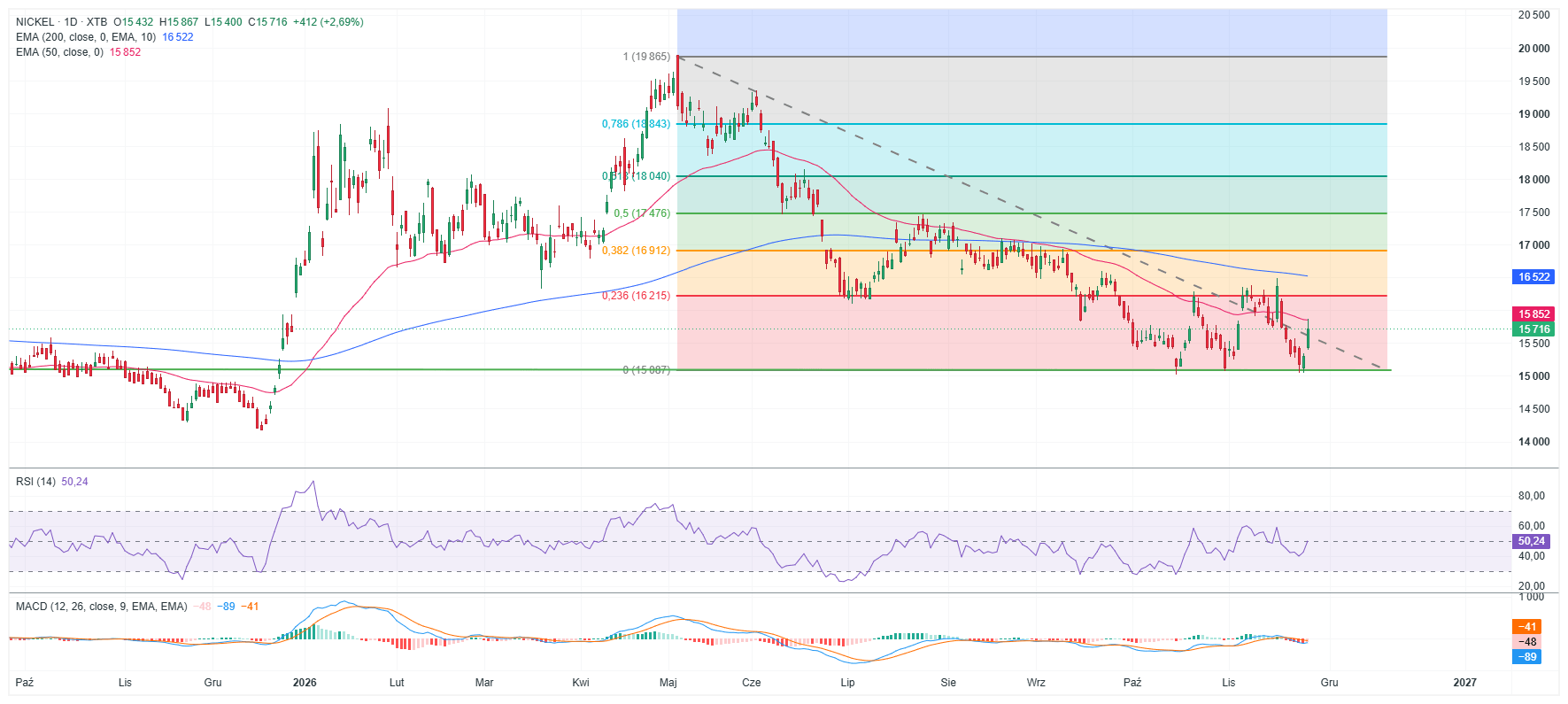
Key nickel levels to monitor:
- $17,000: Potential medium-term recovery target.
- 23.6% Fibonacci retracement: Key technical resistance to overcome.
- $15,000: Primary support and current recovery area.
- $14,200: Secondary support if selling pressure returns.
Today Markets Analysis
Nickel’s latest recovery offers a more positive short-term technical picture, but the market has yet to demonstrate that its underlying supply-demand imbalance is improving. Indonesia’s 2027 production policy, Chinese industrial activity and exchange inventory movements will remain the most important factors shaping the next major price direction.
For investors and traders, the distinction between a short-term technical rebound and a genuine fundamental recovery will be critical. A sustained decline in inventories and evidence of lower Indonesian output would provide stronger confirmation of a bullish shift.
Currency Hedger, a contributor to Today Markets’ market coverage, provides currency risk management, international payment and foreign exchange solutions for businesses operating across global markets.
Explore Currency Hedger at https://currencyhedger.com/ or open an account.
Disclaimer: This article is provided for informational and educational purposes only and does not constitute investment advice, financial advice or a recommendation to buy or sell any financial instrument. Commodities and futures trading involve substantial risk and may not be suitable for all investors. Market prices, forecasts and technical levels can change without notice. Investors should conduct their own research and consider their financial circumstances and risk tolerance before making investment decisions.





